Blood counts are clues to human disease
(PhysOrg.com) -- A new genome-wide association study published today in Nature Genetics begins to uncover the basis of genetic variations in eight blood measurements and the impact those variants can have on common human diseases. Blood measurements, including the number and volume of cells in the blood, are routinely used to diagnose a wide range of disorders, including anaemia, infection and blood cell cancers.
An international team of scientists measured haemoglobin concentration, the count and volume of red and white cells and the sticky cells that prevent bleeding - platelets, in over 14,000 individuals from the UK and Germany. They uncovered 22 regions of the human genome implicated in the development of these blood cells. Of the 22 regions, 15 had not previously been identified.
The study represents the first genome-wide association of blood measurements to be completed in cohorts with large sample sizes.
"This study has been made possible by a great collaboration of scientists from the UK and Germany, and the contribution of clinical colleagues working in the field of heart disease, diabetes and coeliac disease in the UK, Germany and the United States," explains Dr Nicole Soranzo, group leader at the Wellcome Trust Sanger Institute and co-lead of the HaemGen consortium. "This unique collaboration has allowed us to discover novel genetic determinants of blood cell parameters, providing important insights into novel biological mechanisms underlying the formation of blood cells by the blood stem cells and their role in disease.
"This study highlights the importance of studying large collections of samples from healthy individuals where many different traits are measured."
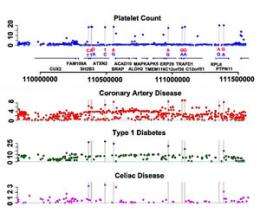
The team compared regions of the human genome implicated in blood cell development with regions associated with risk of heart disease. By looking at the genetic data of 10,000 people with disease with that of 10,000 apparently healthy people, they found that one of the genetic variants associated with platelet counts also causes an increased risk of heart disease. The new variant was found in a region of the genome already known to influence the risk of hypertension, coeliac disease and diabetes in children and young adults, or so-called type 1 diabetes.
Further analysis showed that these genetic risk factors are uniquely found in individuals of European origin. By comparing human data with genetic data from chimpanzees, the team were able to conclude that the genetic variant was the result of a selection event favouring variants that increase the risk of heart disease, coeliac disease and type 1 diabetes in European populations 3,400 years ago. The authors suggest that the risk factors were positively selected for because they gave carriers an increased protection against infection.
"The study of blood traits is challenging because of the difficulty of teasing apart biological processes underlying the origin of blood cells," explains Dr Christian Gieger, Head of the Genetic Epidemiology research unit at the Helmholtz Zentrum and co-lead of the HaemGen consortium. "Until now, few genome-wide association studies have looked beyond single traits. But, through a systematic analysis of correlated traits we can begin to discover such shared genetic variants, forming the basis for understanding how these processes interact to influence health and disease.
"Using these techniques, we can now begin to understand the complex genetic basis of a whole variety of human diseases."
Scientists at the Wellcome Trust Sanger Institute, UK and the Helmholtz Zentrum Munich, Germany initiated the European HaemGen consortium, which encompasses groups from the UK (TwinsUK-KCL, NHS Blood and Transplant (NHSBT), University of Cambridge and University of Leicester) and Germany (Study of Health in Pomerania (SHIP) in Greifswald, the KORA study in the region of Augsburg and GerMIFS (University of Lübeck and Regensburg)). The HaemGen consortium aims to identify genetic loci contributing to variation in blood measurements and uncovers the potential correlation of these loci with disease phenotypes.
"We have uncovered a novel variant linking platelet counts with heart attacks," explains Nicole Soranzo. "Further characterisation of the regions uncovered in this study has the potential to improve our understanding of how blood cell development is linked with human diseases, including blood cell cancers."
More information:
Publication Details: Soranzo NS, Spector TD, Mangino M et al. (2009) A genome-wide meta-analysis identifies 22 loci associated with eight hematological parameters in the HaemGen consortium. Nature Genetics. Published online before print as doi: 10.1038/ng.467
Additional Research: Dr Soranzo has an honorary appointment at the Dept of Twin Research, Kings College London and is also joint lead author on a second study into haematological parameters, published at the same time: Ganesh SK, Zakai NA, van Rooij FJA , Soranzo N et al. Multiple loci influence erythrocyte phenotypes in the CHARGE Consortium. Nature Genetics Published online before print as doi: 10.1038/ng.466
Source: Wellcome Trust Sanger Institute (news : web)


