Forgotten treasures shed new light on Little Grey Rabbit author
October 12, 2009
(PhysOrg.com) -- A suffragette poem, penned by a world-famous children’s author and kept privately at a University of Manchester Hall of Residence for over a century, has been made available online.
The passionate lines called “Argument” were hand-written by Alice J Taylor - later to become Alison Uttley - and published in the University’s women’s student magazine of 1904 - itself a unique document.
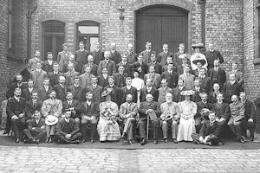
It is now available on the Alison Uttley Society website with a rare photograph, taken in 1906, of eminent Manchester physicist Professor Arthur Schuster, physics department staff, other University dignitaries and Schuster's current and former students.
Physicist and astronomer Arthur Stanley Eddington, who verified Einstein's new theory of gravity by observing the 1919 eclipse, poses alongside Schuster and student Uttley.
The picture was found in pieces at the bottom of a drawer by retired Professor of Physics Robin Marshall from the University’s Faculty of Engineering and Physical Sciences, who digitally reassembled the photo.
Known to millions across the world as the author of Tales Of Little Grey Rabbit and Sam Pig - Uttley was the second woman ever to graduate in physics at The University of Manchester.
She bequeathed a third of her literary income to support students at Ashburne Hall, where the documents are kept.
Ashburne Hall was founded in 1899 as a hall of residence for women students and Uttley lived there between 1903 and 6.
In the journal, Uttley also describes a series of wacky inventions including a vacuum cleaner used to transport students to their lectures, boots with central heating, and a teapot with an alarm which is sprung when running low.
Uttley’s diaries, which are kept at the University’s John Rylands Library, were published last month.
President of the Uttley Society, Professor Denis Judd, said the poem and picture provides a unique glimpse into the early radicalism of the author.
Professor Judd, who edited the ‘Private Diaries of Alison Uttley 1932 to 1971’ said: “This fascinating document has been stored at the University’s Ashburne Hall for more than a century.
“With the recent publication of the Uttley diaries - it struck me that these documents, which have been lying forgotten in the Hall’s archive, tell us more about her early years.
“So we felt it would be good to draw the public’s attention to them.”
He added: “In her diaries she was scornful and dismissive of her near neighbour Enid Blyton and wrote how she detested her main illustrator, Margaret Tempest.
“But these entries show an idealistic, and playful side of a much younger Uttley.
“And the photograph - so lovingly restored by Professor Marshall gives a unique glimpse into early twentieth university life.
“We hope the public will enjoy them on the Uttley society web site.”
After her husband James’ suicide in 1930, Uttley launched her writing career to support her only child John, and went on to write more than 100 books.
Sam Pig, Brock the Badger, Tim Rabbit, Little Grey Rabbit, Squirrel and Hare have mesmerised children ever since.
THE POEM
(Written during the Lent term of 1906)
At Ashburne there is a Society
Which has rapidly gained notoriety,
It’s name I can state with propriety,
“Argument”
We meet after Punch on a Saturday
With tea and sweet cakes we’re a party gay,
Instead of elicit chatting as Students may,
“Argument.”
We talk of meetings Political
And all of us soon are so critical
Our speeches become analytical
“Argument
“The Signs of our age are Synthetical,”
Do you call Walt Whitman poetical?”
“My theory is not hypothetical
Argument.”
We talk of the Status of human kind
Of Suffrage, and greatness of human mind
Equality, love, but we always find
Argument
If we began all our talks at the break of day
They’d continue till after the Sun’s last ray
As we get into bed, the last word we say
Argument!
A.J.T. (Alice Jane Taylor)
More information: To see the entries, visit http://www.alisonuttley.co.uk
-
No matter their size black holes 'feed' in the same way
Dec 06, 2006 |
not rated yet |
0
-
Einstein's relativity theory proven with the 'lead' of a pencil
Nov 09, 2005 |
not rated yet |
0
-
Private papers reveal ‘Who’s Who of British Science’
Jun 11, 2009 |
not rated yet |
0
-
World Year of Physics 2005 Begins with Paris Conference
Jan 10, 2005 |
not rated yet |
0
-
John L. Hall: Long-time NIST Physicist Wins Nobel Prize
Oct 04, 2005 |
not rated yet |
0
-
Engineers build first sub-10-nm carbon nanotube transistor
Feb 01, 2012 |
4.9 / 5 (32) |
30
-
Something old, something new: Evolution and the structural divergence of duplicate genes
Jan 31, 2012 |
4.6 / 5 (7) |
1
-
The hidden nanoworld of ice crystals: Revealing the dynamic behavior of quasi-liquid layers
Jan 30, 2012 |
5 / 5 (4) |
1
-
Stock market network reveals investor clustering
Jan 27, 2012 |
3.9 / 5 (23) |
8
-
Of microchemistry and molecules: Electronic microfluidic device synthesizes biocompatible probes
Jan 26, 2012 |
5 / 5 (2) |
0
-
Bohr-Einstein debate: why did Bohr not simply say...
Feb 06, 2012
-
Best/Worst U.S. Presidents
Jan 31, 2012
- More from Physics Forums - History & Humanities
More news stories
Employers feel no love for unscrupulous practice of 'service sweethearting'
A new study led by two Florida State University marketing professors finds that some frontline service employees who are rewarded for hikes in customer loyalty and satisfaction also may engage in "service ...
Other Sciences / Economics & Business
Feb 10, 2012 |
3.3 / 5 (3) |
11
A frank discussion of the power law and linking correlation to causation
(PhysOrg.com) -- Michael Stumpf a mathematics professor at Imperial College in London, and Mason Porter a lecturer at Oxford have teamed together to write and publish a perspective piece in Science regarding the in ...
US workers are 'giving away the store,' costing firms billions
Nearly 70 percent of the nation's service employees give away free goods and services from hamburgers to cable TV costing companies billions of dollars a year, according to a groundbreaking study.
Other Sciences / Economics & Business
Feb 09, 2012 |
3.5 / 5 (4) |
10
New insights into how to correct false knowledge
The abundance of false information available on the Internet, in movies and on TV has created a big challenge for educators.
Other Sciences / Social Sciences
Feb 07, 2012 |
4.9 / 5 (7) |
9
|
Neanderthal demise due to many influences, including cultural changes: study
As an ice age crept upon them thousands of years ago, Neanderthals and modern human ancestors expanded their territory ranges across Asia and Europe to adapt to the changing environment.
Other Sciences / Archaeology & Fossils
Feb 07, 2012 |
4.4 / 5 (5) |
8
|
Scientists discover molecular secrets of 2,000-year-old Chinese herbal remedy
For roughly two thousand years, Chinese herbalists have treated Malaria using a root extract, commonly known as Chang Shan, from a type of hydrangea that grows in Tibet and Nepal. More recent studies suggest that halofuginone, ...
New method to examine batteries -- MRI from the inside
There is an ever-increasing need for advanced batteries for portable electronics, such as phones, cameras, and music players, but also to power electric vehicles and to facilitate the distribution and storage of energy derived ...
Google might launch Drive for cloud storage soon
(PhysOrg.com) -- Google's next big move, according to the Wall Street Journal, is a cloud storage service called Drive. Hardly first to the plate, Google is simply catching up to introducing its cloud reposi ...
Lab study raises questions over nano-particle impact
Tests involving chickens have raised questions about the impact on health from engineered nano-particles, the ultra-fine grains commonly used in drugs and processed foods, scientists said on Sunday.
A mitosis mystery solved: How chromosomes align perfectly in a dividing cell
Although the process of mitotic cell division has been studied intensely for more than 50 years, Whitehead Institute researchers have only now solved the mystery of how cells correctly align their chromosomes during symmetric ...
Starve a virus, feed a cure? Findings show how some cells protect themselves against HIV
A protein that protects some of our immune cells from the most common and virulent form of HIV works by starving the virus of the molecular building blocks that it needs to replicate, according to research published online ...