Intelligent Traffic System Predicts Future Traffic Flow on Multiple Roads
October 12, 2009 By Lisa Zyga Intelligent Traffic System Predicts Future Traffic Flow on Multiple Roads

Enlarge

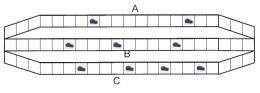
In the three-route system, information on a display board lets drivers know the predicted future congestion of each of the three roads, helping drivers choose the fastest route. Image credit: Dong, et al.

(PhysOrg.com) -- In urban areas, there’s almost always more than one way to get somewhere, but often it’s difficult to predict which road will be fastest. In an attempt to improve traffic flow and decrease congestion, researchers have been developing intelligent traffic systems that display real-time information about various roads on a display board, helping drivers make the best road choice. Until now, this information has always displayed traffic conditions from the immediate past. A new system can now predict future traffic conditions based on real-time data, giving drivers more relevant information to choose the fastest route.

The researchers, Chuanfei Dong, et al, from the Georgia Institute of Technology, the University of Science and Technology of China, Syracuse University, and the University of Shanghai for Science and Technology, have recently reported the results of their new intelligent traffic system, called the prediction feedback strategy (PFS). In simulations, the researchers demonstrated that PFS could control better than three other information feedback strategies. Even if only some drivers choose to use the information, the improved strategy could help to alleviate and enhance the capacity of existing infrastructure.

“The greatest significance of our work is that PFS can predict the future situation of roads, so then we can know what will happen and how to prevent congestion in the future,” Dong told PhysOrg.com.

While intelligent traffic feedback strategies have almost always been applied to two-route systems, in this study the researchers investigated how the strategies performed in a more complex three-route scenario. In this model, drivers choose one of three routes according to real-time information feedback. The researchers then performed simulations with strategies based on previous vehicles’ overall travel times (determined at the end of the route), the average velocity of vehicles (determined at various steps of the route), or congestion of each route, which is calculated by vehicles sending their location using GPS to a control center (determined at various steps of the route). Out of these three strategies, the last one that calculates congestion has shown to be most efficient.

The researchers’ new strategy, PFS, takes the congestion information from the previous strategy, but then takes another step by predicting the road situation in the future based on the current road situation. By predicting the future, PFS can overcome a lag effect that hinders the other strategies. This advantage enables PFS to accommodate an increased vehicle capacity compared to the other strategies. Although the average vehicle speed is slightly slower using PFS (since more vehicles mean lower speed), the flux (which measures a combination of average velocity and vehicle density) is largest using PFS.

“In [the previous strategies], the travel time reported by a driver at the end of two routes only represents the road condition in front of him, but perhaps the vehicles behind him have gotten into the jammed state,” Dong explained. “Unfortunately, this information will induce more vehicles to choose his route until a vehicle from the jammed cluster leaves the system. This effect apparently does harm to the system. On the other hand, PFS can predict the future situation of the road and the effects to the route situation caused by the traffic jam at the end of the traffic system; therefore, the new strategy may improve the road situation.”

More information:
• Dong Chuan-Fei, Ma Xu, Wang Bing-Hong, and Sun Xiao-Yan. “Effects of Prediction Feedback on Multi-Route Intelligent Traffic Systems.” arXiv:0909.5202v2

• Prediction feedback in intelligent traffic systems, Physica A: Statistical Mechanics and its Applications, Volume 388, Issue 21, 1 November 2009, Pages 4651-4657, doi:10.1016/j.physa.2009.07.018

Copyright 2009 PhysOrg.com.
All rights reserved. This material may not be published, broadcast, rewritten or redistributed in whole or part without the express written permission of PhysOrg.com.


print this article email this article download pdf blog this article bookmark this article     Stumble it Digg this share on Facebook retweet share on Reddit add to delicious
Rate this story - 4.4 /5 (64 votes)

Rank Filter

Move the slider to adjust rank threshold, so that you can hide some of the comments.


Display comments: newest first

  • RayCherry - Oct 12, 2009
    • Rank: not rated yet
    Can they predict were the traffic accident is going to ocurr five minutes after the rain starts?

    Jokes aside, if we accept the loss of privacy (and explicitly agree to it) then our car and phone GPS systems can relay information to city grid flow control systems. Together with accident report and confirmation, not only can flows be influenced to avoid the accident, but to clear the route to be used by the emergency responders and tow trucks.

    The problem is getting local city adminstrators to invest in the technology, reducing the investment in concrete infrastructure and all those construction companies that rely on our 'bigger roads' mentality.

    They would also have to provide adequate reassurance that adherence (or non-adherence) to the voluntary GPS data gathering system is non-prejudicial to the providers (us, the car/fleet owners and drivers).

    Some compulsory adherence could be useful to reduce crime, with driving offences punishable with (temporarily) forced adherence.
  • Fakeer - Oct 12, 2009
    • Rank: not rated yet
    Mathematically graph theory and routing optimization are great. And they do work great for many automated redundant path networks (and others like UPS, Fedex trucks). But coming to real world traffic how many times have we gotten off the freeway and winded though residential areas to get home from work?
  • rjm1percent - Oct 13, 2009
    • Rank: not rated yet
    Won't everybody with the technology then follow the optimal route, thereby causing congestion?
  • antialias - Oct 13, 2009
    • Rank: not rated yet
    No, because everybody will not make the choice of where to go at the same instant (because everybody is not at an intersection at the same time). So continually updated information will route people this way and that way as the flow of traffic indicates.

    This can lead to an optimal distribution of drivers to the available roads with - on average - minmal travel times for each.
  • nadsozinc - Oct 19, 2009
    • Rank: not rated yet
    Whatever, SimCity 2000 did this in 1993.

October 12, 2009 all stories

Comments: 5

4.4 /5 (64 votes)
  • Stumble this up

  • Digg this

  • share this

  • hide
  • Related Stories

  • Counterintuitive physics may help everyone drive home quicker
    created Oct 02, 2008 | popularity not rated yet | comments 0
  • IBM labs eye giving cars 'reflexes'
    created Jun 26, 2007 | popularity not rated yet | comments 0
  • If all drivers were polite, they would get where they're going faster
    created May 23, 2006 | popularity not rated yet | comments 0
  • An accident? Construction work? A bottleneck? No, just too much traffic
    created Mar 04, 2008 | popularity not rated yet | comments 0
  • New algorithms may help merging traffic
    created May 24, 2006 | popularity not rated yet | comments 0


  • hide
  • Relevant PhysicsForums posts

  • Aspiring Engineering major looking for general answers
    created Nov 19, 2009
  • Calculating max load of square tube (steel)
    created Nov 19, 2009
  • Passive Chemical Heating
    created Nov 19, 2009
  • Shortening Boat Trailer
    created Nov 18, 2009
  • More from Physics Forums - General Engineering

Other News

Hackers leak e-mails, stoke climate debate

Technology / Internet

created 7 hours ago | popularity 4.3 / 5 (12) | comments 5

(AP) -- Computer hackers have broken into a server at a well-respected climate change research center in Britain and posted hundreds of private e-mails and documents online - stoking debate over whether some scientists have ...


plug-in hybrid electric vehicle

Pulling the plug on hybrid myths

Technology / Energy

created Nov 19, 2009 | popularity 3.8 / 5 (12) | comments 17

(PhysOrg.com) -- Whether you call them myths, urban legends, fables or old wives' tales, there's a lot of misinformation out there about plug-in electric hybrid vehicles. These vehicles, abbreviated PHEVs, ...


UK police make 2 Trojan computer virus arrests

Technology / Internet

created Nov 18, 2009 | popularity 5 / 5 (1) | comments 10

(AP) -- A couple suspected of helping spread some of the Internet's most aggressive computer viruses has been arrested in the English city of Manchester, police said Wednesday.


A sign marks the entrance to IBM Corporate Headquarters

IBM makes Big Blue cloud

Technology / Software

created Nov 16, 2009 | popularity 2.9 / 5 (8) | comments 8

IBM on Monday announced it has created the world's largest business computing "cloud" capable of holding an amount of digital data on a par with 250 billion iTunes songs.


Google SPDY

Google's SPDY will speed up downloads

Technology / Internet

created Nov 16, 2009 | popularity 4.4 / 5 (16) | comments 7

(PhysOrg.com) -- As part of its effort to speed up the Web, Google is experimenting with SPDY, a new application layer protocol, that it hopes will speed up the conversation between browsers and Web servers ...