Growing geodesic carbon nanodomes
October 12, 2009 Growing geodesic carbon nanodomes

Enlarge

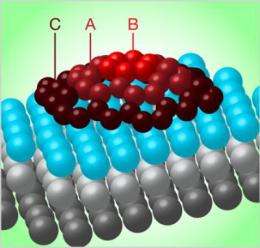
Carbon atoms form dome structures on iridium substrates, en route to forming larger scale graphene sheets. Credit: Image courtesy of Alan Stonebraker.

Researchers analyzing the assembly of graphene (sheets of carbon only one atom thick) on a surface of iridium have found that the sheets grow by first forming tiny carbon domes. The discovery offers new insight into the growth of graphene layers and points the way to possible methods for assembling components of graphene-based computer circuits.

Paolo Lacovig, Monica Pozzo, Dario Alfč, Paolo Vilmercati, Alessandro Baraldi, and Silvano Lizzit at institutions in Italy, the UK and USA report their discovery in a paper appearing October 12 in the journal Physical Review Letters.

The researchers' spectroscopic study suggests that graphene grows in the form of tiny islands built of concentric rings of . The islands are strongly bonded to the iridium surface at their perimeters, but are not bonded to the iridium at their centers, which causes them to bulge upward in the middle to form minuscule geodesic domes. By adjusting the conditions as the carbon is deposited on the , the researchers could vary the size of the carbon domes from a few nanometers to hundreds of nanometers across.

Investigating the formation of graphene nanodomes helps physicists to understand and control the production of graphene sheets. In combination with methods for adjusting the conductivity of graphene and related materials, physicists hope to replace electronics made of silicon and metal with tiny, efficient carbon-based chips.

Jorge Sofo and Renee Diehl (Penn State University) highlight the graphene nanodome research in a Viewpoint in the October 12 issue of Physics.

More information: Growth of Dome-Shaped Carbon Nanoislands on Ir(111): The Intermediate between Carbidic Clusters and Quasi-Free-Standing Graphene, Paolo Lacovig, Monica Pozzo, Dario Alfč, Paolo Vilmercati, Alessandro Baraldi, and Silvano Lizzit, Phys. Rev. Lett. 103, 166101 (2009) - Published October 12, 2009, Download PDF (free)

Source: American Physical Society


print this article email this article download pdf blog this article bookmark this article     Stumble it Digg this share on Facebook retweet share on Reddit add to delicious
Rate this story - 5 /5 (4 votes)


October 12, 2009 all stories

Comments: 0

5 /5 (4 votes)
  • Stumble this up

  • Digg this

  • share this

  • hide
  • Related Stories

  • A Smarter Way to Grow Graphene
    created May 14, 2008 | popularity not rated yet | comments 0
  • Simulations may explain nanoparticles 'pinned' to graphene
    created Apr 24, 2008 | popularity not rated yet | comments 0
  • From graphene to graphane, now the possibilities are endless
    created Jul 31, 2009 | popularity not rated yet | comments 0
  • Sheet of carbon atoms acts like a billiard table, physicists find
    created Sep 14, 2007 | popularity not rated yet | comments 0
  • Move over, silicon: Advances pave way for powerful carbon-based electronics
    created Dec 18, 2007 | popularity not rated yet | comments 0


  • hide
  • Relevant PhysicsForums posts

  • LED Headlights do not work
    created 1hour ago
  • strange 'weight-lifting' machine in Feynman's lectures on physics book..
    created 1hour ago
  • tonometer experiment
    created 6 hours ago
  • Radiation heat transfer between air or wall
    created 6 hours ago
  • More from Physics Forums - General Physics

Other News

Fast, easy, and highly sensitive arsenic detection with gold nanoparticles

Nanotechnology / Nanomaterials

created 6 hours ago | popularity 5 / 5 (1) | comments 0

(PhysOrg.com) -- Mention of arsenic poisoning usually brings to mind underhanded murder. However, the danger of arsenic poisoning from contaminated drinking water is far greater. Low concentrations of arsenic are found in ...


Nanotech in Space: Experiment To Weather the Trials of Orbit

Nanotech in Space: Experiment To Weather the Trials of Orbit

Nanotechnology / Nanomaterials

created 18 hours ago | popularity 4 / 5 (2) | comments 0

Novel nanomaterials developed at Rensselaer were sent into orbit on Nov. 16 aboard Space Shuttle Atlantis.


Water droplets direct self-assembly process in thin-film materials

Nanotechnology / Nanomaterials

created Nov 23, 2009 | popularity 5 / 5 (4) | comments 2

You can think of it as origami - very high-tech origami. Researchers at the University of Illinois have developed a technique for fabricating three-dimensional, single-crystalline silicon structures from thin films by coupling ...


Nanotube defects equal better energy and storage systems

Nanotube defects equal better energy and storage systems

Nanotechnology / Nanomaterials

created Nov 19, 2009 | popularity 4.4 / 5 (10) | comments 2

(PhysOrg.com) -- Most people would like to be able to charge their cell phones and other personal electronics quickly and not too often. A recent discovery made by UC San Diego engineers could lead to carbon ...


Peptides control crystal growth with 'switches, throttles and brakes'

Peptides control crystal growth with 'switches, throttles and brakes'

Nanotechnology / Bio & Medicine

created Nov 23, 2009 | popularity 5 / 5 (3) | comments 0

(PhysOrg.com) -- By producing some of the highest resolution images of peptides attaching to mineral surfaces, scientists have a deeper understanding how biomolecules manipulate the growth crystals. This research ...