Birds in captivity lose hippocampal mass
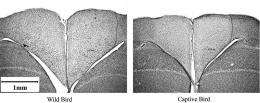
(PhysOrg.com) -- Being in captivity for just a few weeks can reduce the volume of the hippocampus by as much as 23 percent, according to a new Cornell study.
Caged birds may still sing, but being in captivity for just a few weeks can reduce the volume of the hippocampus by as much as 23 percent, according to a new Cornell study. The hippocampus is the part of the brain involved in spatial learning and memory tasks.
The research, by psychology graduate student Bernard Tarr and professor Tim DeVoogd, indicates that the hippocampus is highly sensitive to some or all of the environmental conditions that change in captivity -- including, among other things, social stimulation, exercise, food-storing opportunities and stress. The article is online at the journal of Developmental Neurobiology's Web site and will appear in a forthcoming issue of the journal,
The results provide new clues that could help researchers better understand human stress disorders such as depression and post-traumatic stress disorder (PTSD), which have been linked in previous studies of mammals to decreased hippocampal volume.
The research could also provide a new model for future studies of stress, stress disorders and spatial memory that take advantage of broad similarities in hippocampal function in birds and mammals.
To test the effect of captivity on the birds, Tarr and colleagues caught a total of 20 wild black-capped chickadees (which are frequently used in research on learning and memory) in the late fall of two successive years. The researchers injected each bird with BrdU, a chemical that marks newly forming brain cells; then tagged and released 10 of the birds and housed a corresponding 10 in the lab.
About five weeks after the first capture, the researchers recaptured the tagged wild birds and compared their hippocampal volumes to those of their lab-housed counterparts. They found that lab-housed birds had, on average, 23 percent less hippocampal volume (relative to total brain size) than the recaptured birds.
The volume decrease could be due to a combination of factors, but stress is likely a significant contributor, said Tarr. "It's not improbable to intuitively consider that being captive is highly stressful for these animals," he said. "So what we might have shown is, there really is a relationship between stress and a reduction of hippocampal volume."
That finding adds a new dimension to previous research examining whether the process of caching (stashing food for retrieval later) actually causes the hippocampus to grow.
Chickadees tested in the fall, when the need to cache food is highest, have been shown to have larger hippocampuses than those tested in other seasons. But captive birds that were allowed to cache in the lab showed no hippocampal-volume differences when compared with those that were kept inactive.
"If it's true that caching stimulates the hippocampus, for birds you allow out [to cache] you'd expect to see the hippocampus grow in volume," Tarr said.
It's possible that the caching activities in the lab are simply not as challenging or intense as those in the wild, he said. But it's also possible that in the lab, any benefit from caching exercises could be reversed by the detrimental effect of captivity.
Either way, Tarr said, the recent study suggests that research on the subject to date cannot be considered conclusive.
The findings also complement evidence from imaging and clinical studies in humans and other mammals that link depression and PTSD with decreased hippocampal volume.
In those studies, researchers had no way of knowing which came first: environmental stress that caused the hippocampus to shrink, or an inherently smaller hippocampus that predisposed certain individuals to depression or PTSD under stressful conditions.
But in the research by Tarr and colleagues, the 20 chickadees were randomly assigned to be either released or kept captive -- making it highly unlikely that the two groups had an inherent difference in average hippocampus size at the outset. The findings therefore suggest a causal link between captivity and hippocampal changes.
"This lends strong support to the notion that in mammals -- and that would specifically include humans -- with PTSD [or depression], there is an environmental input that triggers or results in some neurobiological change or output," Tarr said.
More information: www3.interscience.wiley.com/jo … l/122616256/abstract
Provided by Cornell University (news : web)


