Targeting tumors: Researchers develop more precise approach to delivery of chemotherapy drugs
October 12, 2009 by Tom Vasich Targeting tumors: Researchers develop more precise approach to delivery of chemotherapy drugs

Enlarge

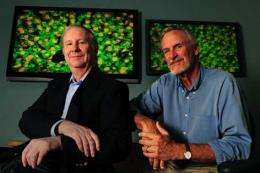
Kenneth Longmuir, left, and Richard Robertson inserted the anti-cancer drug doxorubicin into liposomes (orange globules shown in background) and attached a protein that targets only the liver. Image: Daniel A. Anderson

(PhysOrg.com) -- Chemotherapy is one of the most effective ways to fight cancer, but the toxic medicine can cause collateral damage to healthy tissue. UC Irvine's Kenneth Longmuir, physiology & biophysics associate professor, and Richard Robertson, anatomy & neurobiology professor, believe they have developed a way for these drugs to reach specific tumors with increased precision, thereby limiting side effects.

In a study appearing online in the International Journal of Pharmaceutics, the researchers show that doxorubicin — commonly used to treat a number of cancers — can be directed almost entirely to a particular spot in the body with virtually no spread to other organs.

"Although doxorubicin is a potent anti-cancer agent, its usefulness is compromised by its serious side effects on normal tissue," Longmuir says. "When administered in a chemotherapeutic regimen, the drug distributes widely in the body, including the heart, rather than just in tumor regions. This chance of heart damage restricts the amount of doxorubicin that a patient can receive."

He notes that less than a quarter — and in many cases less than 10 percent — of the medicine typically reaches its target. The remainder is dispersed throughout normal organs, resulting in considerable toxicity.

To overcome this, the researchers focused on the fact that all tissue, even a tumor, is surrounded by a dense area of sugar-containing molecules called polysaccharides. The chemical composition of these polysaccharides differs for each type of tissue.

"We knew that if we could find a molecular guide to a specific polysaccharide coating, we could create a highly targeted drug delivery system," Robertson says. "Fortunately, such a guide exists in the malaria microorganism Plasmodium."

Plasmodium has the exceptional ability to only recognize the liver's polysaccharide coating. So Robertson and Longmuir isolated the protein that allows Plasmodium to do this and built a doxorubicin delivery system around it.

They inserted the drug into fatty, tubelike structures called liposomes that are staples of nanomedicine. Then they bonded Plasmodium's targeting protein to these liposome packages, in essence "addressing" them to the liver.

In tests on mice, the research team demonstrated that doxorubicin was conveyed to the liver, and away from the heart, with a specificity rate of more than 99 percent.

The next step is to try the drug transport system in several experimental models, Longmuir says. He and Robertson are developing new liposome packages with targeting proteins that only recognize the unique polysaccharide features of tumors.

"By rapidly and accurately delivering chemotherapeutic agents to tumor regions, treatments can become safer and more effective," Longmuir says. "This promising approach opens up a new avenue to helping people survive cancer."

More information: http://www.sciencedirect.com/science/journal/03785173

Provided by UC Irvine


print this article email this article download pdf blog this article bookmark this article     Stumble it Digg this share on Facebook retweet share on Reddit add to delicious
Rate this story - 5 /5 (1 vote)


October 12, 2009 all stories

Comments: 0

5 /5 (1 vote)
  • Stumble this up

  • Digg this

  • share this

  • hide
  • Related Stories

  • Researchers create new strategy for highly-selective chemotherapy delivery
    created Sep 24, 2009 | popularity not rated yet | comments 0
  • Nanoparticles carry chemotherapy drug deeper into solid tumors
    created Jun 26, 2007 | popularity not rated yet | comments 0
  • Scientists can predict nano drug outcome
    created Feb 05, 2009 | popularity not rated yet | comments 0
  • 'Smart bomb' nanoparticle strategy impacts metastasis
    created Jul 07, 2008 | popularity not rated yet | comments 0
  • Novel approach to detoxifying cancer drugs
    created Nov 07, 2006 | popularity not rated yet | comments 0


  • hide
  • Relevant PhysicsForums posts

  • 23 Years in a Vegetative State....or not?
    created Nov 25, 2009
  • Has the H1N1 vaccine been scientifically proven to work?
    created Nov 24, 2009
  • nesfatin
    created Nov 22, 2009
  • Obsessive Compulsive Disorder
    created Nov 20, 2009
  • More from Physics Forums - Medical Sciences

Other News

An end to sleep problems? Researchers discover enzyme behind effects of sleep deprivation

Medicine & Health / Research

created 18 minutes ago | popularity not rated yet | comments 0

There is hope for those who miss one night too many or whose children keep them up at night. The unwelcome effects of a bad night's sleep - forgetfulness, impaired mental performance - can be dealt with by reducing the concentration ...


Ginkgo biloba doesn’t prevent cardiovascular events but may have potential peripheral artery disease benefits

Medicine & Health / Research

created 42 minutes ago | popularity not rated yet | comments 0

(PhysOrg.com) -- Ginkgo biloba didn’t prevent cardiovascular death or major events such as heart attack and stroke in people age 75 and older, but the herb may affect peripheral vascular disease, according to research reported ...


Implant-based cancer vaccine is first to eliminate tumors in mice

Implant-based cancer vaccine is first to eliminate tumors in mice

Medicine & Health / Cancer

created 19 hours ago | popularity 4.7 / 5 (22) | comments 4

(PhysOrg.com) -- A cancer vaccine carried into the body on a carefully engineered, fingernail-sized implant is the first to successfully eliminate tumors in mammals, scientists report this week in the journal ...


Brain's endocannabinoid signaling pathway kept in check by two enzymes

Medicine & Health / Research

created 16 hours ago | popularity 4 / 5 (4) | comments 1

(PhysOrg.com) -- A research team has shown that blocking the degradation of two naturally occurring cannabinoids in the endocannabinoid signaling pathway of the brain produces marijuana-like behavioral effects in mice, according ...


Scientists find emotion-like behaviors, regulated by dopamine, in fruit flies

Medicine & Health / Neuroscience

created 20 hours ago | popularity 5 / 5 (3) | comments 0

Scientists at the California Institute of Technology have uncovered evidence of a primitive emotion-like behavior in the fruit fly, Drosophila melanogaster. Their findings, which may be relevant to the relationship betwee ...