By Simulating Gullies, Geographers Discover Ways to Tame Soil Erosion
(PhysOrg.com) -- Dead zones in critical waterways, accelerated loss of arable land and massive famines. They're all caused by the 24 billion tons of soil that are lost every year to erosion, a phenomenon that costs the world as much as $40 billion annually. But predicting where erosion occurs, and thus how to prevent it, is a serious challenge.
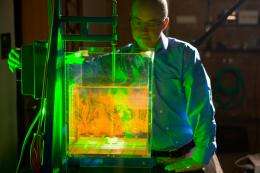
That's why University at Buffalo geographer Sean Bennett has constructed various systems to model it, with assistance from UB's machine shop. His methods range from the deceptively low-tech, like simulating rainstorms over sandboxes to the high-tech, such as the use of particle image velocimetry (PIV) in large, re-circulating flumes to study how water and grains of sand interact.
The purpose of his work is both exceedingly practical -- geared toward helping farmers learn how to best prevent erosion -- and fundamental, to better understand how planetary surfaces evolve over time.
"We have feet in two domains," he explains, "we're studying processes similar to those that created Niagara Falls; at the same time, we're studying how these processes degrade soil resources worldwide."
The UB research is helping scientists better understand some of the key triggers of erosion, the complex formation of channels on the landscape, called rills and gullies.
"Rills and gullies are the dominant erosion processes on agricultural landscapes today and the main contributor to soil loss," says Bennett, PhD, UB professor of geography in the College of Arts and Sciences and an active researcher in the UB 2020 Strategic Strength in Extreme Events.
Rills and gullies also are a primary cause behind excess sediment and nutrients in waterways, which transports soil and chemicals further downstream.
Bennett says that these high nutrient loadings of nitrogen and phosphorus from eroding agricultural areas destroy aquatic resources, causing unmitigated growth of aquatic algae, depletion of dissolved oxygen and the creation of "dead zones" in places like the Gulf of Mexico.
Ironically, past research by Bennett demonstrated that when farmers till fields to remove rills and gullies, they actually end up accelerating erosion.
"Our numerical model showed that you could reduce soil losses by 400 percent if you adopt a no-till farming practice," says Bennett. "This is because the gullies grow to some maximum size on the landscape during a growing season. If farmers repair them by tilling the soil each spring, the practice actually causes much greater soil loss over the long term."
Bennett's physical model showed similar phenomena.
"Our laboratory landscape showed the same thing," he says, "rills grow and evolve in time and space, erosional processes get arrested and reach an endpoint. After that, they don't produce much sediment."
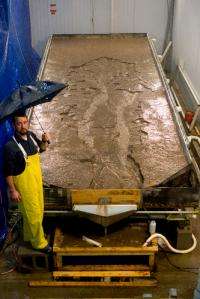
To model how rills and gullies form, Bennett and his students built a rainfall soil erosion facility, erecting a 30-foot by 8-foot flume containing eight tons of soil, which allowed them to monitor their simulated landscape, looking for disturbances in the soil and the creation of rills and gullies.
Using digital cameras positioned directly above the flume, they developed digital elevation models of the topography across the flume, at millimeter-scale accuracy.
"Each set of images represents how the topography evolved at a discrete space and time during the simulated storm," says Bennett.
The images reveal at what point during the rainfall and runoff, phenomena called headcuts -- small intense areas of localized erosion -- begin to carve deep channels into the soil.
"If we can predict where and when these headcuts occur, and develop technology that allows us to control them, then we can greatly improve soil resource management," says Bennett.
Such technologies include runoff diversions, grass barriers and vegetated waterways.
The images also revealed with startling clarity the fractal patterns that the simulated storm created in the landscape.
"Fractal organization is one of the most compelling ideas in science," says Bennett."While I always knew that landscapes had fractal characteristics, I never saw it demonstrated so clearly as when I saw these treelike patterns in the images we took of our rill networks.
To study sediment transport processes in rivers and how particles interact with the turbulent flow, Bennett designed a 30-foot by 2-foot flume channel, which was constructed by the UB machine shop.
In one experiment, the researchers fill the channel with sand and water, flatten the bed, and then turn on the centrifugal pump to initiate sediment movement.
"Once the flow reaches a certain velocity, the entire bed erupts into ripples, created by the instability between the fast-moving fluid overlying the slow-moving sediment," Bennett explains.
"The PIV system can provide us with high-quality images and data right at the bed surface while these bedforms are being created," he continues. "By examining the physics of sediment transport in this way, we can develop improved models for flow and transport in rivers, allowing us to better manage our river systems and aquatic ecology."
Bennett hopes to use these flumes and equipment to expand his research on the interactions between vegetation and river function and form. Such interactions are critical to the process of restoring and stabilizing degraded streams, a primary thrust of the National Science Foundation-funded "Ecosystem Restoration Through Interdisciplinary Exchange" graduate training program at UB, in which Bennett participates through research and training.
Provided by University at Buffalo (news : web)


