Self-sacrifice among strangers has more to do with nurture than nature
October 12, 2009 Self-sacrifice among strangers has more to do with nurture than nature

Enlarge

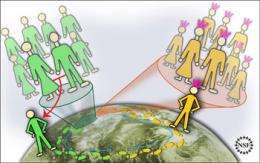
In this schematic representation, garb is a proxy for social behavior. Researchers have found that in groups with diasporas, behavior is not necessarily genetically handed down, but rather it is something culturally absorbed. Immigrants to a new culture tend to "do as Romans do" after assimilating. Credit: Zina Deretsky, National Science Foundation

(PhysOrg.com) -- Socially learned behavior and belief are much better candidates than genetics to explain the self-sacrificing behavior we see among strangers in societies, from soldiers to blood donors to those who contribute to food banks. This is the conclusion of a study by Adrian V. Bell and colleagues from the University of California Davis in the Oct. 12 edition of Proceedings of the National Academy of Sciences.

Altruism has long been a subject of interest to evolutionary social scientists. Altruism presents them with a difficult line to argue: behaviors that help unrelated people while being costly to the individual and creating a risk for genetic descendants could not likely be favored by evolution: at least by common evolutionary arguments.

The researchers used a mathematical equation, called the Price equation, that describes the conditions for altruism to evolve. This equation motivated the researchers to compare the genetic and the cultural differentiation between neighboring social groups. Using previously calculated estimates of , they used the World Values Survey (whose questions are likely to be heavily influenced by culture in a large number of countries) as a source of data to compute the cultural differentiation between the same neighboring groups. When compared they found that the role of culture had a much greater scope for explaining our pro-social behavior than genetics.

In applying their results to ancestral populations, the World Values Survey was less useful. But ancient , such as exclusion from the marriage market, denial of the fruits of cooperative activities, banishment and execution happen now as they did then. These activities would have exerted strong selection against genes tending toward , and presumably in favor of genes that predisposed individuals toward being pro-social rather than anti-social. This would result in the gene-culture coevolution of human prosocial propensities.

Bell is currently continuing his research in Tonga, where he is planning through ethnography to estimate statistically what social learning behaviors people have in general that may explain the distribution of cultural beliefs across the Tongan Islands. He is developing a survey instrument that will help capture people's cultural beliefs and measure the effect of migration on the similarities and differences between populations.

Source: National Science Foundation (news : web)


print this article email this article download pdf blog this article bookmark this article     Stumble it Digg this share on Facebook retweet share on Reddit add to delicious
Rate this story - 4.5 /5 (4 votes)

Rank Filter

Move the slider to adjust rank threshold, so that you can hide some of the comments.


Display comments: newest first

  • RobertKarlStonjek - Oct 12, 2009
    • Rank: not rated yet
    This explanation only works if a significant proportion of a population already had the altruistic trait and fails for the emergence of the trait when new as greedy individuals could easily outcompete a minority of altruistic individuals.

    If it is cultural, then these researchers will have no trouble teaching altruism to psychopaths, at least the non-violent ones...

    I think it's back to the drawing board for these guys...
  • mogmich - Oct 13, 2009
    • Rank: not rated yet
    If this explanation is correct, it means that in all stable human societies, the majority is more or less altruistic. And that living in a stable society is crucial for human survival.

    This is probably the case, and has always been.
  • ArtflDgr - Oct 13, 2009
    • Rank: 1 / 5 (1)
    when they can train an aligator to be nuturing then i will concede. till then, the hardware cant do anything outside its framweork of operation. maybe that framework amazes people with heads in the books all the time who cant actually get up and do much. its not that the bumblebee cant fly, its that scientists have such hubris to deny reality. money from state increases said hubris till they can find actually anything, even if it isnt there.
  • designmemetic - Oct 19, 2009
    • Rank: not rated yet
    this strikes me as a basic meme analysis project. Nice to see it being undertaken. Unfortunately my strong suspicion is that altruism is a very complex trait that would be a co-factor of biology, sociology, and maybe some game theory.

    p.s. if you were an extraterrestrial secretly watching our planet would you a) stay hidden and use it as a laboratory to learn more about the development of altruism in your own species or b) boldly introduce yourself and upset the natural order of evolution?
  • frajo - Oct 19, 2009
    • Rank: not rated yet
    if you were an extraterrestrial secretly watching our planet would you a) stay hidden and use it as a laboratory to learn more about the development of altruism in your own species or b) boldly introduce yourself and upset the natural order of evolution?

    There is no "unnatural" evolution.
    To answer your question I'd like to refer to Boris and Arkady Strugatsky's novel "Hard to Be a God" which demonstrates that good intentions and god-like power are not sufficient to get a good work done.

October 12, 2009 all stories

Comments: 5

4.5 /5 (4 votes)
  • Stumble this up

  • Digg this

  • share this

  • hide
  • Related Stories


  • hide
  • Relevant PhysicsForums posts

  • Quantum Economies: Phyisical Modeling of Economic Systems
    created Nov 16, 2009
  • The real purpose of cretenic marketing/commercial propaganda
    created Nov 15, 2009
  • Speculative Attack
    created Nov 13, 2009
  • Animals which attack their "cousins"
    created Nov 07, 2009
  • More from Physics Forums - Social Sciences

Other News

Biology, training and profit sharing make best traders

Biology, training and profit sharing make best traders

Other Sciences / Mathematics

created 3 hours ago | popularity not rated yet | comments 0

(PhysOrg.com) -- Cambridge researchers have identified a group of traders consistently able to outperform the market, even during the credit crisis.


Explained: The Discrete Fourier Transform

Explained: The Discrete Fourier Transform

Other Sciences / Mathematics

created 3 hours ago | popularity 3.6 / 5 (5) | comments 4

(PhysOrg.com) -- In 1811, Joseph Fourier, the 43-year-old prefect of the French district of Isčre, entered a competition in heat research sponsored by the French Academy of Sciences. The paper he submitted ...


Political views may skew perception of skin tone, new study finds

Other Sciences / Social Sciences

created 17 hours ago | popularity 3.6 / 5 (5) | comments 5

(PhysOrg.com) -- Political affinity could influence how some people view the skin tone of biracial political candidates, according to a new study from the University of Chicago Booth School of Business, New York University ...


In College Football, Home Field Advantage Often Overestimated

Other Sciences / Mathematics

created 17 hours ago | popularity 4 / 5 (1) | comments 0

This year, many of college football's biggest rivalry games take place over Thanksgiving weekend. A win earns bragging rights for the year. Visiting teams are often thought to be at a considerable disadvantage, especially ...


Workplace literacy schemes are too short to improve skills

Other Sciences / Social Sciences

created 5 hours ago | popularity not rated yet | comments 0

The five billion pound Skills for Life programme is based on the assumption that an improvement in literacy and numeracy will increase people's earning potential, as well as their productivity and employability. However, ...