The first neotropical rainforest was home of the Titanoboa
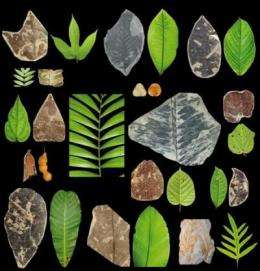
Smithsonian researchers working in Colombia's Cerrejón coal mine have unearthed the first megafossil evidence of a neotropical rainforest. Titanoboa, the world's biggest snake, lived in this forest 58 million years ago at temperatures 3-5 C warmer than in rainforests today, indicating that rainforests flourished during warm periods.
"Modern neotropical rainforests, with their palms and spectacular flowering-plant diversity, seem to have come into existence in the Paleocene epoch, shortly after the extinction of the dinosaurs 65 million years ago," said Carlos Jaramillo, staff scientist at the Smithsonian Tropical Research Institute. "Pollen evidence tells us that forests before the mass extinction were quite different from our fossil rainforest at Cerrejón. We find new plant families, large, smooth-margined leaves and a three-tiered structure of forest floor, understory shrubs and high canopy."
Historically, good rock exposures and concentrated efforts by paleontologists to understand the evolution of neotropical rainforests—one of the most awe-inspiring assemblages of plant and animal life on the planet—have been lacking. "The Cerrejón mining operation is the first clear window we have to see back in time to the Paleocene, when the neotropical rainforest was first developing," said Scott Wing, a paleontologist from the Smithsonian's National Museum of Natural History.
Some of the more than 2,000 fossil leaves, including the compound leaves and pods of plants in the bean family and leaves of the hibiscus family are among the oldest, reliable evidence of these groups. This was the first time that the plant families Araceae, Arecaceae, Fabaceae, Lauraceae, Malvaceae and Menispermaceae, which are still among the most common neotropical rainforest families, all occurred together.
Many newcomers to modern rainforests remark that the leaves all look the same, a reasonable observation given that most have smooth margins and long "drip-tips" thought to prevent water from accumulating on the leaf surface.
S. Joseph Wright, senior scientist at STRI, has noted that all of the areas in the world today with average yearly temperatures greater than 28 C are too dry to support tropical rainforests. If tropical temperatures increase by 3 C by the end of this century as predicted in the 2007 report of the Intergovernmental Panel on Climate Change, "We're going to have a novel climate where it is very hot and very wet. How tropical forest species will respond to this novel climate, we don't know," said Wright.
Based on leaf shape and the size of the cold-blooded Titanoboa, Cerrejón rainforest existed at temperatures up to 30-32 C and rainfall averages exceeded 2500 mm per year.
But Titanoboa's rainforest was not as diverse as modern rainforests. Comparison of the diversity of this fossil flora to modern Amazon forest diversity and to the diversity of pollen from other Paleocene rainforests revealed that there are fewer species at Cerrejón than one would expect. Insect-feeding damage on leaves indicated that they could have been eaten by herbivores with a very general diet rather than insects specific to certain host plants.
"We were very surprised by the low plant diversity of this rainforest. Either we are looking at a new type of plant community that still hadn't had time to diversify, or this forest was still recovering from the events that caused the mass extinction 65 million years ago," said Wing. "Our next steps are to collect and analyze more sites of the same age from elsewhere in Colombia to see if the patterns at Cerrejón hold, and study additional sites that bracket the Cretaceous mass extinction, in order to really understand how the phenomenal interactions that typify modern rainforests came to be."
More information: This work is scheduled to be published online in the Proceedings of the National Academy of Sciences during the week of Oct. 12-16.
Source: Smithsonian Tropical Research Institute


