Astronomers Detect Sodium Gas Ejected by Lunar Impact
October 12, 2009 Astronomers Detect Sodium Gas Ejected by Lunar Impact

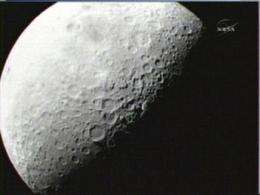
This image provided by NASA shows the first image taken of the moon from the Lunar Crater Observation and Sensing Satellite Friday morning Oct. 9, 2009. Two NASA spacecraft are barreling toward the moon at twice the speed of a bullet, about to crash into a lunar crater in a search for ice.

(PhysOrg.com) -- Boston University astronomers announced today observations of a cloud of sodium gas ejected from the Moon’s surface as a result of the NASA impact experiment that was part of its Lunar Reconnaissance Orbiter mission (LCROSS). Jeffrey Baumgardner and Jody Wilson, senior research associates in the Center for Space Physics (CSP), conducted the observations from BU’s observing facility housed on the grounds of the McDonald Observatory in Ft. Davis, Texas.

near the Moon’s south pole went from zero to blazing just after the impact!” Dr. Wilson reported to colleagues back in Boston.

Added Baumgardner: “We took a series of five-minute time exposures before, during and after the event and the detection is unambiguous.”

Sodium is a minor component of the lunar regolith (soil), but it can serve as a tracer of more abundant elements because it scatters (or reflects) sunlight very efficiently. The observing strategy of the BU team was to make their measurements at a point approximately 100 km above the lunar impact point, an altitude sufficient for sodium gas to be in sunlight (and therefore visible) and yet far enough away from the bright glare of the Moon’s surface.

“Sodium is continuously being ejected and lost from the Moon, creating an always present, but very faint and transient lunar atmosphere,” Dr. Wilson explained. “The ways that so-called surface-sputtering occurs on primitive bodies, such as the Moon, the and Jupiter’s moon Io, are topics of great interest to astronomers who study how atmospheres can escape from a large celestial body.”

Impacting meteors, the solar wind and sunlight are all agents that can eject sodium atoms from the . While such surface-physics processes can be studied in laboratories here on Earth, this was the first successful attempt to conduct a “laboratory in space” experiment where the characteristics of the impactor were so well known.

“The full implications of these results will, of course, require detailed data analysis and modeling,” commented Michael Mendillo, professor of Astronomy at Boston University. “At this point, all we do know is that the BU team had a better night than the Red Sox.”

Baumgardner added: “The relation between what we saw in sodium and what the main objective of the experiment was --detecting possible signatures of water -- will require coordinated analyses of all of the observations made on Earth and onboard the NASA spacecraft.”

Provided by Boston University


print this article email this article download pdf blog this article bookmark this article     Stumble it Digg this share on Facebook retweet share on Reddit add to delicious
Rate this story - 4.4 /5 (21 votes)

Rank Filter

Move the slider to adjust rank threshold, so that you can hide some of the comments.


Display comments: newest first

  • deatopmg - Oct 12, 2009
    • Rank: 3.7 / 5 (3)
    Isn't it likely that the early moon had oceans of water for a while so that NaCl could have been concentrated into deposits?
  • shavera - Oct 12, 2009
    • Rank: 4 / 5 (3)
    Isn't it likely that the early moon had oceans of water for a while so that NaCl could have been concentrated into deposits?

    They didn't find salt, they just found sodium. Sodium exists in plenty of other compounds aside from salt. Furthermore, reading the text will show that sodium is a minor component in the soil, so it certainly isn't concentrated like a salt bed would be.
  • otto1923 - Oct 12, 2009
    • Rank: 2.5 / 5 (2)
    I thought of salts too- like on mars which indicated the presence of water. Different chemistry, different salt. Could the impact have dissociated sodium and chlorine? A blaze of sodium gas could mean unnatural concentrations.
  • Thadieus - Oct 12, 2009
    • Rank: 3 / 5 (3)
    its too bad they created a dry hole instead of a wet hole.
  • Mercury_01 - Oct 12, 2009
    • Rank: 4.7 / 5 (3)
    Careful guys, this news site is now an elite club for super special science initiates only. They might delete your comment for having an entertainment value of .5 or above. And watch out otto, some of these guys still dont believe in water on mars, which is grounds for immediate comment deletion!!

    On the serious side, a mechanical impact, even though energetic at the split second of impact, would be unlikely to dissociate chlorine from sodium in an amount likely to be picked up by the spectrometer. Also, sodium chloride is just one of many thousands of compounds that are classified as salts. Whatever form of sodium that was detected was most likely a part of the rock itself.
  • zevkirsh - Oct 13, 2009
    • Rank: 4.9 / 5 (7)
    sodium is a major component of cheese, so this actually isn't so surprising.
  • probes - Oct 13, 2009
    • Rank: not rated yet
    yes, with sodium being a major component of cheese and the impact itself being "soft" we can make the obvious inference. But we should remain very tight-lipped about it, until it is scientifically verified, and the results puplished in peer-reviewed journals concerned with cheese.
  • otto1923 - Oct 13, 2009
    • Rank: not rated yet
    And watch out otto
    Na und, Otto entertains most himself. Perchlorates on Mars right? Formed from sublimation of subsurface water to thin atmosphere or vacuum? Whats not to believe? What was that white stuff at the bottom of that little pit? Chalk?? Moon cheese- more like Brie than Cheddar? On the moon no one can hear you smell- WTF
  • probes - Oct 14, 2009
    • Rank: not rated yet
    Excuse me but if astronomers have detected sodium gas from the LCROSS impact, what does that have to do with cheeses, Brie, Cheddar etc? I do not understand. I guess a light crust could form on the surface.
  • DozerIAm - Oct 14, 2009
    • Rank: not rated yet
    I gouda comeup with a cheese joke here, but instead I'll say this... a permanently shaded site like this would make an excellent first moonbase location. They could run out solar panels to the sunny areas nearby, set up a small nuclear reactor for backup power, and begin getting on with the up close and personal science that nasa needs to do.

October 12, 2009 all stories

Comments: 10

4.4 /5 (21 votes)
  • Stumble this up

  • Digg this

  • share this

  • hide
  • Related Stories

  • Researchers Produce Images of Gases Escaping from Jupiter's Moon Io
    created Jul 19, 2007 | popularity not rated yet | comments 0
  • Mercury's 'tail' is longer than thought
    created Feb 27, 2008 | popularity not rated yet | comments 0
  • India's Chandrayaan-1 spacecraft reaches its final orbit
    created Nov 13, 2008 | popularity not rated yet | comments 0
  • NASA Moon-Impactor Mission Passes Major Review
    created Feb 02, 2007 | popularity not rated yet | comments 0
  • SMART-1 To Crash Into Lunar Surface In August
    created Feb 07, 2006 | popularity not rated yet | comments 0


  • hide
  • Relevant PhysicsForums posts

  • Sideral question
    created 15 hours ago
  • Doppler shifted blackbody spectrum
    created 18 hours ago
  • Earth v. Moon
    created 20 hours ago
  • help me with coordinates and orbits
    created 20 hours ago
  • More from Physics Forums - General Astronomy

Other News

Astronauts finish another spacewalk, still no baby (AP)

Astronauts finish another spacewalk, still no baby

Space & Earth / Space Exploration

created 6 hours ago | popularity 3 / 5 (2) | comments 0

(AP) -- A spacewalking astronaut put aside the impending birth of his daughter and blazed through his first-ever venture outside the International Space Station on Saturday.


Unseasonably hot and dry weather combined with strong winds to fan scores of blazes in the country's southeastern states

Australia issues 'catastrophic' alerts as fires rage

Space & Earth / Environment

created 12 hours ago | popularity 4.5 / 5 (2) | comments 0

Australia has issued "catastrophic" alerts after record-breaking temperatures and wild lightning storms sparked more than 100 fires across the country, officials said Saturday.


Commuters wait on the platform shrouded by fog in London

Climate change not man-made, say majority of Britons: poll

Space & Earth / Environment

created Nov 15, 2009 | popularity 3.3 / 5 (15) | comments 45

Less than half of Britons believes that human activity is to blame for global warming, according to a poll carried out for The Times newspaper and published on Saturday.


Mysteriously warm times in Antarctica

Mysteriously warm times in Antarctica

Space & Earth / Earth Sciences

created Nov 18, 2009 | popularity 4.2 / 5 (21) | comments 28

(PhysOrg.com) -- A new study of Antarctica's past climate reveals that temperatures during the warm periods between ice ages (interglacials) may have been higher than previously thought. The latest analysis ...


UN: Fight climate change with free condoms (AP)

UN: Fight climate change with free condoms

Space & Earth / Environment

created Nov 18, 2009 | popularity 3.1 / 5 (11) | comments 24

(AP) -- The battle against global warming could be helped if the world slowed population growth by making free condoms and family planning advice more widely available, the U.N. Population Fund said Wednesday.