New Twist on Favorite X-ray Technique Promises Ultrafast Molecular Studies
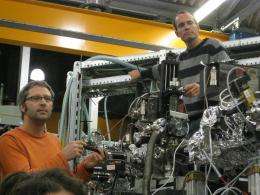
(PhysOrg.com) -- A team of physicists from the Stanford Synchrotron Radiation Lightsource, including graduate student David Bernstein, have made a promising discovery that a well-known synchrotron technique is applicable to free-electron lasers.
In an article published in Applied Physics Letters on September 28, the research team from SLAC and FLASH in Hamburg, Germany, show that Near Edge X-ray Absorption Fine Structure Spectroscopy can be altered slightly and used with free-electron lasers to better understand the properties of materials. Taking advantage of the extremely short X-ray pulses of the newly-commissioned Linac Coherent Light Source, the technique could be used to investigate ultrafast molecular interactions.
"NEXAFS spectroscopy is an extremely well developed technique for synchrotrons," Bernstein said. "The beauty of this experiment is that it shows that we can use a technique we already have to explore this new regime."
Each type of atom can absorb a specific range of wavelengths of light, known as an absorption spectrum. The NEXAFS technique uses this spectrum by targeting specific types of atoms with X-ray wavelengths in just the right range. By measuring how the atoms absorb X-rays of a known wavelength and intensity, researchers can investigate both magnetic and electrical bonding energies of the atoms, providing information about the environment surrounding the atom being studied. This is done by measuring how much light at a specific wavelength passes through the sample and calculating how much is absorbed.
The experiment works beautifully at synchrotrons because the NEXAFS spectroscopy technique relies on knowing the exact intensity of the incoming X-rays at a specific wavelength, an easily controlled factor in synchrotron labs. But a free-electron laser, or FEL, is noisy by nature, meaning the amount of light emitted at a precise energy is inconsistent from pulse to pulse.
"Because of the nature of the FEL, it was not initially clear that this technique could be used with a free-electron laser because you must know the incoming intensity of the light," Bernstein said. The SLAC team—including Bernstein, Yves Acremann, Andreas Scherz, Mark Burkhardt and adviser Jo Stöhr—joined with physicists at FLASH, the soft X-ray free-electron laser in Hamburg, to find a way to quiet the noisy laser.
By directing a fifty-femtosecond FLASH pulse at an X-ray grating, the researchers dispersed the free-electron laser X-ray beams by wavelength, much as a prism separates visible light to form rainbows. Based on their dispersal pattern, a physicist can determine what color light hits the sample. "With this, we can shine different energies of light at different areas of the sample," Bernstein said.
Samples are placed on delicate slides only 100 nanometers thick with a window made of silicon nitride, which is fairly transparent to X-rays. Each window is divided vertically: one half is covered with the sample; the other is left blank. The blank half of each window allows researchers to characterize the beam, creating comparison points for the intensity of X-ray that passed through the sample. The X-rays pass through the sample windows and hit a phosphorescent crystal which glows. The researchers photograph the glow to quantify how much of the X-ray beam has been transmitted, which indicates how the specific type of atom is bonded and what it may be bonded to.
"By being able to use specific techniques that we know and love in an FEL we can do so much more with them," said Bernstein. He said he hopes that NEXAFS can be used with LCLS for spectroscopy experiments with enormous amounts of light and short X-rays pulses, which would allow researchers to study many interactions, including visualizing atomic processes at never before seen speeds.
"Free-electron lasers provide the time resolution and extreme brightness needed to explore the femtosecond regime," Bernstein said. "It would open the door to ultrafast spectroscopy on free electron lasers."
Provided by SLAC National Accelerator Laboratory (news : web)


.jpg)


