Graphene Used As Floating-Molecular Carpet To Ornament It With 24-Carat Gold 'Snowflakes'
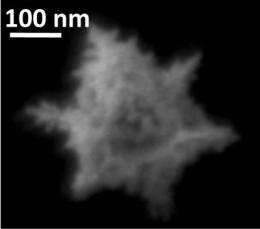
(PhysOrg.com) -- In an effort to make graphene more useful in electronics applications, Kansas State University engineers made a golden discovery -- gold "snowflakes" on graphene.
Vikas Berry is a K-State assistant professor of chemical engineering who works with graphene, a carbon material only a single atom thick and discovered just five years ago. To functionalize graphene with gold -- thus controlling its electronics properties -- Berry and Kabeer Jasuja, a K-State doctoral student in chemical engineering, imbedded gold on graphene.
To do this, the engineers placed the graphene oxide sheets in a gold ion solution that had a growth catalyst. Here, the atomically thick sheets swim and bathe in a pool of chemicals.
"Graphene-derivatives act like swimming molecular carpets when in solution and exhibit fascinating physiochemical behavior," Berry said. "If we change the surface functionality or the concentration, we can control their properties."
They found that rather than distributing itself evenly over graphene, the gold formed islands on the sheets' surfaces. They named these islands snowflake-shaped gold nanostars, or SFGNs.
"So we started exploring how these gold nanostars are formed," Berry said. "We found out that nanostars with no surface functionality are rather challenging to produce by other chemical processes. We can control the size of these nanostars and have characterized the mechanism of nucleation and growth of these nanostructures. It's similar to the mechanism that forms real snowflakes."
Berry said the presence of graphene is critical for the formation of the gold nanostars. "If graphene is absent, the gold would clump together and settle down as big chunks," he said. "But the graphene helps in stabilizing the gold. This makes the nanostars more useful for electronic applications."
In July, Jasuja and Berry published their work in the journal ACS Nano.
The discovery of these gold "snowflakes" on graphene shows promise for biological devices as well as
electronics. Berry is attaching DNA to these gold islands to make DNA sensors. He is joined by Nihar Mohanty, a doctoral student in chemical engineering, and undergraduate researcher Ashvin Nagaraja, a senior in electrical engineering. Nagaraja is a 2004 Manhattan High School graduate.
Berry said graphene-gold based DNA sensors will have enhanced sensitivity. Chemically reducing graphene oxide to obtain graphene requires harsh chemicals that destroy the DNA.
"Now we can use the harsh chemicals on graphene oxide imbedded with gold to obtain graphene with gold islands. Then we can use these gold islands to functionalize DNA."
Berry also is using graphene in conjunction with microwaves. He and Jasuja are "cooking" the graphene sheets as another way to produce particles on the material's surface.
Some of Berry's other graphene research involves using the modified graphene sheets to compartmentalize a coagulating solution, thus stabilizing it. His group has recently used hydrides to reduce graphene oxide to produce reduced graphene oxide in the matter of a few seconds. The graphene produced in this way can remain stable in the solution for several days. Further results will shortly appear in the journal Small
Discovered only five years ago, graphene has captured the attention of a large number of researchers who are studying its exceptional electrical, mechanical and optical properties, Berry said. His research group is among the few studying the material's interfacial properties and biological applications.
"We're entering a new era," Berry said. "From the zero-dimensional or one-dimensional molecular or polymer solutions, we are now venturing into the two-dimensional graphene solutions, which have fascinating new properties."
Provided by Kansas State University (news : web)


