Researchers claim a third of dinosaurs might never have existed
October 13, 2009 by Lin Edwards T.rex

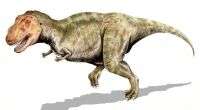
Tyrannosaurus rex, a theropod from the Late Cretaceous of North America, pencil drawing. Image: Wikipedia.

(PhysOrg.com) -- A new ten-year study by US paleontologists suggests that up to a third of dinosaur fossils may have been incorrectly identified as new species, when they are actually juveniles of species in which there was a dramatic change as they developed.

Jack Horner, of Montana State University, said in a new documentary to be aired on the National Geographic channel, that one example was the Nanotyrannus, which was identified as a separate species but which may in fact be a juvenile , whose changed dramatically as it matured, becoming much less elongated. This was suggested after a dinosaur mid-way between the size of a Nanotyrannus and Tyrannosaurus Rex was discovered.

According to Horner, Nanotyrannus, which had 17 teeth in the lower jaw, was in fact a juvenile T. Rex, which had 12 lower-jaw teeth. The newly discovered dinosaur had 14 teeth in the lower jaw. Horner suggests that as the Tyrannosaurus Rex grew, it lost its small, blade-like teeth for larger bone-crushers.

The researchers also studied late Cretaceous fossils of Triceratops found in the Hell Creek formation in eastern Montana. These dinosaurs had died at various ages, and their fossils revealed a number of changes as the animals grew. The skulls revealed the juveniles' horns curved backwards, while the adults' horns pointed forwards, while the bones around the frill flattened and lengthened as the dinosaur matured.

Another researcher, Mark Goodwin, of the University of California in Berkeley, explained that they had been able to obtain a better growth series than had been available before, and this enabled them to document the changes occurring during the growth of the animals.

Big changes in the body from infancy to adulthood may have been occurred for similar reasons to changes that occur in species today that ensure members of a species recognize each other and can distinguish between adults and juveniles needing protection.

Not all paleontologists are convinced by the study. Paleontologist Hans-Dieter Sues, of the National Museum of Natural History in Washington DC agreed that some dinosaurs identified as separate species may turn out to be juveniles, since many vertebrates change in appearance as they mature. But the conclusions of the study are controversial and the claim that about a third have been misidentified is exaggerated, according to Sues. Testing the hypotheses is also difficult because there are not enough available fossils.

The research is featured in a National Geographic documentary entitled " Decoded".

© 2009 PhysOrg.com


Rate this story - 4.4 /5 (21 votes)

Rank Filter

Move the slider to adjust rank threshold, so that you can hide some of the comments.


Display comments: newest first

  • RayCherry - Oct 13, 2009
    • Rank: 3 / 5 (2)
    DNA? Very dificult to recover a complete genome, but surely there are sufficient materials to distinguish species?
  • Ashy - Oct 13, 2009
    • Rank: 5 / 5 (1)
    Parts of DNA is not enough. Many species have identical DNA parts. For example your genome and chimpanzee's gemone similar at ~98%, and your genome and mice's gemone similar at more than 70%
  • bhiestand - Oct 14, 2009
    • Rank: 3 / 5 (1)
    I'm assuming another comment was deleted or there is some other miscommunication...? DNA wasn't mentioned in the article. It sounds like all of their evidence is fossil-based, and that's one of the serious limits they face.
  • croghan27 - Oct 14, 2009
    • Rank: not rated yet
    At the beginning of the science of paleontology there was such intense competition to 'discover' new fossels that several were 'discovered' several times .... This is no surprise.
  • RayCherry - Oct 15, 2009
    • Rank: not rated yet
    bhiestand: my comment is probably hidden for your page by the Rank Filter which you can alter at the top of the list of comments. FizzBizz decided to rank my comment as a 1/5 which is below the filter level of 2.5 and so my comment is hidden.

    I mentioned DNA because I have read previous articles here and elsewhere that have indicated some genetic material recoveries from dinosaur remains (if they are infact correctly identified as dinosaur).

    I understand (in layman's terms) the process of fossilisation, but I find it difficult to believe that modern bio-archaeoligical techniques can not recover any cell tissue at all from the preserved skeletal/structural remains and the material immediately surrounding them.

    Answering Ashy above, if the parts of the genome recovered are actually enough to distinguish one species from another, (combined with the information that the bone structure provides), then we do not require a complete sequence for each bone being examined.

October 13, 2009 all stories

Comments: 5

4.4 /5 (21 votes)

  • hide
  • Related Stories

  • Tyrannosaurus rex may have been scavenger
    created Feb 18, 2006 | popularity not rated yet | comments 0
  • Edmonton city site was dinosaur dining room
    created Jun 29, 2007 | popularity not rated yet | comments 0
  • Burrowing, digging dinosaurs found in southwest Montana
    created Mar 21, 2007 | popularity not rated yet | comments 0
  • Museum unveils world's largest T-rex skull
    created Apr 07, 2006 | popularity not rated yet | comments 0
  • Huge meat-eating dinosaur uncovered
    created Apr 19, 2006 | popularity not rated yet | comments 0


  • hide
  • Relevant PhysicsForums posts

  • Do we lose weight by respiration ? (Losing carbons)
    created 1hour ago
  • Sleeping habits and the risk of cancer
    created Feb 08, 2010
  • Pressure in chambers of the heart
    created Feb 07, 2010
  • Primordial soup canned?
    created Feb 07, 2010
  • More from Physics Forums - Biology

Other News

TED takes on 'What the world needs now'

Other Sciences / Other

created 2 hours ago | popularity not rated yet | comments 0

Let the mind-bending begin! A TED conference that attracts brilliant minds and challenges them to solve humanity's ills got underway Tuesday in the southern California city of Long Beach.


New research reveals burglars have changed their 'shopping list'

Other Sciences / Social Sciences

created 2 hours ago | popularity 3.5 / 5 (2) | comments 3

Globalisation, and particularly cheaper electronic goods from China and the Far East, has altered behaviour among Britain's burglars according research in progress at the University of Leicester.


Study challenges bird-from-dinosaur theory of evolution - was it the other way around?

Study challenges bird-from-dinosaur theory of evolution - was it the other way around?

Other Sciences / Archaeology & Fossils

created 14 hours ago | popularity 3.7 / 5 (11) | comments 4 | with audio podcast

(PhysOrg.com) -- A new study just published in the Proceedings of the National Academy of Sciences provides yet more evidence that birds did not descend from ground-dwelling theropod dinosaurs, experts say, a ...


'Counterfactual' thinkers are more motivated and analytical, study suggests

Other Sciences / Social Sciences

created 17 hours ago | popularity 4.4 / 5 (5) | comments 6 | with audio podcast

(PhysOrg.com) -- "If only I had..." Almost everyone has said those four words at some time. Rather than intensifying regret, '"what if" reflection about pivotal moments in the past helps people to weave a coherent life story, ...


The Glass Cliff: Female representation in politics and business

Other Sciences / Social Sciences

created 9 hours ago | popularity not rated yet | comments 0

Leadership positions in business have proven to be precarious for women. Female business leaders are more likely to be appointed to powerful leadership positions when an organization is in crisis or high-risk circumstances. ...