Researchers create molecular diode
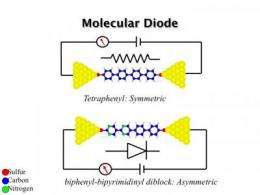
Recently, at Arizona State University's Biodesign Institute, N.J. Tao and collaborators have found a way to make a key electrical component on a phenomenally tiny scale. Their single-molecule diode is described in this week's online edition of Nature Chemistry.
In the electronics world, diodes are a versatile and ubiquitous component. Appearing in many shapes and sizes, they are used in an endless array of devices and are essential ingredients for the semiconductor industry. Making components including diodes smaller, cheaper, faster and more efficient has been the holy grail of an exploding electronics field, now probing the nanoscale realm.
Smaller size means cheaper cost and better performance for electronic devices. The first generation computer CPU used a few thousand transistors, Tao says noting the steep advance of silicon technology. "Now even simple, cheap computers use millions of transistors on a single chip."
But lately, the task of miniaturization has gotten much harder, and the famous dictum known as Moore's law—which states that the number of silicon-based transistors on a chip doubles every 18-24 months—will eventually reach its physical limits. "Transistor size is reaching a few tens of nanometers, only about 20 times larger than a molecule," Tao says. "That's one of the reasons people are excited about this idea of molecular electronics."
Diodes are critical components for a broad array of applications, from power conversion equipment, to radios, logic gates, photodetectors and light-emitting devices. In each case, diodes are components that allow current to flow in one direction around an electrical circuit but not the other. For a molecule to perform this feat, Tao explains, it must be physically asymmetric, with one end capable of forming a covalent bond with the negatively charged anode and the other with the positive cathode terminal.
The new study compares a symmetric molecule with an asymmetric one, detailing the performance of each in terms of electron transport. "If you have a symmetric molecule, the current goes both ways, much like an ordinary resistor," Tao observes. This is potentially useful, but the diode is a more important (and difficult) component to replicate (see figure).
The idea of surpassing silicon limits with a molecule-based electronic component has been around awhile. "Theoretical chemists Mark Ratner and Ari Aviram proposed the use of molecules for electronics like diodes back in 1974," Tao says, adding "people around world have been trying to accomplish this for over 30 years."
Most efforts to date have involved many molecules, Tao notes, referring to molecular thin films. Only very recently have serious attempts been made to surmount the obstacles to single-molecule designs. One of the challenges is to bridge a single molecule to at least two electrodes supplying current to it. Another challenge involves the proper orientation of the molecule in the device. "We are now able to do this—to build a single molecule device with a well defined orientation," Tao says.
The technique developed by Tao's group relies on a property known as AC modulation. "Basically, we apply a little periodically varying mechanical perturbation to the molecule. If there's a molecule bridged across two electrodes, it responds in one way. If there's no molecule, we can tell."
The interdisciplinary project involved Professor Luping Yu, at the University of Chicago, who supplied the molecules for study, as well as theoretical collaborator, Professor Ivan Oleynik from the University of South Florida. The team used conjugated molecules, in which atoms are stuck together with alternating single and multiple bonds. Such molecules display large electrical conductivity and have asymmetrical ends capable of spontaneously forming covalent bonds with metal electrodes to create a closed circuit.
The project's results raise the prospect of building single molecule diodes - the smallest devices one can ever build. "I think it's exciting because we are able to look at a single molecule and play with it, " Tao says. "We can apply a voltage, a mechanical force, or optical field, measure current and see the response. As quantum physics controls the behaviors of single molecules, this capability allows us to study properties distinct from those of conventional devices."
Chemists, physicists, materials researchers, computational experts and engineers all play a central role in the emerging field of nanoelectronics, where a zoo of available molecules with different functions provide the raw material for innovation. Tao is also examining the mechanical properties of molecules, for example, their ability to oscillate. Binding properties between molecules make them attractive candidates for a new generation of chemical sensors. "Personally, I am interested in molecular electronics not because of their potential to duplicate today's silicon applications, " Tao says. Instead, molecular electronics will benefit from unique electronic, mechanical, optical and molecular binding properties that set them apart from conventional semiconductors. This may lead to applications complementing rather than replacing silicon devices.
Source: Arizona State University (news : web)


