Giving cockroaches the slip (w/ Video)
October 13, 2009 Giving cockroaches the slip

(PhysOrg.com) -- A breakthrough by scientists at Cambridge University may terminate the threat of termites, cockroaches and other pests such as ants and locusts - responsible for billions of pounds worth of damage to homes, crops and people's health across the globe each year.

A new type of cheap, durable, non-toxic and environmentally safe coating has been designed by Jan-Henning Dirks, Christofer Clemente and Walter Federle at the University's Department of Zoology.

These surfaces 'trick' insect feet by making them lubricate themselves.

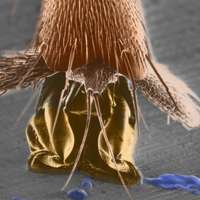
are capable of clinging to almost any natural and artificial substrate by using an emulsion with properties similar to custard or ketchup. They secrete this fluid from pads located on the bottom of their feet.

When studying insect pads in detail, the zoologists discovered that the special surface coating changes the properties of this fluid. As a consequence, the adhesive secretion turns into a lubricant and the insects start slipping, like someone with wet feet in the shower.
Jan-Henning Dirks, who has studied insect adhesion for his PhD, said about the unexpected discovery: "We first came across these surface properties quite by accident, but soon we realised that this could actually be something really useful."

As the video footage of lab tests shows, insects were able to climb with ease a glass rod coated with non-stick PTFE. However, insects trying to reach an apple slice at the top of the glass rod coated with the new material slipped. On the new material, the insects' feet reached on average only about 40% of the friction forces they showed on PTFE.

The University team's surface coating has the potential to restrict the movement of many insects, including , cockroaches, and locusts, providing a novel technique to reduce the devastation, medical problems and economic loss associated with insect . Despite its effectiveness and durability, the new surface coating also leaves insects unharmed.

"We are very excited by the potential of this completely new approach to pest control that has arisen from a basic research project into insect adhesion," said Gillian Davis, Technology Manager at Cambridge Enterprise, the University's commercialisation arm.

"We have patented the technology and are now seeking a commercial partner to work with the inventors to develop the technology.

"Surfaces at risk of infestation both inside and outside the home may benefit from the insect repellent coatings. From crop protection to pest-proof ventilation pipes, furniture and wellingtons, as well as insect-repellent food containers and baby bottles, the practical applications for use are endless - and hugely exciting."

More information: Insect tricks: two-phasic foot pad secretion prevents slipping, http://rsif.royalsocietypublishing.org/content/early/2009/09/14/rsif.2009.0308.abstract

Provided by University of Cambridge (news : web)


print this article email this article download pdf blog this article bookmark this article     Stumble it Digg this share on Facebook retweet share on Reddit add to delicious
Rate this story - 5 /5 (13 votes)

Rank Filter

Move the slider to adjust rank threshold, so that you can hide some of the comments.


Display comments: newest first

  • RayCherry - Oct 13, 2009
    • Rank: 5 / 5 (2)
    cheap, durable, non-toxic and environmentally safe


    The Holy Grail? Insect control without side effects?

    I hope there are a large battery of tests by government and commerce before it hits the distributors. Remember 'cheap and safe' DCT?

    Otherwise, how long before the cockroaches adapt to the new material? Is restricting their movements as effective as restricting their numbers?
  • Caliban - Oct 13, 2009
    • Rank: 5 / 5 (1)
    An interesting development, but it would seem to be impractical- anyone who has lived in a climate that is warm/humid for at least half of the year(with bonus weighting for densely urban) can tell you that roaches, once established, are ubiquitous, and it would require, literally, that every square centimeter of every surface be coated with this compound to prevent roach and ant infestation. Termites are another matter- but I doubt that this compound would be any more effective against them. This also does not take into account the hordes of insects that approach their food of choice via the air.
    I would want to see extensive real-life condition field trials of this before ever putting any stock in its abilitly to deter insect pests.
  • zevkirsh - Oct 13, 2009
    • Rank: not rated yet
    um. youd kill roaches suseptible to this and the mutants that develop resistance survive and pass on the proper genes.
  • Doug_Huffman - Oct 13, 2009
    • Rank: not rated yet
    Residents of Charleston, SC experience both extremes of roach and ant infestation, which is determined by housekeeping habits. I imagine painting all surfaces is less troublesome than cleaning.
  • El_Nose - Oct 14, 2009
    • Rank: not rated yet
    I agree with Caliban - living in a humid near tropical environment we have flying roaches and all types of little bugs that no matter how clean you try to be or are there is always a food source for them, namely mold since it grows on everything that may be a little bit moist and unnoticed.. like persriration off cold water pipes, or dain pipes

October 13, 2009 all stories

Comments: 5

5 /5 (13 votes)
  • Stumble this up

  • Digg this

  • share this

  • hide
  • Related Stories

  • Forest ecologist sees climate consequences
    created Sep 14, 2009 | popularity not rated yet | comments 0
  • Video: Swine flu health tips
    created Apr 30, 2009 | popularity not rated yet | comments 0
  • Stop & Shop Supermarket Chain Goes Hi-Tech
    created Aug 29, 2008 | popularity not rated yet | comments 0
  • Sony to Bring 3D Home in 2010
    created Sep 03, 2009 | popularity not rated yet | comments 0
  • Security Alert: Beware of SMS Messages That Can Take Control of Your Phone
    created Apr 20, 2009 | popularity not rated yet | comments 0


  • hide
  • Relevant PhysicsForums posts

  • Breeding program
    created Nov 20, 2009
  • How does a concentration gradient provide energy?
    created Nov 20, 2009
  • Eyesight and Neural Damage from Electronics
    created Nov 19, 2009
  • Quick question about the Golgi Apparatus?
    created Nov 19, 2009
  • The beginning of humans
    created Nov 18, 2009
  • Omega 3 questions
    created Nov 18, 2009
  • More from Physics Forums - Biology

Other News

Extinct goat Myotragus balearicus

Extinct goat was cold-blooded

Biology / Plants & Animals

created Nov 18, 2009 | popularity 4.9 / 5 (29) | comments 10

(PhysOrg.com) -- An extinct goat that lived on a barren Mediterranean island survived for millions of years by reducing in size and by becoming cold-blooded, which has never before been discovered in mammals.


Bigger not necessarily better, when it comes to brains

Bigger not necessarily better, when it comes to brains

Biology / Plants & Animals

created Nov 17, 2009 | popularity 4.4 / 5 (14) | comments 10

(PhysOrg.com) -- Tiny insects could be as intelligent as much bigger animals, despite only having a brain the size of a pinhead, say scientists at Queen Mary, University of London.


Right-handed chimpanzees provide clues to the origin of human language

Biology / Plants & Animals

created Nov 16, 2009 | popularity 3 / 5 (1) | comments 7

Most of the linguistic functions in humans are controlled by the left cerebral hemisphere. A study of captive chimpanzees at the Yerkes National Primate Research Center (Atlanta, Georgia), reported in the January 2010 issue ...


The creature was found at a depth of 161 metres

Japanese researchers film rare baby fish 'fossil'

Biology / Plants & Animals

created Nov 17, 2009 | popularity 4.7 / 5 (7) | comments 4

Japanese marine researchers said Tuesday they had found and successfully filmed a young coelacanth -- a rare type of fish known as "a living fossil" -- in deep water off Indonesia.


Studies suggest males have more personality

Studies suggest males have more personality

Biology / Plants & Animals

created Nov 18, 2009 | popularity 3.7 / 5 (9) | comments 3

(PhysOrg.com) -- Males have more pronounced personalities than females across a range of species - from humans to house sparrows - according to new research. Consistent personality traits, such as aggression ...