Sky merger yields sparkling dividends
October 13, 2009 Sky merger yields sparkling dividends

Enlarge

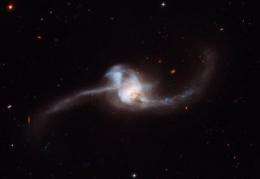
Not surprisingly, interacting galaxies have a dramatic effect on each other. Studies have revealed that as galaxies approach one another massive amounts of gas are pulled from each galaxy towards the center of the other, until ultimately, the two merge into one massive galaxy. NGC 2623 is in the late stages of the merging process, with the centers of the original galaxy pair now merged into one nucleus, but stretching out from the center are two tidal tails of young stars, a strong indicator that a merger has taken place. During such a collision, the dramatic exchange of mass and gases initiates star formation, seen here in both the tails. The prominent lower tail is richly populated with bright star clusters -- 100 of them have been found in these observations. These star clusters may have formed as part of a loop of stretched material associated with the northern tail, or they may have formed from debris falling back onto the nucleus. In addition to this active star-forming region, both galactic arms harbor very young stars in the early stages of their evolutionary journey. Credit: NASA, ESA and A. Evans (Stony Brook University, New York)

(PhysOrg.com) -- Not surprisingly, interacting galaxies have a dramatic effect on each other. Studies have revealed that as galaxies approach one another massive amounts of gas are pulled from each galaxy towards the centre of the other, until ultimately, the two merge into one massive galaxy. The object in the image, NGC 2623, is in the late stages of the merging process with the centres of the original galaxy pair now merged into one nucleus. However, stretching out from the centre are two tidal tails of young stars showing that a merger has taken place. During such a collision, the dramatic exchange of mass and gases initiates star formation, seen here in both the tails.

The prominent lower tail is richly populated with bright star clusters — 100 of them have been found in these observations. The large star clusters that the team have observed in the merged galaxy are brighter than the brightest clusters we see in our own vicinity. These star clusters may have formed as part of a loop of stretched material associated with the northern tail, or they may have formed from debris falling back onto the nucleus. In addition to this active star-forming region, both galactic arms harbour very in the early stages of their evolutionary journey.

Some mergers (including NGC 2623) can result in an active galactic nucleus, where one of the supermassive black holes found at the centres of the two original galaxies is stirred into action. Matter is pulled toward the black hole, forming an accretion disc. The energy released by the frenzied motion heats up the disc, causing it to emit across a wide swath of the electromagnetic spectrum.

NGC 2623 is so bright in the infrared that it belongs to the group of very luminous infrared galaxies (LIRG) and has been extensively studied as the part of the Great Observatories All-sky LIRG Survey (GOALS) project that combines data from some of the most advanced space-based telescopes, including Hubble. Additional data from infrared and X-ray telescopes can further characterise objects like active galactic nuclei and nuclear by revealing what is unseen at visible wavelengths.
Sky merger yields sparkling dividends
Enlarge

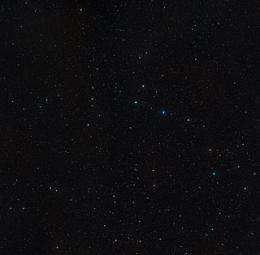
A wide-field image of the region around NGC 2623 constructed from Digitized Sky Survey 2 images. The field of view is approximately 3.0 degrees x 3.0 degrees. Credit: NASA, ESA and the Digitized Sky Survey 2. Acknowledgment: Davide De Martin (ESA/Hubble)

The GOALS project includes data from NASA/ESA's Hubble Space Telescope, NASA's Spitzer Space Telescope, NASA's Chandra X-ray Observatory and NASA's Galaxy Evolution Explorer (GALEX). The joint efforts of these powerful observing facilities have provided a clearer picture of our local Universe.

This data used for this colour composite were taken in 2007 by the Advanced Camera for Surveys (ACS) aboard Hubble. The observations were led by astronomer Aaron S. Evans. A team of over 30 astronomers, including Evans, recently published an important overview paper, detailing the first results of the GOALS project. Observations from ESA's X-ray Multi-Mirror Mission (XMM-Newton) telescope contributed to the astronomers' understanding of NGC 2623.

Source: ESA/Hubble Information Centre (news : web)


print this article email this article download pdf blog this article bookmark this article     Stumble it Digg this share on Facebook retweet share on Reddit add to delicious
Rate this story - 4.7 /5 (3 votes)

Rank Filter

Move the slider to adjust rank threshold, so that you can hide some of the comments.


Display comments: newest first


October 13, 2009 all stories

Comments: 1

4.7 /5 (3 votes)
  • Stumble this up

  • Digg this

  • share this

  • hide
  • Related Stories

  • Hubble's view of barred spiral galaxy NGC 1672
    created Apr 03, 2007 | popularity not rated yet | comments 0
  • Survey Reveals Building Block Process For Biggest Galaxies
    created Apr 12, 2006 | popularity not rated yet | comments 0
  • Colliding galaxies make love, not war
    created Oct 17, 2006 | popularity not rated yet | comments 0
  • Building-block process in evolution of massive galaxy clusters revealed
    created Apr 05, 2006 | popularity not rated yet | comments 0
  • Hubble sees the graceful dance of 2 interacting galaxies
    created Oct 30, 2007 | popularity not rated yet | comments 0


  • hide
  • Relevant PhysicsForums posts

  • basic 'our universe' question..
    created 10 hours ago
  • deriving keplers law
    created Nov 19, 2009
  • rotation of Earth
    created Nov 18, 2009
  • elliptical orbits
    created Nov 18, 2009
  • More from Physics Forums - General Astronomy

Other News

Cassini's Big Sky: The View from the Center of Our Solar System

Cassini's Big Sky: The View from the Center of Our Solar System

Space & Earth / Space Exploration

created 19 hours ago | popularity 4.7 / 5 (10) | comments 1

(PhysOrg.com) -- When NASA's Cassini spacecraft began orbiting Saturn five years ago, a dozen highly-tuned science instruments set to work surveying, sniffing, analyzing and scrutinizing the Saturnian system.


Some 6,000 families were affected by the drought in the Chaco region of Paraguay, particularly indigenous populations

El Nino intensifies Latin America drought

Space & Earth / Earth Sciences

created 21 hours ago | popularity 5 / 5 (2) | comments 0

From a devastating food crisis in Guatemala to water cuts in Venezuela, El Nino has compounded drought damage across Latin America this year.


More than 18 million cubic metres of sand are set to be poured onto the new coastal band of dunes until 2011

Dutch build more dunes against rising seas

Space & Earth / Environment

created 14 hours ago | popularity 3.7 / 5 (3) | comments 0

On the beach at Monster, bulldozers painstakingly turn sand dredged from the bottom of the North Sea bed into dunes in an ambitious effort to safeguard the Netherlands from flooding.


New Method to Measure Snow, Soil Moisture With GPS May Benefit Meteorologists, Farmers

Space & Earth / Earth Sciences

created 14 hours ago | popularity not rated yet | comments 1

(PhysOrg.com) -- A research team led by the University of Colorado at Boulder has found a clever way to use traditional GPS satellite signals to measure snow depth as well as soil and vegetation moisture, a technique expected ...


Astronauts await word of baby girl on Earth (AP)

Astronauts await word of baby girl on Earth

Space & Earth / Space Exploration

created 15 hours ago | popularity 5 / 5 (1) | comments 0

(AP) -- Atlantis' astronauts anxiously awaited word on the birth of one crewman's daughter Friday, as they moved more supplies into the International Space Station and geared up for another spacewalk.