Researcher hunts for new planets, seeking clues on solar system's origin
October 13, 2009 By Anne Ju Jamie Lloyd on the lookout for exoplanets

Enlarge

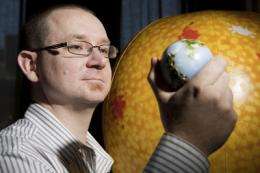
Jamie Lloyd searches for Earthlike, extrasolar planets orbiting small, red stars. In this picture, the size of the "star" and the "planet," as well as the distance between them, are approximately to scale. Our sun is about 10 times larger than the stars Lloyd studies. Image: Lindsay France

(PhysOrg.com) -- The Cornell assistant professor of astronomy works on instrumentation that searches the night skies for planets outside our solar system, called extrasolar planets.

Somewhere in the galaxy, a rocky, blue-green planet like Earth, teeming with oxygen, water and life, might be orbiting its own sun. Jamie Lloyd wants to find it.

The Cornell assistant professor of astronomy works on instrumentation that searches the night skies for planets outside our , called extrasolar planets or exoplanets. So far, about 370 exoplanets have been discovered, and more might lead to hints about the origins of our solar system.

"We don't know whether our solar system is an incredibly rare configuration, or an incredibly common configuration," said Lloyd, who joined the Cornell faculty in 2004. "And that has a profound implication for how much life there might be out there in the universe."

An experimental astrophysicist who has spent time in Chicago, California and at the South Pole, Lloyd develops instruments to search for new kinds of planets -- ones with a hard surface, like ours, called terrestrial planets, and ones that exist in the so-called , the distance from a star in which life could be possible.

Up until recently, none of the known exoplanets were terrestrial -- most are gas giants, like Jupiter and Saturn. But in recent weeks, a French-led team of scientists announced the discovery of the first confirmed rocky exoplanet, named CoRoT-7b. Calling this planet "Earthlike," however, would be a stretch, Lloyd said.

"This is a , but it's nothing like the Earth," Lloyd explained. It orbits so closely to its star that its surface is a molten lava lake of 3,600 degrees Fahrenheit, and molten rock and lava rain from the sky. Not exactly a habitable environment, at least by Earth's standards. But if a planet like CoRoT-7b were to be found orbiting a less massive, less luminous star -- the kind that interests Lloyd -- life on it would certainly be possible, he said.

Nearly all the known exoplanets, including CoRoT-7b, have been detected indirectly with a technique called precision Doppler spectroscopy, in which scientists infer the existence of a planet by observing the motion of the parent star through the Doppler effect on the star's light.

One of Lloyd's major projects focuses on an advanced form of the indirect measurement of exoplanets using an instrument called the Triple Spec Discovery Instrument (TEDI). Built at Cornell, the spectrometer is attached now to the Mount Palomar 200-Inch Hale Telescope operated by the California Institute of Technology. The project is funded by the National Science Foundation.

TEDI will allow scientists to detect planets that orbit red stars, which cannot be measured with existing Doppler technology. These stars, Lloyd said, are interesting because they have less mass than the already-discovered sunlike stars with exoplanets. Thus, red stars would be "pulled around" much more easily by the mass of its orbiting planet.

Having a low-mass star orbited by a higher-mass planet has advantages for detection. If the planet passes in front of a relatively small star, the planet would block a lot of the star, so the planet would be easier to see.

"We still have a lot of work to do to find an Earthlike planet," Lloyd said. "But there is tremendous focus worldwide on searching for habitable planets orbiting red stars. It is only a matter of time before we find one."

Provided by Cornell University (news : web)


print this article email this article download pdf blog this article bookmark this article     Stumble it Digg this share on Facebook retweet share on Reddit add to delicious
Rate this story - 3 /5 (2 votes)

Rank Filter

Move the slider to adjust rank threshold, so that you can hide some of the comments.


Display comments: newest first

  • omatumr - Oct 13, 2009
    • Rank: 1 / 5 (1)
    Jamie Lloyd may want to read Nature Phys. Sci. 240, 99-101 (1972), Transactions of Missouri Acad. Sci. 9, 104-122 (1975), Science 195, 208-209 (1977), Nature 277, 615-620 (1979).

    With kind regards,
    Oliver K. Manuel

October 13, 2009 all stories

Comments: 1

3 /5 (2 votes)
  • Stumble this up

  • Digg this

  • share this

  • hide
  • Related Stories

  • Scientists discover new planet orbiting dangerously close to giant star
    created Nov 18, 2008 | popularity not rated yet | comments 0
  • Team finds smallest transiting extrasolar planet ever
    created Feb 03, 2009 | popularity not rated yet | comments 0
  • Wobbly planets could reveal Earth-like moons
    created Dec 11, 2008 | popularity not rated yet | comments 0
  • Scientists discover a nearly Earth-sized planet (Update)
    created Apr 21, 2009 | popularity not rated yet | comments 0
  • Mass Loss Leaves Close-In Exoplanets Exposed to the Core
    created Apr 21, 2009 | popularity not rated yet | comments 0


  • hide
  • Relevant PhysicsForums posts

  • Sideral question
    created 15 hours ago
  • Doppler shifted blackbody spectrum
    created 17 hours ago
  • Earth v. Moon
    created 20 hours ago
  • help me with coordinates and orbits
    created 20 hours ago
  • More from Physics Forums - General Astronomy

Other News

Astronauts finish another spacewalk, still no baby (AP)

Astronauts finish another spacewalk, still no baby

Space & Earth / Space Exploration

created 6 hours ago | popularity 3 / 5 (2) | comments 0

(AP) -- A spacewalking astronaut put aside the impending birth of his daughter and blazed through his first-ever venture outside the International Space Station on Saturday.


Unseasonably hot and dry weather combined with strong winds to fan scores of blazes in the country's southeastern states

Australia issues 'catastrophic' alerts as fires rage

Space & Earth / Environment

created 12 hours ago | popularity 4.5 / 5 (2) | comments 0

Australia has issued "catastrophic" alerts after record-breaking temperatures and wild lightning storms sparked more than 100 fires across the country, officials said Saturday.


Commuters wait on the platform shrouded by fog in London

Climate change not man-made, say majority of Britons: poll

Space & Earth / Environment

created Nov 15, 2009 | popularity 3.3 / 5 (15) | comments 45

Less than half of Britons believes that human activity is to blame for global warming, according to a poll carried out for The Times newspaper and published on Saturday.


Mysteriously warm times in Antarctica

Mysteriously warm times in Antarctica

Space & Earth / Earth Sciences

created Nov 18, 2009 | popularity 4.2 / 5 (21) | comments 28

(PhysOrg.com) -- A new study of Antarctica's past climate reveals that temperatures during the warm periods between ice ages (interglacials) may have been higher than previously thought. The latest analysis ...


UN: Fight climate change with free condoms (AP)

UN: Fight climate change with free condoms

Space & Earth / Environment

created Nov 18, 2009 | popularity 3.1 / 5 (11) | comments 23

(AP) -- The battle against global warming could be helped if the world slowed population growth by making free condoms and family planning advice more widely available, the U.N. Population Fund said Wednesday.