Professor uses video games to explore facets of autism
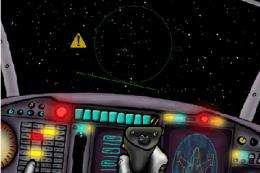
(PhysOrg.com) -- Matthew Belmonte, assistant professor of human development, is looking for order behind the many behavioral and physiological features of autism.
One of the hallmarks of autism is a need to find order, or to try to create it, in a world that can often seem chaotic and disorganized.
But for researchers trying to understand the disorder, which can affect perception, cognition, social and motor skills, communication and other domains, autism itself can seem incoherent and enigmatic.
Matthew Belmonte, assistant professor of human development and a 2009 recipient of the National Science Foundation's Faculty Early Career Development Award, is using a novel tool -- a suite of science-fiction-themed video games he developed with collaborators in computer sciences -- to find order behind the range of autism's manifestations.
Belmonte's NSF Early Career award, of $700,000 over five years, is funded through the American Recovery and Reinvestment Act (ARRA). Development of the video game suite, called Astropolis, was supported in part by a grant from Autism Speaks.
Unlike much of the current research on autism, which isolates and tests a single domain, Belmonte designed the user-friendly video games with embedded tasks that test users -- children with autism or Asperger syndrome ages 10 to 15, along with their unaffected siblings -- across multiple domains.
"Autism has been characterized as a fundamental perceptual abnormality; it's been characterized as a fundamental attentional abnormality; it's been characterized as a failure of theory-of-mind," he said. "We each have our individual pet theories, and we each -- me included -- have designed experiments within these narrow theoretical apertures to confirm or refute hypotheses that are stated along our single tracks."
In this experiment, he hopes to find links between social and nonsocial theories; and between behavioral and physiological data.
He also hopes to sidestep a confounding factor common to autism research. "When we look at people with autism in a lab, it's not clear that we're testing them under naturalistic conditions, because one of the hallmarks of autism is very high levels of anxiety -- anxiety with new people, and anxiety with new places," he said.
As a consequence, researchers often can't be sure if their findings are due to autism itself or simply heightened anxiety.
Belmonte gets around that by giving the games to subjects on laptops to take home and play at their own pace. While the subjects grapple with asteroids, pilot spacecrafts, intercept pirates and salvage hidden cargo, the computer logs how rapidly they shift attention and engage or inhibit motor responses; how well they perceive coherent motion; and whether they can intuit the motivations of other characters.
After the subjects are comfortable with the game on their own, Belmonte uses electroencephalography (EEG) in the lab to measure patterns in neural connectivity as they play.
Earlier research has shown that while autistic children and their unaffected siblings share some physiological traits, including frontal lobes that are slower to activate, the overall patterns of neural connectivity are weaker in autistic children compared with their unaffected siblings. "We're going to be looking at that in much larger numbers now using EEG," Belmonte said.
The project's broad, multivariate scope is part of an emerging trend in autism research, he said. "The field is starting to recognize that you need to do this correlative cross-domain work to figure out what's developmentally related."
In the 20th century, neurobiologists had success tackling problems tied to a circumscribed brain region, he added. "We're now left with the hard problems, in which the deficit is not so much in one localized region, but in the network and the way brain regions talk to each other to implement complex functions."
Along with the technical and administrative costs of the research, the ARRA grant funds one full-time research assistant in Belmonte's lab. Several undergraduates are also involved in the project.
Shared perception lends insight, motivation
Like many autism researchers, Belmonte often fields questions from concerned parents about when there will be a treatment, or a cure.
For Belmonte, though, the question is personal. His older brother has autism, and his niece was recently diagnosed with the disorder. He is optimistic about the prospects for a treatment in the coming decades -- but also acutely aware that for many it will not come soon enough.
Still, Belmonte didn't always know he would study autism as a career. Along with neuroscience, he holds degrees in computer science, literature and creative writing.
He entered autism research in part to answer a more universal question: how the human mind, with or without autism, tries to find or impose order on the world.
"I'd always been fascinated by order and regularity," he said; and as a child, he shared that fascination with his brother.
"There was always a certain empathy between me and my brother. It was always clear to me, even since before I had words for it, that he and I thought in the same way and saw the same things," he said.
"We were both very, very focused on detail -- everyday things, like the way dust motes swirl in the sunbeam when you wave your hand; the rise and fall of shadows under streetlights as you move at a constant velocity along the street. He and I both were very pleased by things like that, because they gave a certain sense of order to the world. He didn't speak, but we didn't really need words to understand this. It was clear that we both got it."
It was also clear that his brother understood more than he could communicate.
"I think in some ways, the major difference between me and my brother ... is that I had spoken language and he did not; and that allowed me to communicate and to think in ways that he could not," Belmonte said.
"I was able to go out looking for those ordering principles, whereas he had more to inject order into the world around him with repetitive behaviors. So there is a very strong sense there, that there but for the grace of God, go I. I do all this [research], and he spends time flapping his hand or flicking a light switch, and it all really boils down to the same motivation."
Provided by Cornell University (news : web)


