Like humans, monkeys fall into the 'uncanny valley'
October 13, 2009 by Kitta MacPherson
Like humans, monkeys fall into the 'uncanny valley'

Enlarge

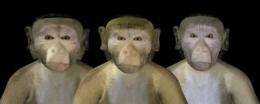
Realistic-looking robots and computer avatars often spur negative responses in humans. Princeton University scientists showed monkeys these computer-generated images of monkeys and saw a similar response. Monkeys, they found, also are unsettled by images that are realistic but synthetic, a response known as the "uncanny valley" effect. Credit: Courtesy of Shawn Steckenfinger

(PhysOrg.com) -- Princeton University researchers have come up with a new twist on the mysterious visual phenomenon experienced by humans known as the "uncanny valley." The scientists have found that monkeys sense it too.

The uncanny valley, a phrase coined by a Japanese researcher nearly three decades ago, describes that disquieting feeling that occurs when viewers look at representations designed to be as human-like as possible -- whether computer animations or androids -- but somehow fall short.

Movie-goers may not be familiar with the term, but they understand that it is far easier to love the out-of-proportion cartoon figures in the "The Incredibles," for example, than it is to embrace the more realistic-looking characters in "The Polar Express." Viewers, to many a Hollywood director's consternation, are emotionally unsettled by images of artificial humans that look both realistic and unrealistic at the same time.

In an attempt to add to the emerging scientific literature on the subject and answer deeper questions about the evolutionary basis of communication, Princeton University researchers have found that macaque monkeys also fall into the uncanny valley, exhibiting this reaction when looking at computer-generated images of monkeys that are close but less than perfect representations.

"Increased realism does not necessarily lead to increased acceptance," said Asif Ghazanfar, an assistant professor of psychology and the Princeton Neuroscience Institute, who led the research. It is the first such finding in any animal other than human. The paper, co-written by Shawn Steckenfinger, a research specialist in the Princeton's Department of Psychology, appears in the October Oct. 12 edition of the .

The work, according to its authors, is significant because it indicates that there is a biological basis for the uncanny valley and supports theories that propose that the brain mechanisms underlying the uncanny valley are evolutionary adaptations. "These data demonstrate that the uncanny valley effect is not unique to humans and that evolutionary hypotheses regarding its origins are tenable," said Ghazanfar.

The uncanny valley hypothesis was introduced by the Japanese roboticist Masahiro Mori in 1970. The "valley" refers to a dip in a graph that charts a human's positive reaction in response to an image on one axis and a robot's human-likeness on another. People like to study other human faces, and they also can enjoy scrutinizing countenances that clearly are not human, such as a doll's or a cartoon figure's. But when an image falls in between -- close to human but clearly not -- it causes a feeling of revulsion.

Experts praised the Princeton report.

"This study makes a significant contribution to existing knowledge of the uncanny valley," said Karl MacDorman, an associate professor in the School of Informatics at Indiana University, who has led important experiments in the fields of android science and computational neuroscience. "The research design is novel, the experiment is carried out with a high degree of rigor, and the results are compelling, important, newsworthy, and support the [hypothesis]."

He believes the results will be of broad interest to scientists and non-scientists, including "ethologists, animal behaviorists, cognitive psychologists of human perception, evolutionary psychologists, primate social cognitive neuroscientists, humanoid roboticists and human character animators."

In the experiments, the monkeys, which normally coo and smack their lips to engage each other, quickly avert their glances and are frightened when confronted by the close-to-real images. When asked to peer at the less close-to-real faces and real faces, however, they viewed them more often and for longer periods.

Despite the widespread acknowledgement of the uncanny valley as a valid phenomenon, there are no clear explanations for it, Ghazanfar said. One theory suggests that it is the outcome of a "disgust response" mechanism that allows humans to avoid disease. Another idea holds that the phenomenon is an indicator of humanity's highly evolved face processing abilities. Some have suggested the corpse-like appearance of some images elicits an innate fear of death. Still others have posited that the response illustrates what is perceived as a threat to human identity.

Ghazanfar said the research is likely to point him in useful directions to further explore these theories.

Source: Princeton University

4.4 /5 (18 votes)  

Filter


Move the slider to adjust rank threshold, so that you can hide some of the comments.


Display comments: newest first

SmartK8
Oct 14, 2009

Rank: 5 / 5 (1)
Needless to say, those apes give me the creeps also. Not sure if that fact makes me a monkey, but maybe they should try to give them a more friendly face, while still keeping them not quite real. Those presented here, their faces read: "We are going to kill you all!" Apparently.
Rank 4.4 /5 (18 votes)
Relevant PhysicsForums posts
  • Factors affecting beet root cell membrane
    created7 hours ago
  • Stem cell question.
    createdFeb 10, 2012
  • Protease cleavage
    createdFeb 10, 2012
  • Pertubance in a model
    createdFeb 10, 2012
  • Cancer drugs and Alzheimer's, Oh my!
    createdFeb 09, 2012
  • Squishing cells
    createdFeb 09, 2012
  • More from Physics Forums - Biology

More news stories

A mitosis mystery solved: How chromosomes align perfectly in a dividing cell

Although the process of mitotic cell division has been studied intensely for more than 50 years, Whitehead Institute researchers have only now solved the mystery of how cells correctly align their chromosomes during symmetric ...

Biology / Cell & Microbiology

created 2 hours ago | popularity 5 / 5 (3) | comments 0 | with audio podcast

The proteins ensuring genome protection

Researchers from the University of Geneva (UNIGE), Switzerland, have discovered the crucial role of two proteins in developing a cell 'anti-enzyme shield'. This protection system, which operates at the level of molecular ...

Biology / Cell & Microbiology

created 2 hours ago | popularity 5 / 5 (2) | comments 0 | with audio podcast

Researchers find extensive RNA editing in human transcriptome

In a new study published online in Nature Biotechnology, researchers from BGI, the world's largest genomics organization, reported the evidence of extensive RNA editing in a human cell line by analysis of RNA-seq data, demons ...

Biology / Biotechnology

created 2 hours ago | popularity 5 / 5 (3) | comments 0 | with audio podcast

Entire genome of extinct human decoded from fossil

(PhysOrg.com) -- In 2010, Svante Pääbo and his colleagues presented a draft version of the genome from a small fragment of a human finger bone discovered in Denisova Cave in southern Siberia. The ...

Biology / Biotechnology

created Feb 07, 2012 | popularity 4.7 / 5 (58) | comments 48 | with audio podcast

Why are there so few fish in the Earth's oceans?

(PhysOrg.com) -- A Stony Brook University researcher has found that, contrary to popular belief, there are not plenty of fish in the sea.

Biology / Plants & Animals

created Feb 08, 2012 | popularity 4.3 / 5 (17) | comments 27 | with audio podcast


Scientists discover molecular secrets of 2,000-year-old Chinese herbal remedy

For roughly two thousand years, Chinese herbalists have treated Malaria using a root extract, commonly known as Chang Shan, from a type of hydrangea that grows in Tibet and Nepal. More recent studies suggest that halofuginone, ...

New method to examine batteries -- MRI from the inside

There is an ever-increasing need for advanced batteries for portable electronics, such as phones, cameras, and music players, but also to power electric vehicles and to facilitate the distribution and storage of energy derived ...

Google might launch Drive for cloud storage soon

(PhysOrg.com) -- Google's next big move, according to the Wall Street Journal, is a cloud storage service called Drive. Hardly first to the plate, Google is simply catching up to introducing its cloud reposi ...

Lab study raises questions over nano-particle impact

Tests involving chickens have raised questions about the impact on health from engineered nano-particles, the ultra-fine grains commonly used in drugs and processed foods, scientists said on Sunday.

Starve a virus, feed a cure? Findings show how some cells protect themselves against HIV

A protein that protects some of our immune cells from the most common and virulent form of HIV works by starving the virus of the molecular building blocks that it needs to replicate, according to research published online ...

Injured boomers beware: Know when to see doctor

(AP) -- It happened to nurse Jane Byron years after an in-line skating fall, business owner Haralee Weintraub while doing "men's" push-ups, and avid cyclist Gene Wilberg while lifting a heavy box.