Tropical Storm Nepartak becoming extra-tropical at sea
October 13, 2009 Tropical Storm Nepartak becoming extra-tropical at sea

Enlarge

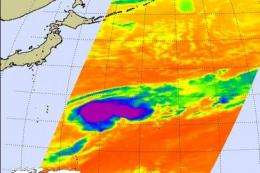
NASA's AIRS imagery revealed that Nepartak had some high, strong thunderstorms in the center of its circulation on Oct. 12 at 11:35 a.m. EDT. The storm started to develop an elongated shape indicating transition into more of a frontal system. Credit: NASA JPL, Ed Olsen

Tropical Storm Nepartak is now speeding in a northeasterly direction in the northwestern Pacific Ocean, where it is becoming extra-tropical and developing frontal qualities.

The last official position of Napartak from the U.S. Navy's Joint Warning Center was on October 13 at 6 a.m. EDT, when the storm was 605 nautical miles east-northeast of the island of Chichi Jima, Japan. That's near 31.5 North and 154.3 East. Nepartak was speeding to the northeast at 33 mph (29 knots) and it had maximum sustained winds near 46 mph (40 knots).

Animated multispectral imagery showed Nepartak was beginning to develop frontal characteristics, which is a sign that the circulation will soon fade. Before it becomes a front, however, it is expected to continue transitioning into an extra-tropical storm, and dry air in the mid-levels of the atmosphere is helping that happen.

The Atmospheric Infrared Sounder (AIRS) flies on NASA's Aqua satellite and captures infrared images of tropical cyclones take the temperatures of thunderstorm's cloud top temperatures to determine their strength. Aqua and AIRS flew over Nepartak on October 12 at 11:35 a.m. EDT, and noticed that the was already starting to take on an elongated shape, indicating a transition to more of a frontal system.

How does infrared imagery know how high clouds are in the sky? The coldest ones are higher in the sky (because in the , the lowest layer of where weather happens, temperatures fall the higher up you go until you get to the stratosphere).

The highest clouds are as cold as or colder than 220 Kelvin or minus 63 degrees Fahrenheit (F) and second highest level of clouds are about 240 Kelvin, or minus 27F. The colder the are, the higher they are, and the more powerful the thunderstorms are that make up the cyclone. Although Nepartak still had some strong convection, it is expected to wane soon with the transition into extra-tropical status. Nepartak is forecast to continue speeding northeast in the next day or two, when the transition should be complete and Nepartak will be no more.

Source: JPL/NASA (news : web)


print this article email this article download pdf blog this article bookmark this article     Stumble it Digg this share on Facebook retweet share on Reddit add to delicious
Rate this story - not rated yet


October 13, 2009 all stories

Comments: 0

not rated yet
  • Stumble this up

  • Digg this

  • share this

  • hide
  • Related Stories

  • A sudden Tropical Storm Grace explodes in far Eastern Atlantic
    created Oct 05, 2009 | popularity not rated yet | comments 0
  • NASA sees Tropical Storm Danny form, US East Coast on watch
    created Aug 26, 2009 | popularity not rated yet | comments 0
  • Ana's path being mapped by NASA Satellites; she's drenching Puerto Rico
    created Aug 17, 2009 | popularity not rated yet | comments 0
  • NASA's Aqua satellite catches 2 views of super Typhoon Choi-Wan
    created Sep 17, 2009 | popularity not rated yet | comments 0
  • Typhoon Choi-Wan swinging by Japan on weekend
    created Sep 18, 2009 | popularity not rated yet | comments 0


  • hide
  • Relevant PhysicsForums posts

  • Climate Science Update
    created 11 hours ago
  • The IPCC and the term "most"
    created Nov 23, 2009
  • Is global warming a fact?
    created Nov 23, 2009
  • Random variability of wind patterns
    created Nov 23, 2009
  • More from Physics Forums - Earth

Other News

Fermi Telescope Peers Deep into Microquasar

Fermi Telescope Peers Deep into Microquasar (w/ Video)

Space & Earth / Astronomy

created 7 hours ago | popularity 4.5 / 5 (4) | comments 0

(PhysOrg.com) -- NASA's Fermi Gamma-ray Space Telescope has made the first unambiguous detection of high-energy gamma-rays from an enigmatic binary system known as Cygnus X-3. The system pairs a hot, massive ...


The Energy Sources of Ultraluminous Galaxies

The Energy Sources of Ultraluminous Galaxies

Space & Earth / Astronomy

created 8 hours ago | popularity 4.4 / 5 (8) | comments 0

(PhysOrg.com) -- Ultraluminous infrared galaxies ((ULIRGs) are galaxies whose luminosity exceeds that of a trillion suns; for comparison, the Milky Way galaxy has a typical (and much more modest) luminosity ...


Space shuttle Atlantis, 7 astronauts back on Earth (AP)

Space shuttle Atlantis, 7 astronauts back on Earth

Space & Earth / Space Exploration

created 9 hours ago | popularity not rated yet | comments 0

(AP) -- Space shuttle Atlantis and its seven astronauts returned to Earth with a smooth touchdown Friday to end an 11-day flight that resupplied the International Space Station.


Herschel takes a peek at the ingredients of the galaxies

Herschel takes a peek at the ingredients of the galaxies

Space & Earth / Astronomy

created 6 hours ago | popularity 5 / 5 (1) | comments 0

(PhysOrg.com) -- The European Space Agency has today released spectacular new observations from the Herschel Space Observatory, including the UK-led SPIRE instrument. Spectrometers on board all three Hershel ...


China is set to launch its second moon orbiter next October, state media have reported

China to launch second lunar probe: state media

Space & Earth / Space Exploration

created 13 hours ago | popularity 5 / 5 (3) | comments 0

China will launch its second moon orbiter next October, state media reported Friday, as it powers ahead with a space programme that has sparked concerns abroad.