Scientist increase the efficiency of a type of solar cell by incorporating ionic salts
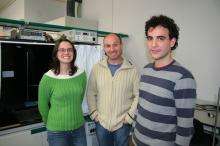
A group of scientists are working on the optimisation of a type of photovoltaic cell (Grätzel cell) that artificially mimics photosynthesis.
Within the Consolider HOPE project (projects funded by the Ministry of Innovation and Science), a group of scientists at Universidad Pablo de Olavide (UPO), headed by Juan Antonio Anta, are working on the optimisation of a type of photovoltaic cell (Grätzel cell) that artificially mimics photosynthesis.
Grätzel cells are photovoltaic devices that take advantage of the interaction of a structured semiconductor less than nanometre in size and an organic dye that acts as a solar collector.
According to Elena Guillén, member of UPO's Coloides y Celdas Solares Nanoestructuradas (Nanostructured Colloids and Solar Cells) Group, this dye can be either synthetic or natural and can even enable the use of chlorophyll for this type of cell.
Thus, researchers at UPO have begun a study with which they hope to increase the efficiency of these eosin or mercurochrome -based organic components by incorporating ionic salts, known as green solvents, with a view to preventing evaporation of the liquid compounds and the consequent reduction in efficiency.
Previous studies show that ionic salts are less volatile and it is this characteristic that the group headed by Professor Anta seeks to exploit. "Notwithstanding its liquid state, these types of solvents have high viscosity levels and, therefore, during the coming months we will continue our study, working on different alternatives within ionic liquids, their synthesis, etc.," comments Elena Guillén.
The pros and cons of the new generation
Although there are already some third generation cells on the market (for example, for recharging mobile phones), according to the researchers their practical use is anecdotal. However, due to their properties of flexibility and variety of colours and shapes, the future of these cells lies in new market niches such as decoration or use in coloured windows that not only allow light through but use this light to generate electricity.
On the other hand, apart from the rapid amortisation of energy production costs -estimated in one year's use-, there is also the low cost of the materials. "Organic materials are usually cheaper," affirms the researcher, despite which the search continues for an alternative organic dye to the one currently used, derived from ruthenium.
"The paradox lies in the fact that if one uses these cells because their competitive edge is that they are cheaper and more readily available, and then one uses a dye based on a precious metal, what is the advantage?" points out Elena Guillén.
On the other hand, the researchers are aware that it is a relatively new technology -this type of cell was invented in 1991- that still need to be greatly developed. Furthermore, the maximum efficiency obtained in laboratory is only 11%, which is competitive but it drops when extrapolated to an industrial scale.
The main technological challenge is currently the problem of cell degradation. "If you use an organic dye, it can be degraded by the action of sunlight, with the consequent reduction in useful life compared to silicon cells. On the other hand," the researcher highlights, "our group is working on one of the key aspect for improving cell stability - elimination of the need to use liquids that can present problems with evaporation, etc. and for which, as already mentioned, our focus is on the use of ionic salts."
Source: Andalucía Innova, via AlphaGalileo


