Building Up Broken Bones
October 14, 2009 Building Up Broken Bones

Enlarge

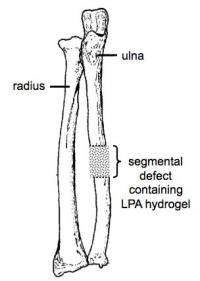
Surgical implantation of an LPA-hydrogel into a bone defect.

(PhysOrg.com) -- Any one of the 8 million Americans who suffer bone fractures each year knows how hard it is to wait for the bones to knit, or heal. Bone healing is also important for integration of dental implants for people with missing or damaged teeth.

A research team at Pacific Northwest National Laboratory is addressing these issues by developing safe, effective and inexpensive implant materials to promote bone regeneration. And the team was recently awarded a grant from Washington State's Life Sciences Discovery Fund (LSDF) to test them.

Dr. Norman Karin, a biologist at PNNL, has identified a lipid growth factor called lysophosphatidic acid (LPA) that promotes bone healing in preclinical models with no apparent toxicity. "LPA can be manufactured for a fraction of the cost of currently available bone healing stimulators," he said.

PNNL's project is titled "A Cost-effective Hydrogel-growth Factor Complex to Improve Bone Healing." It will combine LPA with hydrogels as injectable orthopedic and dental implant materials to stimulate . This approach could also lead to advanced technologies of interest to the military.

The research team will embed this growth factor in proprietary hydrogels to create an implant that will release the growth factor in a controlled fashion. In collaboration with Washington State University, the researchers will then test the ability of the implants to stimulate bone regeneration in experimental animals. If successful, the investigators will continue to develop and pursue commercial licensing of the implants for both human and veterinary clinical use. PNNL recently filed a patent on the use of this growth factor-hydrogel complex for the stimulation of bone healing.

The LSDF was established in 2005 to support research in and promote life sciences competitiveness, enhance economic vitality, and improve health and health care of state citizens. PNNL's proposal was one of six that received an award.

Karin is the principal investigator in this 3-year, $1.03 million program. His research team includes PNNL colleagues Drs. Wendy Shaw and Barbara Tarasevich, and Dr. Steven Martinez, a veterinary surgeon at WSU.

Provided by PNNL


print this article email this article download pdf blog this article bookmark this article     Stumble it Digg this share on Facebook retweet share on Reddit add to delicious
Rate this story - 4 /5 (3 votes)


October 14, 2009 all stories

Comments: 0

4 /5 (3 votes)
  • Stumble this up

  • Digg this

  • share this

  • hide
  • Related Stories

  • Carbon Nanotubes Help Fix Bones
    created Mar 14, 2008 | popularity not rated yet | comments 0
  • Hydrogels provide scaffolding for growth of bone cells
    created Aug 17, 2008 | popularity not rated yet | comments 0
  • Crowning glory: Bonelike coating for dental implants makes everyone smile
    created Apr 04, 2008 | popularity not rated yet | comments 0
  • Porous structures help boost integration of host tissue with implants, study finds
    created Jan 30, 2008 | popularity not rated yet | comments 0
  • New biomedical device uses nanotechnology to monitor hip implant healing
    created Oct 18, 2006 | popularity not rated yet | comments 0


  • hide
  • Relevant PhysicsForums posts

  • Goddard
    created 11 hours ago
  • Rate Laws
    created 12 hours ago
  • why oxygen, cannot act as a pi-donor while NO can?
    created Nov 20, 2009
  • Aspirin
    created Nov 19, 2009
  • More from Physics Forums - Chemistry

Other News

Accidental discovery produces durable new blue pigment for multiple applications

Accidental discovery produces durable new blue pigment for multiple applications

Chemistry / Biochemistry

created Nov 16, 2009 | popularity 4.5 / 5 (30) | comments 6

An accidental discovery in a laboratory at Oregon State University has apparently solved a quest that over thousands of years has absorbed the energies of ancient Egyptians, the Han dynasty in China, Mayan ...


One word: bioplastics

One word: bioplastics

Chemistry / Materials Science

created Nov 17, 2009 | popularity 4.6 / 5 (12) | comments 4

(PhysOrg.com) -- Every year, more than 250 billion pounds of plastic are produced worldwide. Much of it ends up in the world's oceans, a fact that troubles MIT biology professor Anthony Sinskey.


New on-off 'switch' triggers and reverses paralysis in animals with a beam of light

New on-off 'switch' triggers and reverses paralysis in animals with a beam of light (w/ Video)

Chemistry / Biochemistry

created Nov 18, 2009 | popularity 4.8 / 5 (5) | comments 3

In an advance with overtones of Star Trek phasers and other sci-fi ray guns, scientists in Canada are reporting development of an internal on-off "switch" that paralyzes animals when exposed to a beam of ultraviolet ...


New research provides blueprint for molecular basis of global warming

New research provides blueprint for molecular basis of global warming

Chemistry / Materials Science

created Nov 17, 2009 | popularity 4 / 5 (4) | comments 3

A new study indicates that major chemicals most often cited as leading causes of climate change, such as carbon dioxide and methane, are outclassed in their warming potential by compounds receiving less attention.


Ethanol

Microbes to Take Over Ethanol Production?

Chemistry / Biochemistry

created Nov 20, 2009 | popularity 3.5 / 5 (6) | comments 0

(PhysOrg.com) -- Not too long ago, it seemed that ethanol production was the wave of the future. The use of trash, wood chips or different types of plants -- usually grass or corn -- to make ethanol was considered ...