Study: Cancer may pass from mother to unborn child
October 14, 2009 by Lin Edwards baby, infant, newborn

Image: Wikimedia Commons

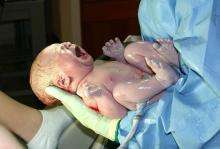
(PhysOrg.com) -- A new study has provided genetic evidence for the first time that it is possible for a mother to transmit cancer to her unborn child via the placenta.

Cases have been reported on rare occasions where a mother and newborn develop the same , but there has never been proof until now that the mother passed the cancer to the child. In theory it should not be possible, since the infant's should destroy the cancer cells.

The team of British and Japanese researchers studied a case in Japan in which the 28-year-old mother developed leukemia shortly after giving birth to a daughter. Eleven months later the baby developed a cancer with the same genetic markers as her mother's cancer cells.

Using advanced genetic fingerprinting techniques, the scientists were able to prove the leukemia cells in the baby were present at her birth, and that they could only have come from the mother, since the cancer cells had an identical mutation in the cancer gene BCR-ABL1.

They also looked at how the cancer cells from the mother could have avoided being destroyed by the infant's immune system, and discovered that the baby's cancer cells lacked part of the DNA that would have indicated to the immune system the cells were foreign. The leader of the team, Professor Mel Greaves of the Institute of Cancer Research in Sutton, UK, said the were in effect invisible to the immune system and therefore were able to implant without being attacked.

The transfer of cancer from mother to unborn child is rare, with only around 30 cases known, and the mother usually has a or . Professor Greaves stressed that even if the mother has cancer it is still extremely unlikely she would pass it on to the child, but if pregnant women with cancer are concerned, they should seek the advice of their specialists.

Chief Clinician at Cancer Research UK, Professor Peter Johnson, said the research was important because it shows that for cancers to grow they need to elude the immune system. This means we might be able to develop new treatments that help alert the patient's immune system to the presence of cancer.

The research findings are published in the Proceedings of the National Academy of Sciences.

More information: Immunologically silent cancer clone transmission from mother to offspring, PNAS, doi:10.1073/pnas.0904658106

© 2009 PhysOrg.com


print this article email this article download pdf blog this article bookmark this article     Stumble it Digg this share on Facebook retweet share on Reddit add to delicious
Rate this story - 5 /5 (2 votes)


October 14, 2009 all stories

Comments: 0

5 /5 (2 votes)
  • Stumble this up

  • Digg this

  • share this

  • hide
  • Related Stories

  • New study aims to reduce risk of childhood leukemia
    created Jan 26, 2009 | popularity not rated yet | comments 0
  • Scientists find that drug stimulated immune system in prostate cancer
    created Jun 02, 2008 | popularity not rated yet | comments 0
  • Boy home after rare stem cell treatment
    created Feb 12, 2008 | popularity not rated yet | comments 0
  • Residual fetal cells in women may provide protection against breast cancer
    created Oct 01, 2007 | popularity not rated yet | comments 0
  • Study: Tumors inhibit immune system
    created May 29, 2006 | popularity not rated yet | comments 0


  • hide
  • Relevant PhysicsForums posts

  • Has the H1N1 vaccine been scientifically proven to work?
    created 17 hours ago
  • nesfatin
    created Nov 22, 2009
  • Obsessive Compulsive Disorder
    created Nov 20, 2009
  • West's zone 2 starling resistor respiratory physiology
    created Nov 18, 2009
  • More from Physics Forums - Medical Sciences

Other News

Dentistry, a high-tech version: Robots not far off, doctor says

Medicine & Health / Health

created 20 minutes ago | popularity not rated yet | comments 0

Robots may practice dentistry one day, but there will always be humans telling you to open wide, said a teacher on the cutting edge of tooth care.


High salt intake directly linked to stroke and cardiovascular disease

Medicine & Health / Health

created 3 hours ago | popularity 4.7 / 5 (3) | comments 0

High salt intake is associated with significantly greater risk of both stroke and cardiovascular disease, concludes a study published in the BMJ today.


Early protein processes crucial to formation and layering of myelin membrane

Medicine & Health / Research

created 8 hours ago | popularity not rated yet | comments 0

New findings from an international team of researchers probing the nerve-insulating myelin sheath were bolstered by the work of Boston College biologists, who used x-rays to uncover how mutations affect the structure of myelin, ...


Eye floaters and flashes of light linked to retinal tear, detachment

Eye floaters and flashes of light linked to retinal tear, detachment

Medicine & Health / Research

created 2 hours ago | popularity not rated yet | comments 0

Suddenly seeing floaters or flashes of light may indicate a serious eye problem that - if untreated - could lead to blindness, a new study shows.


Six bad reactions to swine flu vaccine in Canada: official (Update)

Medicine & Health / Medications

created 15 hours ago | popularity 3.7 / 5 (6) | comments 4

Six severe allergic reactions to swine flu vaccinations have been observed in Canada, health authorities said Tuesday, adding that all of the individuals are feeling better.