Arctic land and seas account for up to 25 percent of world's carbon sink
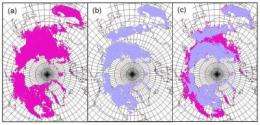
In a new study in the journal Ecological Monographs, ecologists estimate that Arctic lands and oceans are responsible for up to 25 percent of the global net sink of atmospheric carbon dioxide. Under current predictions of global warming, this Arctic sink could be diminished or reversed, potentially accelerating predicted rates of climate change.
In their review paper, David McGuire of the U.S. Geological Survey and the University of Alaska at Fairbanks and his colleagues show that the Arctic has been a carbon sink since the end of the last Ice Age, which over time has accounted for between zero and 25 percent, or up to about 800 million metric tons, of the global carbon sink. On average, says McGuire, the Arctic accounts for 10-15 percent of the Earth's carbon sink. But the rapid rate of climate change in the Arctic - about twice that of lower latitudes - could eliminate the sink and possibly make the Arctic a source of carbon dioxide.
Carbon generally enters the oceans and land masses of the Arctic from the atmosphere and largely accumulates in permafrost, the frozen layer of soil underneath the land's surface. Unlike active soils, permafrost does not decompose its carbon; thus, the carbon becomes trapped in the frozen soil. Cold conditions at the surface have also slowed the rate of organic matter decomposition, McGuire says, allowing Arctic carbon accumulation to exceed its release.
But recent warming trends could change this balance. Warmer temperatures can accelerate the rate of surface decomposition, releasing more carbon into the atmosphere. More concerning, says McGuire, is that the permafrost has begun to thaw, exposing previously frozen soil to decomposition and erosion. These changes could reverse the historical role of the Arctic as a sink for carbon.
"In the short term, warming temperatures could expose more Arctic carbon to decomposition," says McGuire. "And with permafrost melting, there will be more available carbon to decompose."
On the scale of a few decades, the thawing permafrost could also result in a more waterlogged Arctic, says McGuire, a situation that could encourage the activity of methane-producing organisms. Currently, the Arctic is a substantial source of methane to the atmosphere: as much as 50 million metric tons of methane is released per year, in comparison to the 400 million metric tons of carbon dioxide the Arctic sequesters yearly. But methane is a very potent greenhouse gas - about 23 times more effective at trapping heat than carbon dioxide on a 100-year time scale. If the release of Arctic methane accelerates, global warming could increase at much faster rates.
"We don't understand methane very well, and its releases to the atmosphere are more episodic than the exchanges of carbon dioxide with the atmosphere," says McGuire. "It's important to pay attention to methane dynamics because of methane's substantial potential to accelerate global warming."
But uncertainties still abound about the response of the Arctic system to climate change. For example, the authors write, global warming may produce longer growing seasons that promote plant photosynthesis, which removes carbon dioxide from the atmosphere; however, increasingly dry conditions may might counteract and overcome this effect. Similarly, dry conditions can lead to increased fire prevalence, releasing even more carbon.
McGuire contends that only specific regional studies can determine which areas are likely to experience changes in response to climate change.
"If the response of the arctic carbon cycle to climate change results in substantial net releases of greenhouse gases, this could compromise mitigation efforts that we have in mind for controlling the carbon cycle," he says.
Source: Ecological Society of America


