Heat forms potentially harmful substance in high-fructose corn syrup
October 14, 2009 Heat forms potentially harmful substance in high-fructose corn syrup

Enlarge

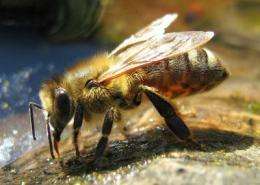
A new study shows that heat can produce a potentially toxic substance in high-fructose corn syrup that can kill honeybees and may also threaten human health. Credit: Wikimedia Commons

Researchers have established the conditions that foster formation of potentially dangerous levels of a toxic substance in the high-fructose corn syrup (HFCS) often fed to honey bees. Their study, which appears in ACS' bi-weekly Journal of Agricultural and Food Chemistry, could also help keep the substance out of soft drinks and dozens of other human foods that contain HFCS. The substance, hydroxymethylfurfural (HMF), forms mainly from heating fructose.

In the new study, Blaise LeBlanc and Gillian Eggleston and colleagues note HFCS's ubiquitous usage as a sweetener in beverages and processed foods. Some commercial beekeepers also feed it to bees to increase reproduction and honey production. When exposed to warm temperatures, HFCS can form HMF and kill honeybees. Some researchers believe that HMF may be a factor in Colony Collapse Disorder, a mysterious disease that has killed at least one-third of the honeybee population in the United States.

The scientists measured levels of HMF in HFCS products from different manufacturers over a period of 35 days at different temperatures. As temperatures rose, levels of HMF increased steadily. Levels jumped dramatically at about 120 degrees Fahrenheit. "The data are important for commercial beekeepers, for manufacturers of HFCS, and for purposes of food storage. Because HFCS is incorporated as a sweetener in many processed foods, the data from this study are important for human health as well," the report states. It adds that studies have linked HMF to in humans. In addition, HMF breaks down in the body to other substances potentially more harmful than HMF.

More information: "Formation of Hydroxymethylfurfural in Domestic and Its Toxicity to the (Apis mellifera)", Journal of Agricultural and Food Chemistry

Source: American Chemical Society (news : web)


print this article email this article download pdf blog this article bookmark this article     Stumble it Digg this share on Facebook retweet share on Reddit add to delicious
Rate this story - 4.3 /5 (4 votes)

Rank Filter

Move the slider to adjust rank threshold, so that you can hide some of the comments.


Display comments: newest first

  • jselin - Oct 14, 2009
    • Rank: 5 / 5 (1)
    I think everyone has been aware of this for quite a while. Cooking fructose bearing fruits or foods should have the same effect.

    In any case, it shouldn't be surprising that heating an organic causes chemical changes.
  • cornrefiner - Oct 15, 2009
    • Rank: 5 / 5 (1)
    Consumers should know that high fructose corn syrup is a safe ingredient. High fructose corn syrup has been used safely in the food supply for humans and honeybees for decades.

    There are several relevant points concerning CCD and HMF that should be taken into account:

    • HMF has been found in all sweetener syrups, including honey and invert sugar.

    • The case for HMF (from any syrup source) as an explanation for widespread CCD in honeybees is dubious, given the highly unusual conditions — extreme storage temperatures, prolonged storage times or non-standard storage containers — required to generate potentially harmful levels of HMF.

    • In a recent paper published by the University of Illinois at Urbana-Champaign and the U.S. Department of Agriculture on CCD, the authors list compromised immune response, specific pathogens, and pesticide exposure , as the leading explanations for CCD.
  • tkjtkj - Oct 18, 2009
    • Rank: not rated yet
    re: Iselin :

    In any case, it shouldn't be surprising that heating an organic causes chemical changes.


    your comment is unfair: it does not reflect the author's conclusions. His work showed a particular chemical reaction that has significant implications. He did not merely show what you suggest.

  • Roj - Oct 19, 2009
    • Rank: not rated yet
    High fructose corn syrup has been used safely ..for decades
    Chlorofluorocarbons were also safe for decades before its ozone annihilating mechanism was discovered.

    The case for HMF as an explanation for widespread CCD in honeybees is dubious
    Does the corn syrup industry need bees to sustain corn crops for production?

    If so, temperatures required for deleterious HMF, compromising immunology of pollinating honeybees, should be qualified, rather than perceived as a public-relations threat.

    If not, I see the corn syrup industry would have no mission nor interest in honey bees, which do not affect market or enrichment, beyond public-relations.

    Consumers should know that high fructose corn syrup is a safe ingredient.
    The special interests of this industry have spoken, but the article's temporary visibility and limited forum provided here offer little pear review, however refreshing and fitting it was for the real players to offer the engagement and post here.

October 14, 2009 all stories

Comments: 4

4.3 /5 (4 votes)
  • Stumble this up

  • Digg this

  • share this

  • hide
  • Related Stories


  • hide
  • Relevant PhysicsForums posts

  • Goddard
    created 10 hours ago
  • Rate Laws
    created 12 hours ago
  • why oxygen, cannot act as a pi-donor while NO can?
    created Nov 20, 2009
  • Aspirin
    created Nov 19, 2009
  • More from Physics Forums - Chemistry

Other News

Accidental discovery produces durable new blue pigment for multiple applications

Accidental discovery produces durable new blue pigment for multiple applications

Chemistry / Biochemistry

created Nov 16, 2009 | popularity 4.5 / 5 (30) | comments 6

An accidental discovery in a laboratory at Oregon State University has apparently solved a quest that over thousands of years has absorbed the energies of ancient Egyptians, the Han dynasty in China, Mayan ...


One word: bioplastics

One word: bioplastics

Chemistry / Materials Science

created Nov 17, 2009 | popularity 4.6 / 5 (12) | comments 4

(PhysOrg.com) -- Every year, more than 250 billion pounds of plastic are produced worldwide. Much of it ends up in the world's oceans, a fact that troubles MIT biology professor Anthony Sinskey.


New on-off 'switch' triggers and reverses paralysis in animals with a beam of light

New on-off 'switch' triggers and reverses paralysis in animals with a beam of light (w/ Video)

Chemistry / Biochemistry

created Nov 18, 2009 | popularity 4.8 / 5 (5) | comments 3

In an advance with overtones of Star Trek phasers and other sci-fi ray guns, scientists in Canada are reporting development of an internal on-off "switch" that paralyzes animals when exposed to a beam of ultraviolet ...


New research provides blueprint for molecular basis of global warming

New research provides blueprint for molecular basis of global warming

Chemistry / Materials Science

created Nov 17, 2009 | popularity 4 / 5 (4) | comments 3

A new study indicates that major chemicals most often cited as leading causes of climate change, such as carbon dioxide and methane, are outclassed in their warming potential by compounds receiving less attention.


Ethanol

Microbes to Take Over Ethanol Production?

Chemistry / Biochemistry

created Nov 20, 2009 | popularity 3.5 / 5 (6) | comments 0

(PhysOrg.com) -- Not too long ago, it seemed that ethanol production was the wave of the future. The use of trash, wood chips or different types of plants -- usually grass or corn -- to make ethanol was considered ...