Researchers uncover recipe for controlling carbon nanotubes
October 14, 2009 Carbon nanotube

Enlarge

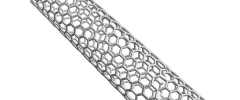
Carbon nanotubes are cylindrical carbon molecules whose novel properties make them useful for applications in chemical engineering, nanotechnology, electronics and other areas.

(PhysOrg.com) -- Carbon nanotubes hold promise for delivering medicine directly to a tumor; acting as sensors so keen they detect the arrival or departure of a single electron; replacing costly platinum in fuel cells; or as energy-saving transistors and wires, but building them with the right structure has been a challenge.

Now, two Case Western Reserve University researchers have found that mixing different metals in a catalyst can help determine the tubes' structure and function, or chirality.

"We have established a link between the structure of a catalyst and the chirality of carbon nanotubes," said R. Mohan Sankaran, an assistant professor of chemical engineering at the Case School of Engineering. "Change the catalyst structure by varying its composition, and you can begin to control the chirality of the nanotubes and their electrical and ."

Nanotubes are normally grown in bulk mixtures. When using a nickel catalyst, typically one-third of those grown are metallic and could be used like metal wires to conduct electricity. About two-thirds are semiconducting nanotubes, which could be used as transistors, said Wei-Hung Chiang, who received his doctorate in chemical engineering in May. But separating them according to properties is "costly and can damage the nanotubes," Chiang said.

Better to make what you want.

Chiang and Sankaran found that a mixed iron and nickel catalyst could change the outcome. Of the compositions tested, a of 27 percent nickel and 73 percent iron produced the most dramatic result: the majority of the nanotubes were semiconducting. The researchers are now working on assessing the purity and integrating the nanotubes into thin film transistors.

Chiang and Sankaran say their findings open the door to experimenting with other elements as catalysts and different combinations, which may produce near-pure nanotubes with desired properties. Their findings appear in a letter published Sept. 20 in the online edition of Nature Materials.

Provided by Case Western Reserve University (news : web)


Rate this story - 4.6 /5 (5 votes)

Rank Filter

Move the slider to adjust rank threshold, so that you can hide some of the comments.


Display comments: newest first


October 14, 2009 all stories

Comments: 1

4.6 /5 (5 votes)

  • hide
  • Related Stories

  • A recipe for controlling carbon nanotubes
    created Sep 20, 2009 | popularity not rated yet | comments 0
  • Reversed growth reveals secrets of carbon nanotubes
    created Aug 25, 2006 | popularity not rated yet | comments 0
  • High Value Semiconducting Carbon Nanotubes
    created Jul 12, 2004 | popularity not rated yet | comments 0
  • Better control of carbon nanotube 'growth' promising for future electronics
    created Oct 01, 2009 | popularity not rated yet | comments 0
  • Carbon nanotube 'ink' may lead to thinner, lighter transistors and solar cells
    created Jan 08, 2009 | popularity not rated yet | comments 0


  • hide
  • Relevant PhysicsForums posts

Other News

Nanoscale Structures with Superior Mechanical Properties Developed

Nanoscale Structures with Superior Mechanical Properties Developed

Nanotechnology / Nanomaterials

created 16 hours ago | popularity 4.6 / 5 (9) | comments 1 | with audio podcast

(PhysOrg.com) -- Researchers at the California Institute of Technology have developed a way to make some notoriously brittle materials ductile -- yet stronger than ever -- simply by reducing their size.


Spray-on liquid glass

Spray-on liquid glass is about to revolutionize almost everything

Nanotechnology / Nanomaterials

created Feb 02, 2010 | popularity 4.7 / 5 (240) | comments 93 | with audio podcast report

(PhysOrg.com) -- Spray-on liquid glass is transparent, non-toxic, and can protect virtually any surface against almost any damage from hazards such as water, UV radiation, dirt, heat, and bacterial infections. ...


IBM Scientists Demonstrate World's Fastest Graphene Transistor

IBM Scientists Demonstrate World's Fastest Graphene Transistor

Nanotechnology / Nanophysics

created Feb 05, 2010 | popularity 4.9 / 5 (38) | comments 25 | with audio podcast

(PhysOrg.com) -- In a just-published paper in the magazine Science, IBM researchers demonstrated a radio-frequency graphene transistor with the highest cut-off frequency achieved so far for any graphene device ...


Conductive eTextiles: Stanford finds a new use for cloth

Conductive eTextiles: Researchers move from making batteries from paper to making batteries from cloth

Nanotechnology / Nanomaterials

created Feb 05, 2010 | popularity 4.3 / 5 (7) | comments 4 | with audio podcast

(PhysOrg.com) -- Stanford researchers have moved from making batteries from paper to making batteries from cloth. Your-T-shirt could become a lighted, moving display.


Carbon Based Chips May One Day Replace Silicon Transistors

Carbon Based Chips May One Day Replace Silicon Transistors

Nanotechnology / Nanomaterials

created Feb 03, 2010 | popularity 4.7 / 5 (18) | comments 3 | with audio podcast weblog

(PhysOrg.com) -- IBM researchers are hopeful that, over the next decade, silicon-based transistors will be replaced by carbon-based transistors. IBM has already laid out the ground work for carbon-based transistors.