Carbon capture shows major potential in China
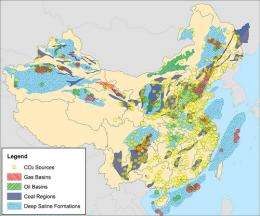
(PhysOrg.com) -- Carbon dioxide capture and storage technologies may represent a cost-effective, viable option to help China continue to meet its growing energy demands while also delivering deep and sustained reductions in industrial greenhouse gas emissions, according to a study announced today.
Carbon dioxide capture and storage technologies may represent a cost-effective, viable option to help China continue to meet its growing energy demands while also delivering deep and sustained reductions in industrial greenhouse gas emissions, according to a study announced today.
Much of the discussion around China's options for significantly limiting carbon dioxide emissions has been all or nothing - that the country either continue increasing its domestic use of coal with parallel increases in greenhouse gas emissions or that it stop using coal completely and endure the economic consequences.
The new study shows there is a much-needed third option for addressing these twin challenges — large-scale deployment of carbon dioxide (CO2) capture and storage technologies. The study identifies enormous and widely distributed deep geologic CO2 storage formations in China that could allow for cost-effective, large-scale deployment of capture and storage technologies for at least 100 years.
Click here to view of summary of the report's findings.
"For the first time ever, we have quantified the potential for future large-scale carbon capture and storage deployment within China," said Bob Dahowski, lead scientist for this research at the Department of Energy's Pacific Northwest National Laboratory. "Our work suggests that CO2 capture and storage can provide a key element of China's portfolio of options for cost effectively reducing greenhouse gas emissions."
Until now, the scientific community had a limited understanding of the potential magnitude for large-scale deployment of CO2 storage in China. PNNL teamed with scientists from the Chinese Academy of Sciences' Institute of Rock and Soil Mechanics (IRSM) in this five-year study. The team's key findings include:
• China has enough deep geologic CO2 storage capacity to meet anticipated demand for up to 100 years and potentially more - specifically, the capacity to store as much as 2,300 billion metric tons of CO2;
• There are more than 1,620 large stationary CO2 emission sources in China. They include coal-fired power plants, cement kilns, steel mills, refineries and other industrial facilities.
• These sources collectively emit more than 3.8 billion metric tons of CO2 each year — 70 percent of these large point source emissions are from coal-fired power plants.
• More than 90 percent of these power plants and CO2-emitting facilities are located within 100 miles of a potential carbon storage reservoir. This close proximity means that CO2 capture and storage technologies could be widely deployed across most regions of China with little need to build extensive long-distance CO2 pipelines.
• The close proximity also means that the expense of transporting, storing and ensuring the long-term fate of the injected CO2 within these storage reservoirs should be less than $10 per ton for most projects. These estimates are exclusive of the costs of capture, compression and dehydration, which will be considered in future iterations of this work.
• An initial evaluation of potential offshore storage options suggests that offshore basins may be able to safely store as much as 780 billion metric tons of CO2.
The team surveyed China's candidate deep geological carbon dioxide storage reserves onshore and offshore; mapped locations of the largest stationary CO2 emissions sources; assessed CO2 pipeline infrastructure needs; and evaluated the economics of deploying CO2 transport and storage technologies to China's large and well-distributed deep geologic CO2 storage formations.
These findings are important as the international community looks for ways to balance economic growth and the resulting demands for energy with the need to reduce and mitigate greenhouse gas emissions globally.
Provided by Pacific Northwest National Laboratory (news : web)


