Do lava lamps and actual lava share similar characteristics?

October 14, 2009 By Lauren Schenkman, Inside Science Do lava lamps and actual lava share similar characteristics?

Enlarge

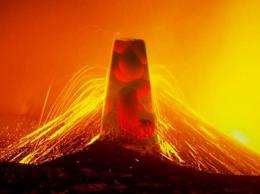
Earth's inner mantle consists of high-temperature slowly circulating molten rock that is often explained by an analogy to the flow inside a lava lamp. Credit: ISNS | NPS.gov

When Imre Jánosi's teenage daughter asked him how her new lava lamp worked, she probably expected a quick explanation. But her innocent question sent Jánosi, a physicist at Loránd Eötvös University in Budapest, on an experimental quest to plumb the physics of the popular novelty toy.

"I wanted to find something, an easy explanation for what happens inside," Jánosi explained. "So I started to check the web and the professional literature, and that was a real surprise. There was practically no useful information, nothing about the physics."

Jánosi knew the basics, of course; a lava lamp operates on the principle of convection. The chamber is filled with water (sometimes mixed with additives) and a wax-like substance. Initially, the wax is denser than the water, and settles at the bottom of the lamp. A light bulb heats up the wax until it's less dense than the surrounding liquid. It then rises to the top, cools, and falls back to the bottom.

But Jánosi considered this to be a vague, hand-waving explanation at best. He wanted to know the details. He also had a scientific motivation; Jánosi works in the von Karman Laboratory of Environmental Flow in Hungary, which uses small-scale experiments to study the behavior of fluids in the atmosphere, oceans, and deep inside the Earth. Teachers and even scientists often compare the lava lamp's undulations to the slow convection in the Earth's mantle, and Jánosi wondered if it was truly a good analogy.

Jánosi and his colleague Balázs Gyüre concocted their own lava lamp recipe. A glass cylinder filled with , a heating pad, and a water-cooled lid served as the lamp. Silicone oil was the perfect lava; it was denser than salt water at room temperature, but less dense than salt water when heated past a critical temperature. After much frustration playing with the ratios of oil to water, they had it: a lab-grade lava lamp.

While blobs form and distend erratically in a commercial lava lamp, Jánosi's flowed like clockwork. The silicon on the bottom heated up until it formed a blob that floated to the top. As it cooled, the blob dropped back to the bottom. The lamp could run for two weeks without stopping, while Jánosi and Gyüre studied its behavior at different temperatures.

Earth's inner mantle consists of hot, flowing rock that circulates extremely slowly, and is often explained by analogy to the flow in a lava lamp. But Jánosi found that there are some key differences. The wax in a is more viscous than water, meaning it flows less easily.

However, Jánosi said, "Hot plumes that are rising up in the liquid mantle ... are at least 100 times lower in viscosity than the surroundings."

Secondly, lava lamps contain two separate substances that don’t mix together, while the mantle is a blend of many of different materials.

To help him explain the lava lamp's workings to his daughter, Jánosi's paper will be published in the journal Physical Review E.

But his scientific love affair with the toy is far from over. By tinkering with his lamp's ingredients, Jánosi may be able to bottle the mantle's physics. "If we could come up with an analogy for mantle convection ... that would be a great step," he said.

© 2009 Inside Science News Service. Used with permission.
ISNS


print this article email this article download pdf blog this article bookmark this article     Stumble it Digg this share on Facebook retweet share on Reddit add to delicious
Rate this story - 4.2 /5 (6 votes)

Rank Filter

Move the slider to adjust rank threshold, so that you can hide some of the comments.


Display comments: newest first

  • rjm1percent - Oct 14, 2009
    • Rank: not rated yet
    So really his explanation for convection inside lava lamps was in fact just as 'hand-wavey' as he had first proposed...
  • abhishekbt - Oct 15, 2009
    • Rank: not rated yet
    "To help him explain the lava lamp's workings to his daughter, Jánosi's paper will be published in the journal Physical Review E"

    And his daughter is supposed to read and understand that? The 'hand-wavey' was better!

October 14, 2009 all stories

Comments: 2

4.2 /5 (6 votes)
  • Stumble this up

  • Digg this

  • share this

  • hide
  • Related Stories

  • A Halogen Bulb
    created Sep 26, 2004 | popularity not rated yet | comments 0
  • How does a dog walk? Surprisingly, many of us don't really know
    created Jan 26, 2009 | popularity not rated yet | comments 0
  • Volcano taming
    created Jun 05, 2008 | popularity not rated yet | comments 0
  • And the mountain moved: Scientists study how Heart Mountain shifted
    created May 17, 2006 | popularity not rated yet | comments 0
  • Meteorites may have caused ancient lava
    created Oct 28, 2005 | popularity not rated yet | comments 0


  • hide
  • Relevant PhysicsForums posts

  • Some Explanation with Rigid Rotator
    created 3 hours ago
  • How to Make a Ferrofluid?
    created 7 hours ago
  • avoidance of admitting that we dont know somethin
    created 12 hours ago
  • Speed of light : missing energy
    created 16 hours ago
  • Can light produce darkness and can noise procude quiteness 4
    created 18 hours ago
  • Magnetic Oscillation Equations
    created Nov 21, 2009
  • More from Physics Forums - General Physics

Other News

Restored machine to explore mysteries of Big Bang (AP)

Restored machine to explore mysteries of Big Bang

Physics / General Physics

created 16 hours ago | popularity 4.5 / 5 (15) | comments 9

(AP) -- Scientists are preparing the world's largest atom smasher to explore the depths of matter after successfully restarting the $10 billion machine following more than a year of repairs.


nuclear power plant

Doubts raised on nuclear industry viability

Physics / General Physics

created Nov 19, 2009 | popularity 3.1 / 5 (20) | comments 19

(PhysOrg.com) -- The investment in nuclear power has been growing around the world over the last few years, being viewed as a means for countries to control their energy security, avoid the price fluctuations ...


Researchers Find Innate Correlations Among Different Power Law Phenomena

Researchers Find Innate Correlations Among Different Power Law Phenomena

Physics / General Physics

created Nov 17, 2009 | popularity 4.3 / 5 (15) | comments 14

(PhysOrg.com) -- Studying the patterns that emerge in natural and social phenomena is a popular area of research, although usually individual phenomena are studied separately from each other. In a recent study, ...


Scientists demonstrate 'universal' programmable quantum processor

Scientists demonstrate 'universal' programmable quantum processor

Physics / Quantum Physics

created Nov 15, 2009 | popularity 4.6 / 5 (21) | comments 11

Physicists at the National Institute of Standards and Technology have demonstrated the first "universal" programmable quantum information processor able to run any program allowed by quantum mechanics -- th ...


Proton's party pals may alter its internal structure

Proton's party pals may alter its internal structure

Physics / General Physics

created Nov 18, 2009 | popularity 4.6 / 5 (20) | comments 9

A recent experiment at the DOE's Thomas Jefferson National Accelerator Facility has found that a proton's nearest neighbors in the nucleus of the atom may modify the proton's internal structure.