Arctic ice cap 'to disappear in future summers'
October 15, 2009 by Elodie Mazein
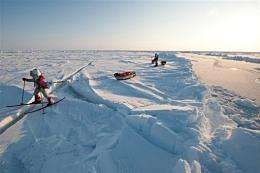
On their trip, Pen Hadow (R) and Ann Daniels found the average thickness of the ice floes was 1.8 metres

Enlarge

In this undated image obatined from www.catlinarcticsurvey.com, British explorers Pen Hadow (R) and Ann Daniels cross a refrozen lead in the North Pole. The Arctic ice cap will disappear completely in summer months within 20 to 30 years, a polar research team said as they presented findings from an expedition led by adventurer Hadow.

The Arctic ice cap will disappear completely in summer months within 20 to 30 years, a polar research team said as they presented findings from an expedition led by adventurer Pen Hadow.

It is likely to be largely ice-free during the warmer months within a decade, the experts added.

Veteran polar explorer Hadow and two other Britons went out on the Arctic ice cap for 73 days during the northern spring, taking more than 6,000 measurements and observations of the sea ice.

The raw data they collected from March to May has been analysed, producing some stark predictions about the state of the ice cap.

"The summer ice cover will completely vanish in 20 to 30 years but in less than that it will have considerably retreated," said Professor Peter Wadhams, head of the polar ocean physics group at Britain's prestigious Cambridge University.

"In about 10 years, the Arctic ice will be considered as open sea."

Starting off from northern , Hadow, Martin Hartley and Ann Daniels skied over the ice cap to measure the thickness of the remaining ice, assessing its density and the depth of overlying snow, as well as taking weather and readings.

Across their 450-kilometre (290 mile) route, the average thickness of the ice floes was 1.8 metres (six feet), while it was 4.8 metres when incorporating the compressed ridges of ice.

"An average thickness of 1.8 metres is typical of first year ice, which is more vulnerable in the summer. And the multi-year ice is shrinking back more rapidly," said Wadhams.

"It's a concrete example of global change in action.

"With a larger part of the region now in first year ice, it is clearly more vulnerable. The area is now more likely to become open water each summer, bringing forward the potential date when the summer sea ice will be completely gone."

Doctor Martin Sommerkorn, senior adviser for the World Wide Fund for Nature's international Arctic programme, said the survey painted a sombre picture of the ice meltdown, which was happening "faster than we thought".

"Remove the Arctic ice cap and we are left with a very different and much warmer world," he said.

Loss of sea cover will "set in motion powerful climate feedbacks which will have an impact far beyond the Arctic itself," he added.

"This could lead to flooding affecting one quarter of the world's population, substantial increases in greenhouse gas emission from massive carbon pools and extreme global weather changes."

"Today's findings provide yet another urgent call for action to world leaders ahead of the United Nations climate summit in Copenhagen in December to rapidly and effectively curb global greenhouse gas emissions."

(c) 2009 AFP

2.8 /5 (32 votes)  

Filter


Move the slider to adjust rank threshold, so that you can hide some of the comments.


Display comments: newest first

jcrow
Oct 15, 2009

Rank: 3.4 / 5 (10)
Strangely quiet,
Where are all the corporate sheep?
Loodt
Oct 15, 2009

Rank: 2.5 / 5 (13)
Yeah, and pigs will fly.

These stupid clowns couldn't make it to the North Pole, lived on half rations because of bad weather and had to abandon their trip after being rescued. They have nothing to say that would interest me!
lengould100
Oct 15, 2009

Rank: 3.1 / 5 (9)
Agreed, jcrow. Too quiet. Sort of like with the kiddies playing, I'd rather hear a little noise from them than silence. That way, at least I know where they are.
3432682
Oct 15, 2009

Rank: 2.9 / 5 (9)
There is a very strong 60-year solar irradiance cycle, which matches almost perfectly with ocean cycles, and temperature. It says we started a 30-year cooling trend about 10 years ago. CO2 is likely to add a modest boost to temperatures, about 1 F in the coming century, far short of IPCC predictions.
LKD
Oct 15, 2009

Rank: 2.8 / 5 (9)
Wow, how pathetic. They only did a portion of their trip, not even half. Lovely how science no longer is based on fact. http://www.catlin...routemap

Better reading is this: http://www.prison...ted.html
solrey
Oct 15, 2009

Rank: 3.4 / 5 (10)
The Catlin expedition was PR stunt junk science at it's worst. They only made it about halfway to the pole due to consistently challenging, extreme cold weather conditions. The measurements were taken along the thin line of their 435km route (purposefully chosen to only cover first year ice, btw), which is not even close to a representative sampling of 5,000,000km^2 of Arctic sea ice. They actually traveled parallel to a line of buoys monitoring ice thickness.

What most people aren't aware of is another Arctic ice thickness survey conducted at the same time (ironically) by towing a "sounder" behind a DC-3.
translate.google.com/translate?js=n&prev=_t&hl=en&ie=UTF-8&u=http://www.radiobremen.de/wissen/nachrichten/wissenawipolararktis100.html&sl=de&tl=en&history_state0=

"Result: The sea-ice in the surveyed areas is apparently thicker than the researchers had suspected."

"Normally, ice is newly formed after two years, over two meters thick. “Here were Eisdicken up to four meters,” "
Velanarris
Oct 15, 2009

Rank: 3 / 5 (13)
Agreed, jcrow. Too quiet. Sort of like with the kiddies playing, I'd rather hear a little noise from them than silence. That way, at least I know where they are.


We're elsewhere, talking about things that are relevant (read: non-fiction).
jonnyboy
Oct 15, 2009

Rank: 2.3 / 5 (8)
It seems like every time I get to the bottom of the comments, Velanarris has written what was on my mind. Keep up the good work !!!!!!!!
IcePowder
Oct 15, 2009

Rank: 2.7 / 5 (9)
Like all things press it will play itself out till the next state of fear project takes hold providing a scientific milk tit of money keeping the practitioners in the limelight . . . , Till then, thou, we'll have to put up with this sort of bad science fiction.
brianweymes
Oct 15, 2009

Rank: 2.7 / 5 (7)
The question is not if but when. On one hand you have scientists who believe the arctic will produce ice free summers relatively quickly, like less than 20 or 30 years. Others believe it is a slower process that could take until 2100, although the momentum seems to be shifting in support of a sooner ice free arctic. Solrey the study you linked to is interesting but hardly enough by itself to contradict the observed overall warming trend in the arctic. http://nsidc.org/...mpr.html summarizes how bad the last few years have been.

For those who fail to read the writing on the wall, the chances you will have to confront your own cognitive dissonance is good if you live much longer into the future, as the evidence will soon be incredibly overwhelming in support of Global Warming and all its tangents. Better do it sooner rather than later.
dan42day
Oct 15, 2009

Rank: 2.3 / 5 (3)
Would anyone care to purchase some ocean-front property in northern Canada?
LKD
Oct 16, 2009

Rank: 3 / 5 (4)
Dear brianweymes, lengould100, and jcrow,

This article is why we can't actually have a rational discussion of this topic, or come to any viable conclusion. The whole climate change field is so rife with this irresponsibility, scientists ignoring whole areas of global effects when drawing conclusions, making ridiculously false claims of world destruction, these papers which are blatantly biased and corrupted by scientists (who should be stripped of their degree's) who make the data match their desires instead of presenting the information honestly.

Why can we not speak on this topic with science? There is only fact in science. Yet this whole topic has been hijacked to the point that no one can believe anything that is written.

The science community should be ashamed so many have fallen from honor to such vileness. Where is your honor that you can not say: "We can't fully grasp causality. But this is occurring, and we are researching reasons."
RobertKLR
Oct 16, 2009

Rank: 5 / 5 (1)
In ten years the Arctic ocean will be a navigable sea. This is like the seven day forecast the local weatherman gives. Each day he has to revise it so essentially it is a one day forecast followed by six guesses. In ten years let's revisit this prediction.
Nartoon
Oct 17, 2009

Rank: 2 / 5 (4)
And the Arctic has never been ice free year round before, let alone in the summer?
Noein
Oct 17, 2009

Rank: 1 / 5 (2)
Strangely quiet,
Where are all the corporate sheep?


Maybe they went on a religious retreat to re-affirm their deep religious faith in global warming denialism.
Shootist
Oct 18, 2009

Rank: 1 / 5 (1)
Arctic ice cap 'to disappear in future summers'

or not.
USPorcupine
Oct 18, 2009

Rank: 1 / 5 (1)
Here we go again blaa blaa blaa.....We all going to die if we don't do something Whaaaaaaaaaaaaaaa. Sea level will rise 60 feet and more we all doomed
I am realy getting tired of this.
OOOhh I am realy scared or maybe not.
Maybe for sure not.
Sean_W
Oct 19, 2009

Rank: 1 / 5 (1)
Since even the BBC has admitted that the climate models have been wrong for the last ten years are we really supposed to believe that even stupider predictions will be right in ten years from now?
Streamtracker
Oct 19, 2009

Rank: not rated yet
Solrey, here's the press release directly from the institute:

http://www.awi.de...6036fcb4

Multiple flights northwards from various stations showed an ice thickness between 2.5 (two years old ice in the vicinity of the North Pole) and 4 metres (perennial ice in Canadian offshore regions). All in all, the ice was somewhat thicker than during the last years in the same regions, which leads to the conclusion that Arctic ice cover recovers temporarily. The researchers found the thickest ice with a thickness of 15 metres along the northern coast of Ellesmer.

Seems you got it wrong.
GrayMouser
Oct 20, 2009

Rank: 1 / 5 (2)
In ten years the Arctic ocean will be a navigable sea. This is like the seven day forecast the local weatherman gives. Each day he has to revise it so essentially it is a one day forecast followed by six guesses. In ten years let's revisit this prediction.

It was supposed to be like that 3 years ago (according to the "experts"] and it was much closer to that 70 years ago.

http://wattsupwit...trusted/
Snowhare
Oct 25, 2009

Rank: not rated yet

@GreyMouser It was supposed to be like that 3 years ago (according to the "experts"] and it was much closer to that 70 years ago.


You need to provide a reference for your assertion that the Artcic Ocean was more navigable 70 years ago than it has been in the last couple of years.

You didn't provide any references for that claim when I requested it in the 'Arctic ice pack at third lowest extent since 1979: US' thread.

I've searched for any references matching your claim and cannot find anything supporting it.
Rank 2.8 /5 (32 votes)
Related Stories
Relevant PhysicsForums posts
  • Discrepancy between oxygen and carbon-dioxide levels
    created19 hours ago
  • where gems are found in the world
    created22 hours ago
  • Wind Waves in Reservoir ~ Wind run-up and Wind set-up
    createdFeb 08, 2012
  • Balance of oxygen in the atmosphere
    createdFeb 01, 2012
  • The case for a methanol-based economy
    createdJan 30, 2012
  • Weather in a rotating cylinder
    createdJan 25, 2012
  • More from Physics Forums - Earth

More news stories

NASA sees wide-eyed cyclone Jasmine

Cyclone Jasmine's eye has opened wider on NASA satellite imagery, as it moves through the Southern Pacific Ocean.

Space & Earth / Earth Sciences

created 20 minutes ago | popularity not rated yet | comments 0

NASA sees Giovanna reach cyclone strength, threaten Madagascar

Tropical Storm 12S built up steam and became a cyclone on February 10, 2012 as NASA's Terra satellite passed overhead. Residents of east-central Madagascar should prepare for this cyclone to make landfall ...

Space & Earth / Earth Sciences

created 19 minutes ago | popularity not rated yet | comments 0

Humans may have helped the decline of African rainforests 3000 years ago

(PhysOrg.com) -- Large areas of rainforests in Central Africa mysteriously disappeared over three thousand years ago, to be replaced by savannas. The prevailing theory has been that the cause was a change ...

Space & Earth / Environment

created 12 hours ago | popularity 4.2 / 5 (5) | comments 10 | with audio podcast report

Could Venus be shifting gear?

(PhysOrg.com) -- ESA’s Venus Express spacecraft has discovered that our cloud-covered neighbour spins a little slower than previously measured. Peering through the dense atmosphere in the infrared, the ...

Space & Earth / Space Exploration

created 8 hours ago | popularity 5 / 5 (5) | comments 7 | with audio podcast

Mars Science Laboratory computer issue resolved

(PhysOrg.com) -- Engineers have found the root cause of a computer reset that occurred two months ago on NASA's Mars Science Laboratory and have determined how to correct it.

Space & Earth / Space Exploration

created 9 hours ago | popularity 5 / 5 (5) | comments 3 | with audio podcast


CIA website offline, Anonymous takes credit

The website of the Central Intelligence Agency was unresponsive on Friday after the hacker group Anonymous claimed to have knocked it offline.

Complex wiring of the nervous system may rely on a just a handful of genes and proteins

Researchers at the Salk Institute have discovered a startling feature of early brain development that helps to explain how complex neuron wiring patterns are programmed using just a handful of critical genes. ...

The power of estrogen -- male snakes attract other males

A new study has shown that boosting the estrogen levels of male garter snakes causes them to secrete the same pheromones that females use to attract suitors, and turned the males into just about the sexiest ...

New error-correcting codes guarantee the fastest possible rate of data transmission

Error-correcting codes are one of the triumphs of the digital age. They’re a way of encoding information so that it can be transmitted across a communication channel — such as an optical fiber o ...

Small modular reactor design could be a 'SUPERSTAR'

(PhysOrg.com) -- Though most of today's nuclear reactors are cooled by water, we've long known that there are alternatives; in fact, the world's first nuclear-powered electricity in 1951 came from a reactor ...

Curry spice component may help slow prostate tumor growth

Curcumin, an active component of the Indian curry spice turmeric, may help slow down tumor growth in castration-resistant prostate cancer patients on androgen deprivation therapy (ADT), a study from researchers ...