How the Moon produces its own water
October 15, 2009
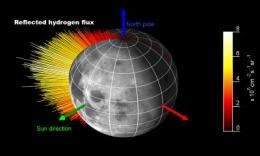
These are the Chandrayaan-1 SARA measurements of hydrogen flux recorded on the Moon on February 6, 2009. Credit: Elsevier 2009 (Wieser et al.), ESA-ISRO SARA data
(PhysOrg.com) -- The Moon is a big sponge that absorbs electrically charged particles given out by the Sun. These particles interact with the oxygen present in some dust grains on the lunar surface, producing water. This discovery, made by the ESA-ISRO instrument SARA onboard the Indian Chandrayaan-1 lunar orbiter, confirms how water is likely being created on the lunar surface.
It also gives scientists an ingenious new way to take images of the Moon and any other airless body in the Solar System.
The lunar surface is a loose collection of irregular dust grains, known as regolith. Incoming particles should be trapped in the spaces between the grains and absorbed. When this happens to protons they are expected to interact with the oxygen in the lunar regolith to produce hydroxyl and water. The signature for these molecules was recently found and reported by Chandrayaan-1's Moon Mineralogy Mapper (M3) instrument team.
The SARA results confirm that solar hydrogen nuclei are indeed being absorbed by the lunar regolith but also highlight a mystery: not every proton is absorbed. One out of every five rebounds into space. In the process, the proton joins with an electron to become an atom of hydrogen. "We didn't expect to see this at all," says Stas Barabash, Swedish Institute of Space Physics, who is the European Principal Investigator for the Sub-keV Atom Reflecting Analyzer (SARA) instrument, which made the discovery.
Although Barabash and his colleagues do not know what is causing the reflections, the discovery paves the way for a new type of image to be made. The hydrogen shoots off with speeds of around 200 km/s and escapes without being deflected by the Moon's weak gravity. Hydrogen is also electrically neutral, and is not diverted by the magnetic fields in space. So the atoms fly in straight lines, just like photons of light. In principle, each atom can be traced back to its origin and an image of the surface can be made. The areas that emit most hydrogen will show up the brightest.
Whilst the Moon does not generate a global magnetic field, some lunar rocks are magnetised. Barabash and his team are currently making images, to look for such 'magnetic anomalies' in lunar rocks. These generate magnetic bubbles that deflect incoming protons away into surrounding regions making magnetic rocks appear dark in a hydrogen image.
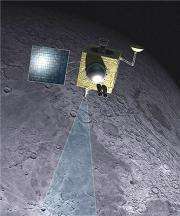
This artist's concept shows the Indian lunar orbiter Chandrayaan-1. The spacecraft will carry two European experiments on board which are direct descendents of ESA's SMART-1 - the infrared spectrometer, SIR2, and the X-ray spectrometer, C1XS, to study the mineralogy and the chemical composition of the lunar surface. The third European instrument on board is the SARA Sub-kiloelectronvolt Atom Reflecting Analyser, that will study the interaction between the lunar surface and the solar wind. Credits: ISRO
The incoming protons are part of the solar wind, a constant stream of particles given off by the Sun. They collide with every celestial object in the Solar System but are usually stopped by the body's atmosphere. On bodies without such a natural shield, for example asteroids or the planet Mercury, the solar wind reaches the ground. The SARA team expects that these objects too will reflect many of the incoming protons back into space as hydrogen atoms.This knowledge provides timely advice for the scientists and engineers who are readying ESA's BepiColombo mission to Mercury. The spacecraft will be carrying two similar instruments to SARA and may find that the inner-most planet is reflecting more hydrogen than the Moon because the solar wind is more concentrated closer to the Sun.
More information: This article reflects findings presented in ‘Extremely high reflection of solar wind protons as neutral hydrogen atoms from regolith in space’, by M. Wieser, S. Barabash, Y. Futaana, M. Holmström, A. Bhardwaj, R. Sridharan, M.B. Dhanya, P. Wurz, A. Schaufelberger and K. Asamura, in press, Planetary and Space Science, 2009.
-
IBEX spacecraft detects fast neutral hydrogen coming from the moon
Jun 18, 2009 |
not rated yet |
0
-
Where did Venus's water go?
Dec 18, 2008 |
not rated yet |
0
-
Europe all set for lunar mission Chandrayaan-1
Sep 25, 2008 |
not rated yet |
0
-
Moon's polar craters could be the place to find lunar ice, scientists report
Dec 18, 2008 |
not rated yet |
0
-
NASA's Moon Mapper Beholds Home
Aug 03, 2009 |
not rated yet |
0
-
Engineers build first sub-10-nm carbon nanotube transistor
Feb 01, 2012 |
4.9 / 5 (30) |
30
-
Something old, something new: Evolution and the structural divergence of duplicate genes
Jan 31, 2012 |
4.6 / 5 (7) |
1
-
The hidden nanoworld of ice crystals: Revealing the dynamic behavior of quasi-liquid layers
Jan 30, 2012 |
5 / 5 (3) |
1
-
Stock market network reveals investor clustering
Jan 27, 2012 |
3.9 / 5 (23) |
8
-
Of microchemistry and molecules: Electronic microfluidic device synthesizes biocompatible probes
Jan 26, 2012 |
5 / 5 (1) |
0
-
Titan's lack of impact craters
Feb 09, 2012
-
Real pictures of black hole eating a star?
Feb 08, 2012
-
Hypothetical way to travel faster than light, but not technically exceed lightspeed
Feb 06, 2012
-
How do scientists monitor the Sun's activity?
Feb 05, 2012
-
Search patterns in observational studies
Feb 05, 2012
-
Derivation of Pogson's law
Feb 03, 2012
- More from Physics Forums - General Astronomy
More news stories
Could Venus be shifting gear?
(PhysOrg.com) -- ESAs Venus Express spacecraft has discovered that our cloud-covered neighbour spins a little slower than previously measured. Peering through the dense atmosphere in the infrared, the ...
Space & Earth / Space Exploration
3 hours ago |
5 / 5 (4) |
4
|
Humans may have helped the decline of African rainforests 3000 years ago
(PhysOrg.com) -- Large areas of rainforests in Central Africa mysteriously disappeared over three thousand years ago, to be replaced by savannas. The prevailing theory has been that the cause was a change ...
Clam fields found at deep, low-temperature Mariana vents
(PhysOrg.com) -- Scientists have marveled at the unusual life forms thriving at high temperature hydrothermal vents of the deep ocean.
Space & Earth / Earth Sciences
3 hours ago |
not rated yet |
0
|
Mars Science Laboratory computer issue resolved
(PhysOrg.com) -- Engineers have found the root cause of a computer reset that occurred two months ago on NASA's Mars Science Laboratory and have determined how to correct it.
Space & Earth / Space Exploration
4 hours ago |
5 / 5 (5) |
2
|
Two new moons for Jupiter
Advances in technology have lead to the discovery of new planets outside of our Solar System, and now even new moons in our own backyard.
Space & Earth / Space Exploration
3 hours ago |
not rated yet |
2
New understanding of DNA repair could eventually lead to cancer therapy
A research group in the Faculty of Medicine & Dentistry at the University of Alberta is hoping its latest discovery could one day be used to develop new therapies that target certain types of cancers.
Zuckerberg's focus drives Facebook's ascent
When Mark Zuckerberg showed up to rent Judy Fusco's Los Altos, Calif., house in the fall of 2004, soon after he'd arrived in Silicon Valley, the landlord was immediately struck by his confidence.
Both maternal and paternal age linked to autism
Older maternal and paternal age are jointly associated with having a child with autism, according to a recently published study led by researchers at The University of Texas Health Science Center at Houston (UTHealth).
Night, weekend delivery OK for babies with birth defects
Weekday delivery is no better than night or weekend delivery for infants with birth defects, according to a new study presented today at The Pregnancy Meeting, the Society for Maternal-Fetal Medicine's annual conference. ...
Sonic Cradle lands spot in TED exhibition
A Simon Fraser University graduate student project that melds music, meditation and modern technology has landed a rare spot as an exhibit at TEDActive 2012 in Palm Springs, California this month.
From virginity to Viagra
Americans will spend more than $17 billion on Valentine's Day, but far less on programs like sex education for adolescents. The editors of the new book, Sex for Life, From Virginity to Viagra, How Sexuality Changes Throughout ...

Oct 15, 2009
Rank: 1 / 5 (1)
Oct 15, 2009
Rank: 5 / 5 (3)
Oct 15, 2009
Rank: 3.7 / 5 (3)
Oct 15, 2009
Rank: 5 / 5 (1)
The quantities are likely rather small. So don't expect any puddles forming from 'solar manufactured molecules'
Oct 15, 2009
Rank: 3 / 5 (1)
Oct 15, 2009
Rank: 5 / 5 (1)
If the negative ion happens to be oxygen, the two can combine to form to form OH, which is very reactive, stealing another O from nearby, and becoming a water molecule. This tends to stick to the regolith rather than escape.
Either way, the Moon doesn't acquire a net charge, although local areas, especially near sunrise, can have the upper surface charged. Apollo astronauts and some satellites have detected electrostatically levitated dust early in the Lunar day.