Study predicts Australian seabed response to climate change
October 15, 2009 Study predicts seabed response to climate change

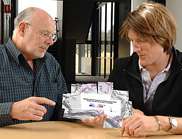
CSIRO scientists view a 3D model of Australia's marine territory. Simulations using Sedsim software were performed to predict the potential impact of climate change on the seabed. Image: CSIRO

(PhysOrg.com) -- CSIRO scientists have produced the first preliminary predictions of the potential impact of climate change on the Australian seabed.

The results of the five-year study predict potential high-risk areas due to movement, erosion and changes in reef growth.
According to CSIRO Wealth from Oceans Flagship project leader Dr Cedric Griffiths, the interaction between the ocean and the seabed is poorly understood.

"We have more information about the surfaces of the Moon and Mars than we do about the seabed surrounding Australia, let alone the effect that may have on it," Dr Griffiths said.

"Over 92 per cent of Australia’s identified oil and gas resources lie offshore, and will be produced from facilities that are connected in some way to the seabed.

"The lack of knowledge of the magnitude and location of future seabed changes is not only potentially putting our offshore infrastructures, such as petroleum pipelines and platforms, at risk, but can also cause over-design.

"This research can help companies and authorities plan and manage coastal and offshore resources more effectively."

Dr Griffiths and his team applied a numerical sediment transport model called Sedsim to ocean and seabed data, over a range of possible climate scenarios across Australia’s entire marine territory. The model, further developed by CSIRO, is most often used to assist offshore petroleum exploration.

Three climate change scenarios were used to conduct simulations from 2000 to 2050.

The extreme scenario model - which assumes highest rainfall, highest and maximum sediment flow - indicated that:

• Many offshore oil and gas development sites will be susceptible to increased erosion
• Predicted changes in cyclone activity in the Ningaloo region may cause significant damage to the reef
• Wind-driven waves and storm events in southern regions will lead to increased beach and cliff erosion
• Temperature and salinity changes in northern waters will impact marine life.

"There are still many uncertainties about future climate change and impacts, however the research provides a useful starting point to discuss possible response strategies," Dr Griffiths said.

"It emphasises the importance of seabed evolution in managing coastal and offshore resources and infrastructure planning and design."

Sedsim has been used successfully in Germany to model coastal changes in the Baltic Sea where the coastline retreats on average 45 metres every 100 years. In Australia, the versatile model will be applied to predict the effects of various disturbances on seabed environments and develop response scenarios and coastal protection strategies.

"We hope to continually improve the model as new data are collected which will give us more accurate predictions for the future," Dr Griffiths said.

Provided by CSIRO (news : web)


print this article email this article download pdf blog this article bookmark this article     Stumble it Digg this share on Facebook retweet share on Reddit add to delicious
Rate this story - 1 /5 (3 votes)


October 15, 2009 all stories

Comments: 0

1 /5 (3 votes)
  • Stumble this up

  • Digg this

  • share this

  • hide
  • Related Stories

  • Deep sea pipelines to green gas production
    created Oct 10, 2008 | popularity not rated yet | comments 0
  • Iceberg Scour Affects Biodiversity
    created Jul 17, 2008 | popularity not rated yet | comments 0
  • King tides -- a glimpse of future sea level rise
    created Jan 12, 2009 | popularity not rated yet | comments 0
  • Australian rainfall – a view of the future
    created Oct 04, 2007 | popularity not rated yet | comments 0
  • Aerosols -- their part in our rainfall
    created Feb 12, 2009 | popularity not rated yet | comments 0


  • hide
  • Relevant PhysicsForums posts

  • Which countries around the world cause the most destruction to the rain forest
    created 13 hours ago
  • HadleyCru data hacked
    created Nov 20, 2009
  • Younger Dryas Caused by Ice Dam Collapse?
    created Nov 17, 2009
  • Modeling rainfall and flooding
    created Nov 15, 2009
  • More from Physics Forums - Earth

Other News

Baby can wait as expectant dad finishes spacewalk (AP)

Baby can wait as expectant dad finishes spacewalk

Space & Earth / Space Exploration

created 12 hours ago | popularity 3 / 5 (2) | comments 0

(AP) -- A spacewalking astronaut put aside the impending birth of his daughter and blazed through his first-ever venture outside the International Space Station on Saturday.


Unseasonably hot and dry weather combined with strong winds to fan scores of blazes in the country's southeastern states

Australia issues 'catastrophic' alerts as fires rage

Space & Earth / Environment

created 18 hours ago | popularity 4 / 5 (3) | comments 0

Australia has issued "catastrophic" alerts after record-breaking temperatures and wild lightning storms sparked more than 100 fires across the country, officials said Saturday.


Commuters wait on the platform shrouded by fog in London

Climate change not man-made, say majority of Britons: poll

Space & Earth / Environment

created Nov 15, 2009 | popularity 3.3 / 5 (15) | comments 46

Less than half of Britons believes that human activity is to blame for global warming, according to a poll carried out for The Times newspaper and published on Saturday.


Mysteriously warm times in Antarctica

Mysteriously warm times in Antarctica

Space & Earth / Earth Sciences

created Nov 18, 2009 | popularity 4.2 / 5 (21) | comments 28

(PhysOrg.com) -- A new study of Antarctica's past climate reveals that temperatures during the warm periods between ice ages (interglacials) may have been higher than previously thought. The latest analysis ...


UN: Fight climate change with free condoms (AP)

UN: Fight climate change with free condoms

Space & Earth / Environment

created Nov 18, 2009 | popularity 3.1 / 5 (11) | comments 24

(AP) -- The battle against global warming could be helped if the world slowed population growth by making free condoms and family planning advice more widely available, the U.N. Population Fund said Wednesday.