Unusual bacteria help balance the immune system in mice
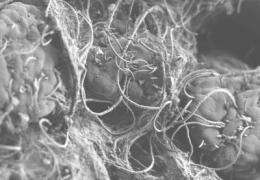
Medical researchers have long suspected that obscure bacteria living within the intestinal tract may help keep the human immune system in balance. An international collaboration co-led by scientists at NYU Langone Medical Center has now identified a bizarre-looking microbial species that can single-handedly spur the production of specialized immune cells in mice.
This remarkable activation of the immune response could point to a similar phenomenon in humans, helping researchers understand how gut-dwelling bacteria protect us from pathogenic bacteria, such as virulent strains of E. coli. The study, published in the Oct. 30, 2009, issue of Cell, also supports the idea that specific bacteria may act like neighborhood watchdogs at key locations within the small intestine, where they sense the local microbial community and sound the alarm if something seems amiss.
In mice, at least, the newly identified neighborhood watchdog looks like something out of Disney's "The Shaggy D.A." Distinguished by long hair-like filaments, "These bacteria are the most astounding things I've ever seen," says Dan Littman, MD, PhD, the Helen L. and Martin S. Kimmel Professor of Molecular Immunology and a Howard Hughes Medical Institute Investigator.
Co-led by Dr. Littman's lab, the collaboration with researchers in Japan, California, and Massachusetts zeroed in on a little-known microbe named segmented filamentous bacterium, or SFB. In mice raised under germ-free conditions, the scientists found that adding SFB was sufficient to trigger the appearance of specialized T helper cells known as Th17 cells. These immune specialists, in turn, can send signals that tell epithelial cells lining the small intestine to increase their output of molecules targeting selected microbes.
For the study's mice, the infection-fighting response was enough to ward off the pathogen Citrobacter rodentium, considered a good model for the type of disease-causing E. coli found in contaminated foods like spinach or ground beef. Without SFB to protect them, mice infected with Citrobacter rodentium became ill before recovering.
In the same way, commensal microbes—beneficial bacteria—could decrease our susceptibility to various pathogenic invaders. "So you can immediately see some practical application of this, if one can mimic the presence of these commensal bacteria to strengthen resistance to pathogenic microbes," Dr. Littman says.
Thanks to rapid progress in the field of genomics, he expects the entire DNA sequence of the SFB species to be completed within a few months. Armed with the sequence, researchers could focus on specific proteins. "For example, can we identify a protein that, when we inject it into an epithelial cell, sets off in motion the whole pathway to make Th17 cells?" he says. "By knowing how to do this, you may be able to give people a peptide or a compound that induces Th17 cells by mimicking the bacterial product, and in that way either protect or ameliorate the effect of the infection."
Too much Th17 cell activation, however, can lead to harmful inflammation, Dr. Littman says. Excessive induction by specific microbes in the gut, then, could contribute to autoimmune diseases such as rheumatoid arthritis, psoriasis, Crohn's disease, and possibly even multiple sclerosis.
Source: New York University School of Medicine (news : web)


