Fish Sense Other Fish Via Ripples
October 15, 2009 By Phillip F. Schewe, ISNS Fish Sense Other Fish Via Ripples

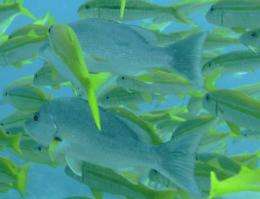
A new study shows how fish can see other fish. Image: ISNS

Although humans experience their world through vision, touch and the other senses, many creatures gather information about their surroundings through unique sensory mechanisms that humans don’t have.

A new study shows how can "see" other fish by detecting the faint swirls cast off by fins.

For some time scientists have known that fish can detect tiny pressure changes underwater using tiny hair-like mast cells, but researchers have discovered that other cells, recessed in a series of pores, are sensitive to quick changes in pressure and can detect the swirls cast off by other fish. The incoming slight pressure gradations are combined to determine features of the source of the swirls.

In human hearing, the movement of the hair cells in the ear triggers tiny electrical signals, which are sent to the brain, where they are used to form a mental image of the sound and the source of the sound. Something like this happens when swirls strike the mast cells in a fish.

J. Leo van Hemmen and his colleagues at the Technical University of Munich and at the Institute of Zoology in Berlin are the first to work out how fish sense the swirling wakes of other fish by measuring the tiny electrical signals triggered in the mast cells, signals that last typically for only a thousandth of a second. The fish-detection scheme works for both predators and their .

The new results were reported in a recent issue of Physical Review Letters.

© 2009 Inside Science News Service. Used with permission.

ISNS


print this article email this article download pdf blog this article bookmark this article     Stumble it Digg this share on Facebook retweet share on Reddit add to delicious
Rate this story - 5 /5 (2 votes)


October 15, 2009 all stories

Comments: 0

5 /5 (2 votes)
  • Stumble this up

  • Digg this

  • share this

  • hide
  • Related Stories

  • Mathematical keys to a sixth sense -- the lateral-line system
    created Aug 28, 2009 | popularity not rated yet | comments 0
  • 'Killer' B cells provide new link in the evolution of immunity
    created Oct 03, 2006 | popularity not rated yet | comments 0
  • Over-fishing: Fewer eggs, smaller fish
    created Jan 19, 2006 | popularity not rated yet | comments 0
  • Scientists trace origin of shark’s electric sense
    created Feb 06, 2006 | popularity not rated yet | comments 0
  • Fish behaviour of the highest order
    created Jun 22, 2006 | popularity not rated yet | comments 0


  • hide
  • Relevant PhysicsForums posts

  • Questions about diffusion
    created 3 hours ago
  • Human Leukocyte Antigen (HLA) typing
    created 10 hours ago
  • Breeding program
    created Nov 20, 2009
  • How does a concentration gradient provide energy?
    created Nov 20, 2009
  • More from Physics Forums - Biology

Other News

The Monarchs' annual migration ritual has yet to be scientifically explained

Tree-eating bugs threaten Monarch butterfly in Mexico

Biology / Ecology

created 11 hours ago | popularity 4 / 5 (1) | comments 0

The mysterious Monarch butterfly, which migrates en masse annually between Canada and Mexico, is now facing a new peril: another insect thriving in Western Mexican forests.


Bigger not necessarily better, when it comes to brains

Bigger not necessarily better, when it comes to brains

Biology / Plants & Animals

created Nov 17, 2009 | popularity 4.5 / 5 (17) | comments 11

(PhysOrg.com) -- Tiny insects could be as intelligent as much bigger animals, despite only having a brain the size of a pinhead, say scientists at Queen Mary, University of London.


Extinct goat Myotragus balearicus

Extinct goat was cold-blooded

Biology / Plants & Animals

created Nov 18, 2009 | popularity 4.9 / 5 (33) | comments 10

(PhysOrg.com) -- An extinct goat that lived on a barren Mediterranean island survived for millions of years by reducing in size and by becoming cold-blooded, which has never before been discovered in mammals.


Right-handed chimpanzees provide clues to the origin of human language

Biology / Plants & Animals

created Nov 16, 2009 | popularity 3 / 5 (1) | comments 7

Most of the linguistic functions in humans are controlled by the left cerebral hemisphere. A study of captive chimpanzees at the Yerkes National Primate Research Center (Atlanta, Georgia), reported in the January 2010 issue ...


The creature was found at a depth of 161 metres

Japanese researchers film rare baby fish 'fossil'

Biology / Plants & Animals

created Nov 17, 2009 | popularity 4.7 / 5 (7) | comments 4

Japanese marine researchers said Tuesday they had found and successfully filmed a young coelacanth -- a rare type of fish known as "a living fossil" -- in deep water off Indonesia.