Nanoscale structures revealed on Diamond's latest beamline
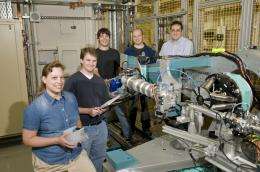
On Monday 12th October, a team of scientists from the University of Bath became the first researchers to use the UK’s national synchrotron facility’s latest experimental station (I07). Designed for investigating the structure of surfaces and interfaces under different conditions, Diamond’s 14th beamline will benefit the physical, chemical and life sciences.
The atomic details that I07’s X-rays will reveal will help progress developments in many technologically and industrially relevant areas such as molecular electronics, as well as advance our knowledge into important biological systems to help with, for example, drug delivery techniques.
Dr Karen Edler, the head of the Self-Organised Materials Group within the Department of Chemistry at the University of Bath, and her team used I07 to investigate polymer (large molecule) hydrogel films which have potential to sense particular organic molecules, such as sugars.
To carry out their experiments they varied the type and concentration of surfactant aggregates embedded within the hydrogel films, along with the salt concentration, to alter and control the structure of the films. They then used I07’s intense X-rays to determine the structure of their polymers to help establish which are the most effective for various applications.
One of the areas the Bath group are looking at is biocompatible polymer hydrogels that could be used as biosensors for potential health applications, such as contact lenses to aid diabetics. The group are working on a hydrogel that is made up of a mixture of polymers which contain a specific group of acids which bind to sugars (synthesised in collaboration with Dr Tony James (Bath)). If made out of this special hydrogel, contact lenses could be used to sense and indicate if the wearer has too much glucose in their body. Although this kind of use is a long way off, it is an early indication of how nanoscale studies of surfaces and interfaces could benefit the wider society.
Pleased with their first results, Dr Edler explains why the group have brought their research to I07: “The surface of a solid or the interface between two components is known to be a key factor in determining the structure and thus the properties of the material, as this is where interactions with the external environment occur. We can use I07 to help determine the nanoscale structure of our hydrogel polymer films to establish the structural ordering that is most suitable for what we want to achieve. We have already used the European Synchrotron Radiation Facility (ESRF) to collect data for this project and we are delighted to bring it to Diamond in the UK. The samples that we use are very fragile and sensitive to air-pressure and relative humidity so it is a great help to only have to transport them a few miles.”
Dr Chris Nicklin, Principal Beamline Scientist on Diamond’s Surface and Interface diffraction beamline, said, “We are delighted to welcome first users to I07. Building a new beamline at Diamond has been an exciting challenge and we are pleased to deliver a fantastic scientific tool within budget and beyond specification. This facility will enable scientists to study in detail the structure of an interface in different environments, such as in liquid, gas or vacuum - useful, for example, in understanding and improving real world processes such as catalytic converters or the role of electrodes in fuel cells. We are able to determine the positions of all of the atoms if they form an ordered layer but can also study larger ‘nanostructures’ or clusters of atoms formed at the interface. Now that we have I07 in operation, we will spend the next six to nine months optimising it to achieve its full potential.”
I07 is part of the second phase of construction at Diamond which is due to be complete in 2012. The further eight Phase II beamlines that are scheduled to be added over the next two years will bring the total of operational beamlines at Diamond to 22, covering a wide range of science; from biology and medicine, to the physical and chemical sciences, through to the environmental and engineering.
Source: Diamond Light Source


