Stem cells offer new hope for kidney disease patients
October 15, 2009 Stem cells offer new hope for kidney disease patients

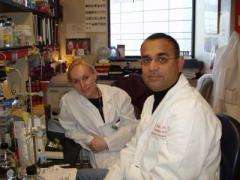
This is Valerie LeBleu, Ph.D., and Raghu Kalluri, M.D., Ph.D., of the American Society of Nephrology. Credit: none

Several cell-based therapy approaches could provide new treatments for patients with Alport syndrome, reports an upcoming paper in the Journal of the American Society of Nephrology (JASN). "Our study opens up many considerations of how new therapies related to the use of stem cells can be devised for our kidney patients with chronic disease," comments Raghu Kalluri, MD, PhD (Harvard Medical School, Boston, MA).

Led by Valerie LeBleu, PhD (also of Harvard Medical School), the researchers tested various types of cell-based therapy in mice with a gene defect similar to that causing Alport syndrome, a genetic kidney disease. Most often occurring in boys, Alport syndrome causes progressive kidney disease leading to kidney failure at a young age. Patients may develop hearing loss and eye disease as well. Although treatment can slow the progression of kidney disease, there is currently no cure for Alport syndrome.

The experiments provide evidence that stem cell treatments could repair the kidney defects associated with Alport syndrome. "We found that stem cells derived from adult bone marrow are equally useful as embryonic ," says Kalluri. "This will make it easier to translate these scientific discoveries to a treatment protocol for patients with Alport syndrome."

Transplantation of bone marrow from unaffected animals significantly improved kidney function in mice in the late stages of disease. Importantly, the results suggested that the beneficial effects of may be achieved without the need for radiation.

Simple blood transfusion from healthy mice also achieved dramatic improvements in kidney function and survival in the mice with end-stage kidney disease. " transplant and protocols have already been approved for previous clinical use in patients with end-stage and Alport syndrome," says Kalluri. "Therefore, clinical application of this procedure is quite feasible and may help our patients immediately." Although the results in mice are promising, real effectiveness can only be tested in human clinical trials. Kalluri adds, "Our study is an important step towards that goal."

More information: "Stem Cell Therapies Benefit Alport Syndrome," doi 10.1681/ASN.2009010123

Source: American Society of Nephrology (news : web)


print this article email this article download pdf blog this article bookmark this article     Stumble it Digg this share on Facebook retweet share on Reddit add to delicious
Rate this story - not rated yet


October 15, 2009 all stories

Comments: 0

not rated yet
  • Stumble this up

  • Digg this

  • share this

  • hide
  • Related Stories


  • hide
  • Relevant PhysicsForums posts

  • The obesity epidemy
    created 2 hours ago
  • 23 Years in a Vegetative State....or not?
    created 8 hours ago
  • Has the H1N1 vaccine been scientifically proven to work?
    created Nov 24, 2009
  • nesfatin
    created Nov 22, 2009
  • More from Physics Forums - Medical Sciences

Other News

Study Finds Eating Fruits and Vegetables Lowers Risks of Heart Disease

Medicine & Health / Health

created 51 minutes ago | popularity not rated yet | comments 0

(PhysOrg.com) -- A new study of adults aged 70 or older found that increased servings of fruits and vegetables were significantly associated with a decrease of cognitive impairment, and that those eating three or more servings ...


On-call radiology residents accurately interpret off-hours neuro CT exams

Medicine & Health / Other

created 1hour ago | popularity not rated yet | comments 0

On-call radiology residents generally provide accurate preliminary interpretation of emergency neuroradiology CT scans after hours when attending neuroradiologist unavailable, according to results of a large study performed ...


Scale of justice

fMRI scans used in murder trial sentencing

Medicine & Health / Other

created 2 hours ago | popularity not rated yet | comments 0

(PhysOrg.com) -- Functional Magnetic Resonance Imaging (fMRI) scans have been used, possibly for the first time, in the sentencing phase of a murder trial in Chicago in the US.


The tall and short of diseases

Medicine & Health / Health

created 1hour ago | popularity 5 / 5 (1) | comments 0

(PhysOrg.com) -- Research shows that being taller means a fatter pay check and an increased risk of some cancers.


Researchers identify proteins in lung cancer cells that may provide potential drug targets

Medicine & Health / Cancer

created 3 hours ago | popularity not rated yet | comments 0

Researchers from Boston University School of Medicine (BUSM) and the Boston University Biomedical Engineering Department have identified a number of proteins whose activation allows them to distinguish between cancer and ...