Spider pill to seek out diseases

October 16, 2009 by Lin Edwards weblog
Spider pill to seek out diseases
Enlarge

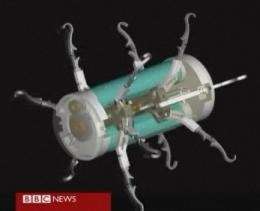
'Spider pill'. Image: BBC News

(PhysOrg.com) -- A remotely controlled 'spider pill' with eight moving legs and a miniature camera may become the next tool of choice in diagnosing cancers of the stomach and colon.

The little pill was invented by a group of scientists in Italy, who were looking for an alternative to endoprobes, which are not well accepted by patients.

The 'spider pill' would be swallowed by the patient and then controlled by the doctor, who would extend and activate the device's tiny legs by wireless radio, and make the gadget crawl around inside the patient's or intestines, rather like a spider. The spider pill can be manipulated to look for signs of disease and relay images from the camera to the doctor.

Swallowing a pill is much less invasive and uncomfortable for the patient than an endoscope, according to Italian cancer specialist Dr Enrico Grasso of the University Hospital Tor Vergata in Rome. Many patients find endoscopy so uncomfortable they refuse the treatment, even though it is extremely effective in diagnosing disease. With a simple pill to swallow, more people may be willing to be screened for cancer.

The spider pill would also help doctors, giving them much more flexibility than manipulating an endoprobe, which is a long tube rather resembling a snake. It can be made to walk back and forwards, and go anywhere the doctor wants to check. After the examination is finished, the spider pill legs are withdrawn and it is allowed to exit the body naturally.

The device has been tested in a pig, but further refinements are needed to make the pill smaller before it can be released for general use.

A pill containing a camera is not a new invention, but previous pills could not be controlled after being swallowed, except those that swim in liquid environments such as the stomach. A crawling spider pill that can be controlled remotely anywhere in the alimentary canal after being swallowed is a first.

More information: BBC News video

© 2009 PhysOrg.com

4.8 /5 (9 votes)  

Rank 4.8 /5 (9 votes)
Related Stories
Relevant PhysicsForums posts
  • Can I forget a language?
    created2 hours ago
  • Is Everyday Technology Killing Us?
    createdFeb 08, 2012
  • Exercise and weight loss
    createdFeb 08, 2012
  • Why do we have head aches? Our brains can't feel anything.
    createdFeb 07, 2012
  • "The end of diseases" by David Agus, interview from Daily Show with Jon Stewart
    createdFeb 04, 2012
  • Oncolytic adenovirus
    createdFeb 04, 2012
  • More from Physics Forums - Medical Sciences

More news stories

New understanding of DNA repair could eventually lead to cancer therapy

A research group in the Faculty of Medicine & Dentistry at the University of Alberta is hoping its latest discovery could one day be used to develop new therapies that target certain types of cancers.

Medicine & Health / Cancer

created 55 minutes ago | popularity 5 / 5 (3) | comments 0 | with audio podcast

Researchers develop new method for creating tissue engineering scaffolds

Researchers at Northwestern University have developed a new method for creating scaffolds for tissue engineering applications, providing an alternative that is more flexible and less time-intensive than current technology.

Medicine & Health / Research

created 8 minutes ago | popularity not rated yet | comments 0 | with audio podcast

Drug halts organ damage in inflammatory genetic disorder

A new study shows that Kineret (anakinra), a medication approved for the treatment of rheumatoid arthritis, is effective in stopping the progression of organ damage in people with neonatal-onset multisystem inflammatory disease ...

Medicine & Health / Medications

created 19 minutes ago | popularity not rated yet | comments 0

Molecular profiling reveals differences between primary and recurrent ovarian cancers

There is a need to analyze tumor specimens at the time of ovarian cancer recurrence, according to a new study published in Molecular Cancer Therapeutics. Researchers used a diagnostic technology called molecular profiling to examine ...

Medicine & Health / Cancer

created 8 minutes ago | popularity not rated yet | comments 0 | with audio podcast

Both maternal and paternal age linked to autism

Older maternal and paternal age are jointly associated with having a child with autism, according to a recently published study led by researchers at The University of Texas Health Science Center at Houston (UTHealth).

Medicine & Health / Psychology & Psychiatry

created 1 hour ago | popularity not rated yet | comments 0 | with audio podcast


Hovering not hard if you're top-heavy, researchers find

Top-heavy structures are more likely to maintain their balance while hovering in the air than are those that bear a lower center of gravity, researchers at New York University's Courant Institute of Mathematical Sciences ...

Grass to gas: Researchers' genome map speeds biofuel development

Researchers at the University of Georgia have taken a major step in the ongoing effort to find sources of cleaner, renewable energy by mapping the genomes of two originator cells of Miscanthus x giganteus, a large perenn ...

Zuckerberg's focus drives Facebook's ascent

When Mark Zuckerberg showed up to rent Judy Fusco's Los Altos, Calif., house in the fall of 2004, soon after he'd arrived in Silicon Valley, the landlord was immediately struck by his confidence.

Night, weekend delivery OK for babies with birth defects

Weekday delivery is no better than night or weekend delivery for infants with birth defects, according to a new study presented today at The Pregnancy Meeting, the Society for Maternal-Fetal Medicine's annual conference. ...

Sonic Cradle lands spot in TED exhibition

A Simon Fraser University graduate student project that melds music, meditation and modern technology has landed a rare spot as an exhibit at TEDActive 2012 in Palm Springs, California this month.

Cochlear implants may be safe, effective for organ transplant patients

Cochlear implants may be a safe, effective option for some organ transplant patients who've lost their hearing as an unfortunate consequence of their transplant-related drug regime, researchers report.