Going plasmonic in search of faster computing, communications
(PhysOrg.com) -- A team of European researchers has demonstrated some of the first commercially viable plasmonic devices, paving the way for a new era of high-speed communications and computing in which electronic and optical signals can be handled simultaneously.
The pioneering devices, which are expected to lead to commercial applications within the next decade, make use of electron plasma oscillation to transmit optical and electronic signals along the same metal circuitry via waves of surface plasmon polaritons. In contrast, signals in electronic circuits are transmitted by electrons, while photons are used to carry data in optical systems.
As an emerging nano-scale technology that is often referred to as “light on a wire,” plasmonics, as the field of research is known, shares the advantages of fibre optics, including ultra-high-speed data transfer, with the benefits of electronic components, particularly their small size. The technology holds the promise of all-optical computer chips operating at ultra-fast speeds, faster communications and a vast new range of sensing devices.
“For the last five years or so it has been possible to build an optical computer chip, but with all-optical components it would have to measure something like half a metre by half a metre and would consume enormous power. With plasmonics, we can make the circuitry small enough to fit in a normal PC while maintaining optical speeds,” explains Anatoly Zayats, a researcher at The Queen's University of Belfast in the United Kingdom.
Until now, however, plasmonic devices had been let down by the short distance over which plasmons could transmit data signals - a problem that Zayats and his team solved in the EU-funded Plasmocom project.
Pushing plasmons further
Plasmonic data transmission functions on the basis of oscillations in the electron density at the boundary of two materials: a dielectic (non-conductive) plasma or polymer and a metal surface. By exciting the electrons with light it is possible to propagate high-frequency waves of plasmons along a metal wire or waveguide, thus transmitting a data signal. However, in many cases the signal dissipates after only a few micrometres - far too short to interconnect two computer chips, for example.
The Plasmocom team took a novel approach, developing what they called dielectric-loaded surface plasmon polariton waveguides (DLSPPW). By patterning a layer of various polymer (polymethyl methacrylate) dielectic onto gold film supported by a glass substrate, they were able to achieve waveguides that were only 500 nanometres in size while extending the signal propagation.
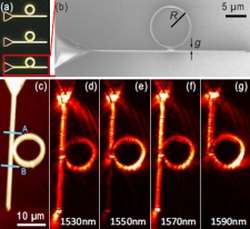
Using this approach, the researchers built a variety of plasmonic devices, including low-loss S bends, Y-splitters and a waveguide ring resonator, a crucial part of the add-drop multiplexers (ADM) in optical networks that combine and separate several streams of data into a single signal and vice versa.
While current commercial optical ring resonators have a radius of up to 300 micrometres, the plasmonic demonstrator built by the Plasmocom team measured just five micrometres.
“The devices performed almost 100 percent as we had modelled them, and showed very good characteristics overall,” Zayats says. “Such devices need to keep getting smaller if we are to continue to see performance gains in new applications,” he adds.
Close to market technology
Crucially, the Plasmocom technology can create plasmonic devices using existing commercial lithography techniques.
“Other groups of researchers have achieved similar or better propagation or smaller device sizes but the processes they have used are often extremely complex and would be difficult to replicate at an industrial scale,” Zayats explains. “Our technology may not be the smallest... but it is closer to market.”
French chipmaker and project partner Silios Technologies is currently drawing up a commercialisation plan, which may involve either producing plasmonic components itself or licensing the Plasmocom technique to one of the big players in the industry.
Zayats notes that interest in the team’s work has been extensive within both academia and industry, evidenced by the success of a workshop in June in Amsterdam attended by representatives of several photonics and electronics firms, including NEC and Panasonic.
“I think that we will start to see this technology make its way into commercial applications over the next five to ten years,” Zayats says. “A key breakthrough will be using plasmonics for inter-chip communication, making it possible to transmit data between one or more chips at optical speeds and eliminating a major bottleneck to faster computers.”
More information: www.plasmocom.org/
Provided by ICT Results


