Migratory route of Eleonora's falcon revealed for first time
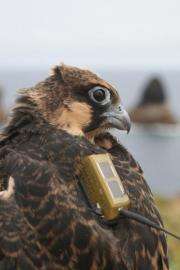
Satellite tracking has allowed a research team to uncover the mysteries of the migration of Eleanora's falcon for the first time. In total, the bird flies more than 9,500 kilometres across the African continent from the Balearic and Columbretes Islands before reaching the island of Madagascar. Some of the previously-obscure secrets now revealed by the scientists show that these falcons migrate by both day and night, and cross supposed ecological barriers such as the Sahara Desert.
Until recently, the scientific community had almost no knowledge of the biology and life strategies of Eleanora's falcon (Falco eleonorae), a migratory bird of prey with low population numbers that nests on marine islands. However, researchers from the Universities of Valencia (UV) and Alicante (UA) tagged 11 individuals (7 adults and 4 chicks) in the colonies of the Balearic Islands between 2007 and 2008 and in the Columbretes Islands in the province of Castellón in 2008, with a further five individuals tagged in 2009.
"This represents a landmark in the study of this species, because to date nobody had been able to catch any Eleanora's falcon individuals and tag them using satellite technology anywhere in their colonies in the western Mediterranean", Pascual López, a researcher at the UV and lead author of the study, which has been published recently in the journal Zoological Studies, tells SINC.
The tagged falcons started their migration of more than 9,500 kilometres in the autumns of 2007 and 2008, travelling from the Balearic Islands to Madagascar. The new discovery made by this study was that the falcons do not fly over the waters of the Mediterranean and along the East African coast, but instead cross straight over the African continent.
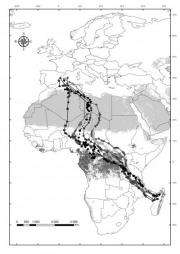
The satellite tracking data have also shown that "Eleonora's falcons can migrate by both day and night (a new discovery among birds of prey of their genus), and cross supposed ecological barriers such as the Sahara Desert, the Equator and extensive stretches of open sea in the Indian Ocean", points out López.
During the two-month migration undertaken by the falcons in order to winter in Madagascar, the biologists received hundreds of position signals for the adults (throughout 10 countries) and the juveniles (in 14 countries). Their migratory route to return to Europe in the spring once again crosses the African continent, "but they follow a completely different path from that used for the autumn migration, flying for more than 1,500km non-stop over the Indian Ocean from Madagascar to Somalia, a phenomenon that has never before been described in birds of prey of this genus, and which pushes them to the limits of their physiological capacity ", says the researcher.
A very special bird
Some of the peculiarities of this bird of prey, which migrates over long distances and evolved only recently, include "a reproductive cycle adapted to the migration of other bird species, starting at the end of the summer and not in the spring (the latest among all European birds of prey). This makes it a model organism for looking into questions about its phylogeography and evolution", adds López, who also wants to find out how the Eleonora's falcons manage to navigate during such a long journey.
Eleonora's falcon was named after Giudicessa Eleonora de Arborea (1350-1404), a Sardinian princess who fought for Sardinia's independence from the Kingdom of Aragon, and who drafted the first laws in Europe protecting birds of prey.
More information: López-López, Pascual; Limiñana, Rubén; Urios, Vicente. "Autumn Migration of Eleonora's Falcon Falco eleonorae Tracked by Satellite Telemetry" Zoological Studies 48(4): 485-491, July 2009.
Source: FECYT - Spanish Foundation for Science and Technology


