Baja California residents watching for Hurricane Rick
October 16, 2009
The Geostationary Operational Environmental Satellite, GOES-11, captured an infrared image of Tropical Storm Rick this morning, October 16 at 2:00 a.m. EDT (0600 UTC). Credit: NASA GOES Project.
Based on computer forecast models, the residents of southern and central Baja California should prepare over the weekend for now Tropical Storm Rick. Rick formed late yesterday, October 15, and is expected to become a major hurricane over the weekend. NASA satellite imagery captured the storm this morning as a strong tropical storm off the western Mexican coast. NASA infrared satellite imagery suggests an eyewall forming indicating the storm is powering up.
Tropical Depression 20-E formed last evening (around 5 p.m. EDT) and rapidly intensified into Tropical Storm Rick. Rick is forecast to strengthen into a hurricane over the weekend, and may become a major hurricane (Category 3 on the Saffir-Simpson Scale) by the end of day on Sunday, October 18.
So what's powering Rick? Warm sea surface temperatures and light wind shear are promoting Rick's strengthening. Those conditions appear to be favorable for maintaining and strengthening Rick over the weekend (the next 2 or 3 days). Wind shear is light, with winds less than 11 mph (10 knots). Sea surface temperatures in Rick's path are near 30 degrees Celsius (86 Fahrenheit). Tropical cyclones need ocean surface temperatures of at least 80 degrees Fahrenheit to maintain strength.
At 5 a.m. EDT on October 16, Rick's maximum sustained winds were already at 65 mph, just 9 mph shy of a Category One Hurricane. The center of Tropical Storm Rick was located near latitude 12.5 north and longitude 98.7 west or about 315 miles (505 kilometers) south-southeast of Acapulco, Mexico. Rick is moving west-northwest near 9 mph, and had a minimum central pressure of 994 millibars.
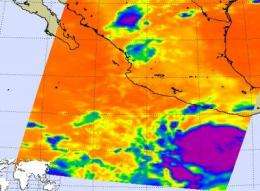
This NASA infrared Atmospheric Infrared Sounder (AIRS) satellite image captured high, cold thunderstorms (purple) in Tropical Storm Rick as he was intensifying on October 16 at 4:41 a.m. EDT (1:41 PDT). AIRS is an instrument that flies aboard NASA's Aqua satellite. Credit: NASA JPL, Ed Olsen
The Geostationary Operational Environmental Satellite, GOES-11, captured an infrared image of Tropical Storm Rick this morning, October 16 at 2:00 a.m. EDT (0600 UTC). Although the storm stretches for a couple of hundred miles, tropical storm-force winds currently extend outward up to 60 miles from the center, but are expected to reach farther outward as Rick intensifies.The NASA infrared Atmospheric Infrared Sounder (AIRS) satellite image captured high, cold thunderstorms in Tropical Storm Rick as he was intensifying on October 16 at 4:41 a.m. EDT (1:41 PDT), and Rick continues to intensify quickly, according to the National Hurricane Center. Infrared imagery during the early morning hours today, October 16, shows increased intensity and area of deep convection, wrapping three-quarters around Rick's center. The National Hurricane Center, who uses the infrared data, noted that "There are indications of a ragged eyewall developing in the last few infrared images."
The storm will head west, later northwest and could pose a danger for Baja California beyond the 5-day scope of the National Hurricane Center's forecast. Therefore, residents of southern and central Baja California should make preparations over the weekend. Evacuations from coastal areas may be called for early next week if the forecast holds.
Source: NASA/Goddard Space Flight Center
-
NASA microwave image sees eyewall opening in Hurricane Linda
Sep 10, 2009 |
not rated yet |
0
-
NASA satellite sees Hurricane Jimena explode in strength over 4 days
Aug 31, 2009 |
not rated yet |
0
-
It's a boy? Tropical Depression 18-E forms in the Eastern North Pacific
Oct 02, 2009 |
not rated yet |
0
-
Baja watching Tropical Storm Patricia in the latest GOES-11 satellite movie
Oct 13, 2009 |
not rated yet |
0
-
NASA sees Tropical Storm Danny form, US East Coast on watch
Aug 26, 2009 |
not rated yet |
0
-
Fast photon control brings quantum photonic technologies closer
1 hour ago |
5 / 5 (2) |
0
-
Engineers build first sub-10-nm carbon nanotube transistor
Feb 01, 2012 |
4.9 / 5 (33) |
30
-
Something old, something new: Evolution and the structural divergence of duplicate genes
Jan 31, 2012 |
4.6 / 5 (7) |
1
-
The hidden nanoworld of ice crystals: Revealing the dynamic behavior of quasi-liquid layers
Jan 30, 2012 |
5 / 5 (5) |
1
-
Stock market network reveals investor clustering
Jan 27, 2012 |
3.9 / 5 (23) |
8
-
Do some geologists actually act a lot like Randy Marsh?
Feb 11, 2012
-
Discrepancy between oxygen and carbon-dioxide levels
Feb 09, 2012
-
where gems are found in the world
Feb 09, 2012
-
Wind Waves in Reservoir ~ Wind run-up and Wind set-up
Feb 08, 2012
-
Balance of oxygen in the atmosphere
Feb 01, 2012
-
The case for a methanol-based economy
Jan 30, 2012
- More from Physics Forums - Earth
More news stories
Planck mission steps closer to the cosmic blueprint
(PhysOrg.com) -- ESA's Planck mission has revealed that our Galaxy contains previously undiscovered islands of cold gas and a mysterious haze of microwaves. These results give scientists new treasure to mine ...
32 minutes ago |
5 / 5 (1) |
0
|
New European rocket lifts off on maiden flight
Europe on Monday successfully launched a new lightweight rocket carrying a test payload, culminating a more than 12-year quest to master the entire range of space launchers.
Space & Earth / Space Exploration
4 hours ago |
5 / 5 (5) |
2
Transforming galaxies
(PhysOrg.com) -- Many of the Universe's galaxies are like our own, displaying beautiful spiral arms wrapping around a bright nucleus. Examples in this stunning image, taken with the Wide Field Camera 3 on ...
1 hour ago |
5 / 5 (1) |
0
|
Alien matter in the solar system: A galactic mismatch
This just in: The Solar System is different from the space just outside it.
Space & Earth / Space Exploration
2 hours ago |
4 / 5 (5) |
7
|
Scientists drill two miles down to ancient Lake Vostok
(PhysOrg.com) -- Russian scientists last week finished penetrating more than two miles through the Antarctic ice sheet to Lake Vostok, a huge freshwater lake that has been buried under the ice for millions ...
Space & Earth / Earth Sciences
1 hour ago |
4.5 / 5 (2) |
0
Fast photon control brings quantum photonic technologies closer
(PhysOrg.com) -- Using photons instead of electrons to transmit information could lead to faster and more secure ways to communicate, among other advantages. Now a team of physicists has taken another step toward realizing ...
New ability to regrow blood vessels holds promise for treatment of heart disease
(Medical Xpress) -- University of Texas at Austin researchers have demonstrated a new and more effective method for regrowing blood vessels in the heart and limbs a research advancement that could have ...
Myths and shame keep many from seeking bankruptcy protection
(PhysOrg.com) -- Two interesting facts that may counter modern ideas about bankruptcy: The overwhelming majority of U.S. filings belong to individuals rather than corporations or entities, and most of these ...
Big Society could threaten biodiversity conservation
A study of the Moray Firth Seal Management Plan (MFSMP), in north-east Scotland, identified four key conditions for long-term success, three of which pointed to the importance of direct government involvement.
Motivation to exercise affects behavior
(Medical Xpress) -- For many people, the motivation to exercise fluctuates from week to week, and these fluctuations predict whether they will be physically active, according to researchers at Penn State. In an effort to ...
'It's not nutritious until it's eaten'
As part of her "Let's Move! Initiative," First Lady Michelle Obama unveiled a new web resource highlighting new changes in the Chefs Move to Schools, during a CMST gathering in Dallas, TX today. CMTS advocates ...
