Fish vision discovery makes waves in natural selection
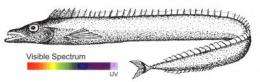
Emory University researchers have identified the first fish known to have switched from ultraviolet vision to violet vision, or the ability to see blue light. The discovery is also the first example of an animal deleting a molecule to change its visual spectrum.
Their findings on scabbardfish, linking molecular evolution to functional changes and the possible environmental factors driving them, were published Oct. 13 in the Proceedings of the National Academy of Sciences.
"This multi-dimensional approach strengthens the case for the importance of adaptive evolution," says evolutionary geneticist Shozo Yokoyama, who led the study. "Building on this framework will take studies of natural selection to the next level."
The research team included Takashi Tada, a post-doctoral fellow in biology, and Ahmet Altun, a post-doctoral fellow in biology and computational chemistry.
Vision 'like a painting'
For two decades, Yokoyama has done groundbreaking work on the adaptive evolution of vision in vertebrates. Vision serves as a good study model, since it is the simplest of the sensory systems. For example, only four genes are involved in human vision.
"It's amazing, but you can mix together this small number of genes and detect a whole color spectrum," Yokoyama says. "It's just like a painting."
The common vertebrate ancestor possessed UV vision. However, many species, including humans, have switched from UV to violet vision, or the ability to sense the blue color spectrum.
From the ocean depths
Fish provide clues for how environmental factors can lead to such vision changes, since the available light at various ocean depths is well quantified. All fish previously studied have retained UV vision, but the Emory researchers found that the scabbardfish has not. To tease out the molecular basis for this difference, they used genetic engineering, quantum chemistry and theoretical computation to compare vision proteins and pigments from scabbardfish and another species, lampfish. The results indicated that scabbardfish shifted from UV to violet vision by deleting the molecule at site 86 in the chain of amino acids in the opsin protein.
"Normally, amino acid changes cause small structure changes, but in this case, a critical amino acid was deleted," Yokoyama says.
More examples likely
"The finding implies that we can find more examples of a similar switch to violet vision in different fish lineages," he adds. "Comparing violet and UV pigments in fish living in different habitats will open an unprecedented opportunity to clarify the molecular basis of phenotypic adaptations, along with the genetics of UV and violet vision."
Scabbardfish spend much of their life at depths of 25 to 100 meters, where UV light is less intense than violet light, which could explain why they made the vision shift, Yokoyama theorizes. Lampfish also spend much of their time in deep water. But they may have retained UV vision because they feed near the surface at twilight on tiny, translucent crustaceans that are easier to see in UV light.
A framework for evolutionary biology
Last year, Yokoyama and collaborators completed a comprehensive project to track changes in the dim-light vision protein opsin in nine fish species, chameleons, dolphins and elephants, as the animals spread into new environments and diversified over time. The researchers found that adaptive changes occur by a small number of amino acid substitutions, but most substitutions do not lead to functional changes.
Their results provided a reference framework for further research, and helped bring to light the limitations of studies that rely on statistical analysis of gene sequences alone to identify adaptive mutations in proteins.
"Evolutionary biology is filled with arguments that are misleading, at best," Yokoyama says. "To make a strong case for the mechanisms of natural selection, you have to connect changes in specific molecules with changes in phenotypes, and then you have to connect these changes to the living environment."
Source: Emory University (news : web)


