On the road to fusion energy, an accelerator to study warm dense matter
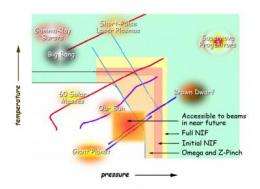
Imagine yourself at the core of Jupiter, a planet 300 times the mass of Earth. At 35,000 degrees Fahrenheit, you and I might think it's hot in here, but to a physicist it's merely warm - warm dense matter, to be precise, stuff that hasn't quite undergone thermonuclear fusion yet.
Warm dense matter exists not only in the interiors of gas giant planets but in other high-temperature, high-pressure regimes as well - in a just-triggered nuclear bomb, for example, or when a fuel capsule in an inertial fusion experiment starts to implode.
Given that the field of warm dense matter ranges from fundamental astrophysics to practical power production, physicists are eager to study it in the laboratory. At the U.S. Department of Energy's Lawrence Berkeley National Laboratory, the Accelerator and Fusion Research Division (AFRD) is building a specialized user facility so scientists can do just that.
Transformers
"Most accelerators are built to boost relatively small bunches of particles to very high energies," says AFRD's Joe Kwan. "To study warm dense matter, we need a different kind of accelerator, one that can deliver very high currents - a great many particles - in short pulses of moderate energy."
Kwan is Project Manager of the Neutralized Drift Compression Experiment-II (NDCX-II), a project of the Heavy Ion Fusion Science Virtual National Laboratory (HIFSVNL), which is a collaboration among Berkeley Lab, Lawrence Livermore National Laboratory, and the Princeton Plasma Physics Laboratory (PPPL). Berkeley Lab's Grant Logan is Director of the HIFSVNL, and Livermore's John Barnard, currently based at Berkeley Lab, and Ron Davidson of PPPL are Deputy Directors.
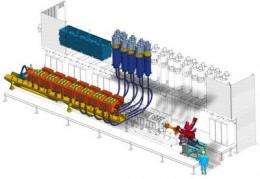
NDCX-II is a linear accelerator (linac) that operates on the principle of induction, in which electrical current in one winding induces a varying magnetic field in the second winding and thus transfers energy to a new current, as in a transformer.
"The NDCX-II is like a string of transformers, where the beam itself acts as the second winding," says Kwan. The beam in this case is made of lithium ions, the lightest of elements after hydrogen and helium.
When the charged beam reaches the end of the linac, eponymous "neutralized drift compression" takes over: plasma is injected to neutralize the ion beam; the ion bunches are squeezed radially by magnetic fields while the tails of the bunches are allowed to catch up to their heads, forming a compact, focused beam at the precise moment it hits the target.
"A high-energy accelerator would send a particle beam through the target like a bullet through paper," Kwan says, "but our ion beam is optimized to deposit most of its energy in the target itself, heating it instantly to warm dense matter."
Says Barnard, "The object is to reach the warm dense matter stage quickly, giving us time to measure its properties before it boils away. Even though the relationship of pressure, temperature, and density of hydrogen fusion - its equation of state - is fairly well understood, no one has ever confirmed the equation of state of warm dense matter."
NDCX-II will hit its thin-film foil targets with 30 nanocoulombs of charge in pulses lasting one nanosecond. These pulses carry energies of three MeV (three million electron volts), focused to a spot one millimeter in diameter.
Through decades of research into heavy ion fusion, AFRD has long experience with induction accelerators - as does Livermore, which began building them in the 1960s for research into thermonuclear fusion (for applications such as hydrogen bombs). Fusion is the common factor. While warm dense matter is a field in itself, fusion energy is much on the minds of NDCX-II's builders.
"U.S. fusion-energy research has well-defined goals and programs," says Logan. "On the one hand, the U.S. is a major participant in ITER, the international tokamak project located in France that's studying magnetic fusion."
A tokamak, the most advanced magnetic fusion concept, uses magnetic fields in a donut-shaped ring to confine, heat, and squeeze plasma until it ignites, and then holds the burning plasma in place. ITER will address whether tokamaks can maintain self-sustaining fusion reactions continuously, as required for power plants.
Controlled implosions
The other major approach to controlled fusion is inertial confinement, in which a fuel capsule is hit by energetic "driver" beams from all directions, causing it to implode and then ignite in a miniature thermonuclar explosion. Currently the major U.S. research program in inertial confinement is Livermore's National Ignition Facility (NIF), a multibillion-dollar, stadium-sized facility optimized for studying nuclear stockpile stewardship, not power production, using powerful laser beams as drivers.
"NIF will be the first to demonstrate the scientific basis for inertial fusion energy through ignition, fusion, and energy production," says Logan. "At the moment, the big question in inertial confinement is capsule ignition."
The process begins when the capsule, which contains frozen hydrogen isotopes, is struck by x-rays produced by the driver beams and undergoes a pre-pulse "that compresses it and gets it moving," Barnard says. A shock wave travels inward through the capsule, increasing the pressure and temperature - meanwhile traveling through the warm dense matter stage - until the hydrogen undergoes fusion, releasing energy outward.
NIF's big glass lasers can only deliver a few shots a day without active cooling, but a power plant will need ignition at a high repetition rate. Also, says Kwan, "The glass lasers' final lenses can be damaged by debris when the capsules ignite."
Berkeley Lab's inertial fusion energy research has emphasized ion beams - focused by magnetic fields, not materials like glass, and accelerated by induction accelerators. Induction acceleration is projected to use energy far more efficiently than the glass laser technology; with ignition as its primary goal, NIF doesn't have to be concerned with energy efficiency.
"Right now the emphasis is on understanding the fundamentals of capsule ignition and implosion," says Barnard. "Once that's achieved in NIF, we'll be prepared to look at more practical questions for future drivers."
Construction of NDCX-II began in July, funded by DOE's Office of Science and aided by stimulus funding from the American Recovery and Reinvestment Act. Built alongside NDCX-I in Building 58, it will use ion-source, target, and beam neutralization systems developed for NDCX-I. Its accelerating cells will also employ two dozen transmission lines for creating high-voltage pulses, known as "Blumleins," from Livermore's retired Advanced Test Accelerator. With these economies, NDCX-II is expected to be completed in March of 2012 at a cost of only $11 million. That modest price will buy a unique, ion-driven user facility for studies of warm dense matter and the physics of inertial-fusion targets.
More information: Technical details of the NDCX-II project may be found in "Toward a physics design for NDCX-II, an ion accelerator for warm dense matter and HIF target physics studies," by Alex Friedman, John Barnard, Richard Briggs, Ron Davidson, Mikhail Dorf, David Grote, Enrique Henestroza, Edward Lee, Matthaeus Leitner, Grant Logan, Adam Sefkow, William Sharp, William Waldron, Dale Welch, and Simon Yu, at repositories.cdlib.org/lbnl/LBNL-1071E/ .
Source: Lawrence Berkeley National Laboratory (news : web)


