More efficient solar power with space technology
October 16, 2009
More efficient solar power with space technology

Enlarge

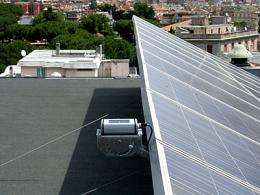
Every photovoltaic plant (solar cell power plants) has a sensor which is verifying the amount of radiation arriving on the panel. If the sensor is experiencing a failure due to snow, dust or a wrong calibration, then the efficiency measurement is giving a wrong interpretation of the energy production. Satellite information measuring the real solar radiation tells the correct amount at any given time and the correct amount of electricity which the plant should produce can be calculated, as a reference. This helps to detect possible failures and the need of plant maintenance operation. Credits: Fly-by Srl

(PhysOrg.com) -- A new system from an Italian company uses weather satellite data to estimate the potential of solar cell power plants and monitor their performance. The approach helps to give a faster return on investments in clean solar energy.

Solar cells have been used for many years to power pocket calculators and, more recently, street signs, garden lighting and other small devices.

But since the need for sustainable living has become a key issue in our society, there has been a considerable increase in interest in exploiting one of the environmental cleanest energy sources to generate electricity: the Sun’s rays.

It has spurred the development throughout Europe of large photovoltaic (PV) plants to generate electricity to power offices, homes and even factories.

The interest has also boosted the search for ways to improve the operation of these plants. Italian company Flyby srl has come up with ways to do just that, by using Europe’s Meteosat weather satellites to map the amount of sunshine available for such sites.

This information assists to determine the best sites for new PV plants, as well as how much electricity they will produce yearly. This helps to decide precisely how large the plants have to be for a given use, optimising investment and improving solar power economy.

The second development uses Meteosat data to monitor if the are working properly all the time, by comparing in real-time the actual production of electricity to what can be expected from the amount of available sunshine.

The system takes data from the satellites and measurements from a ground sensor; any difference indicates the solar cells are not working optimally, and the system immediately sends an alarm. Technicians can then be called in to remedy possible faults.

The satellite solar irradiation data come from two Meteosat Second Generation satellites: Meteosat-8 and Meteosat-9. The services providing these data have been jointly developed by ESA and Eumetsat, the European Organisation for the Exploitation of Meteorological Satellites.

Making the satellite information available for commercial use is a result of the Envisolar project, funded by ESA as part of its Earth Observation Market Development Programme and led by prime contractor DLR in Germany.
More efficient solar power with space technology
Enlarge

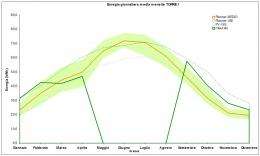
An example of an energy production loss illustrated by the Italian company Flyby using satellite data to validate the correct operation of photovoltaic plant (solar cell power plants). In this case, satellite data were used to detect an unexpected failure of a set of solar panels. The green band is a forecast of power production obtained on the basis of historical satellite data, while the green line is the irradiance measured by the sensor. Credits: Fly-by Srl

ESA’s technology transfer broker D’Appolonia then helped Sonepar Immobiliare e Servizi (SIS) SpA, an Italian distributor of systems, to integrate Flyby’s solution into their systems, with successful results for several plants in Italy.

“Our company is offering services and integrated solutions for energy efficiency and we are particularly focused on sources of renewable energy,” said Maurizio Testa, Marketing Director of SIS.

“It is of utmost importance for us to develop new technology for the improvement of photovoltaic technologies, our primary sector of interest.”

“The tool from Flyby has indeed allowed us to devise a system with a very high spatial resolution and capable of interacting with satellite geographical maps, like solar irradiance maps. Thus, as well as an analysis of a plant’s productivity, it is possible to obtain an economic analysis to evaluate investments [in new PV plants],” added Mr. Testa.

Good results on three solar power plants in Italy

After a development phase, with the participation of the Italian energy leader Enel, the solution using Meteosat weather data is now operating on three photovoltaic plants in Italy: a 59 kW plant in Rome, a 49 kW plant in Milan and a 26 kW plant near Messina. At all sites, production has increased as malfunctions have been found and corrected.

“Photovoltaic plants do not always operate optimally because it may be difficult to spot malfunctions in the solar cells or the installation. By using the satellite information on available solar radiation as a reference, our system helps to spot anomalies faster, increasing production,” said Ciro Lanzetta of Flyby.

“In January 2009 the Milan plant experienced a failure due to snow cover. Using satellite data, this was detected very fast and corrected. Optimal operation all the time is very important. Just 10% reduction in the yearly production of a typical plant producing 35 000-40 000 kWh per year could extend the return on investment of the complete plant by one more year.”

Provided by European Space Agency (news : web)


Rank 2 /5 (2 votes)
Related Stories
Relevant PhysicsForums posts
  • How to tilt a object
    created11 hours ago
  • How to calculate total compressibility in liquid porous solid system
    created16 hours ago
  • Need help reading 3-D
    createdFeb 11, 2012
  • A way to send and receive wireless data
    createdFeb 11, 2012
  • Calling function with no input argument
    createdFeb 10, 2012
  • Force free body diagram problem on gym equipment
    createdFeb 10, 2012
  • More from Physics Forums - General Engineering

More news stories

The joy of cheques

An electronic cheque which eliminates the need for costly processing by banks but preserves the simplicity and ease of a traditional cheque book has been designed by a team of academics in the UK.

Technology / Other

created 58 minutes ago | popularity not rated yet | comments 0

Research shows promise in converting camelina oil into jet fuel

(PhysOrg.com) -- Researchers at Montana State University-Northern have developed a process to convert camelina oil to jet fuel and other high-value chemicals. MSU has applied for a U.S. patent and research is ongoing.

Technology / Energy & Green Tech

created 55 minutes ago | popularity not rated yet | comments 0

Thomas Edison inspires the oscar awards you don't see

Thomas Edison's invention of the first motion picture camera in 1891 inspired scientific and technological advances that he never could have imagined.

Technology / Hi Tech & Innovation

created 9 minutes ago | popularity not rated yet | comments 0

Cutting our carbon footprint

Roofing materials that double as solar panels and can also moderate the temperature of buildings are among the next-generation building products being developed at UNSW.

Technology / Energy & Green Tech

created 44 minutes ago | popularity not rated yet | comments 0

The art of shutting down a nuclear plant

Gaëtan Girardin, researcher in nuclear engineering, gives us the key to understanding nuclear reactor safety. While the disaster at Fukushima is at the center of our conversation, the recent and minor ...

Technology / Energy & Green Tech

created 36 minutes ago | popularity not rated yet | comments 0


With climate change, today's '100-year floods' may happen every three to 20 years: research

Last August, Hurricane Irene spun through the Caribbean and parts of the eastern United States, leaving widespread wreckage in its wake. The Category 3 storm whipped up water levels, generating storm surges ...

Researchers make better heat sensor based on butterfly wings

(PhysOrg.com) -- Scientists have long known that butterfly wings produce their iridescent colors by bouncing light around and between tiny ridges in structures made of chitin. More recently they’ve discovered ...

Manipulating genes with hidden TALENs

(PhysOrg.com) -- A better understanding of gene function in model plant and animal systems could be used to develop useful traits in livestock and crop plants, and might someday lead to developments in stem ...

Couples in the same place emotionally stay together, study says

(Medical Xpress) -- Despite life’s ups and downs, couples whose feelings are in sync consistently over time are more likely to stay together, says a University of California, Davis, study.

Researchers make breakthrough in stem cell research

(Medical Xpress) -- University of Queensland scientists have developed a world-first method for producing adult stem cells that will substantially impact patients who have a range of serious diseases.

Georgia Tech develops software for the rapid analysis of foodborne pathogens

2011 brought two of the deadliest bacterial outbreaks the world has seen during the last 25 years. The two epidemics accounted for more than 4,200 cases of infectious disease and 80 deaths. Software developed at Georgia Tech ...