Mauritana locust infestation spreading to Morocco: UN
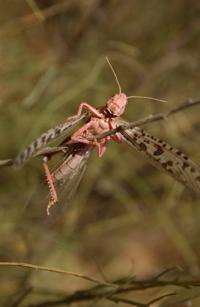
October 16, 2009 A desert locust

Enlarge

A desert locust. An invasion of crickets in Mauritania has spread to Morocco and the western Sahara, and could worsen if there is strong rainfall in coming weeks, the United Nations warned Friday.

An invasion of crickets in Mauritania has spread to Morocco and the western Sahara, and could worsen if there is strong rainfall in coming weeks, the United Nations warned Friday.

"The and locusts are gathering in a worrying fashion to the west of Mauritania," said Elisabeth Byrs, spokeswoman for the UN Office for the Coordination of Humanitarian Affairs.

"If the outbreak is not controlled and if unusually heavy and widespread rains were to fall in the next two months, then the situation will deteriorate further and there is an extremely high risk that it could lead to the early stages of an upsurge in the region."

"The south of Morocco and western Sahara have started to be contaminated... We must be extremely cautious and to sound the alarm before the situation deteriorates," she added.

In 2004, Mauritania was hit by a invasion that ravaged a vast quantity of crops and threatened nearly a million people with starvation.

Mauritania's Desert Locust Centre said Tuesday it was sending special teams to the infested areas to fight a possible new devastating locust invasion in the vast desert country.

(c) 2009 AFP


print this article email this article download pdf blog this article bookmark this article     Stumble it Digg this share on Facebook retweet share on Reddit add to delicious
Rate this story - 4 /5 (1 vote)


October 16, 2009 all stories

Comments: 0

4 /5 (1 vote)
  • Stumble this up

  • Digg this

  • share this

  • hide
  • Related Stories

  • Locust breeding expected to rise
    created Dec 30, 2005 | popularity not rated yet | comments 0
  • What's bugging locusts?
    created May 08, 2008 | popularity not rated yet | comments 0
  • U.S. locusts related to African locusts
    created Dec 21, 2005 | popularity not rated yet | comments 0
  • With an Eye on Locusts and Vegetation, Scientists Make a Good Tool Better
    created Sep 23, 2009 | popularity not rated yet | comments 0
  • Archaeologist: Cattle first kept in Sahara
    created Jul 24, 2006 | popularity not rated yet | comments 0


  • hide
  • Relevant PhysicsForums posts

Other News

Invading camels to be shot in Australian town (AP)

Invading camels to be shot in Australian town

Biology / Ecology

created 46 minutes ago | popularity not rated yet | comments 0

(AP) -- Australian authorities plan to corral about 6,000 wild camels with helicopters and gun them down after they overran a small Outback town in search of water, trampling fences, smashing tanks and contaminating ...


Variable Temperatures Leave Insects wtih a Frosty Reception

Biology / Plants & Animals

created 15 hours ago | popularity not rated yet | comments 0

(PhysOrg.com) -- For the first time, scientists at The University of Western Ontario have shown that insects exposed to repeated periods of cold will trade reproduction for immediate survival.


When camouflage is a plant's best protection

Rare woodland plant uses 'cryptic coloration' to hide from predators

Biology / Plants & Animals

created 17 hours ago | popularity 4.3 / 5 (3) | comments 0

It is well known that some animal species use camouflage to hide from predators. Individuals that are able to blend in to their surroundings and avoid being eaten are able to survive longer, reproduce, and ...


Cells defend themselves from viruses, bacteria with armor of protein errors

Biology / Cell & Microbiology

created 18 hours ago | popularity 5 / 5 (7) | comments 0

When cells are confronted with an invading virus or bacteria or exposed to an irritating chemical, they protect themselves by going off their DNA recipe and inserting the wrong amino acid into new proteins to defend them ...


Researchers discover biological basis of 'bacterial immune system'

Biology / Cell & Microbiology

created 19 hours ago | popularity 4.7 / 5 (3) | comments 0

Bacteria don't have easy lives. In addition to mammalian immune systems that besiege the bugs, they have natural enemies called bacteriophages, viruses that kill half the bacteria on Earth every two days.