Jupiter's Moon Europa Has Enough Oxygen For Life
October 16, 2009
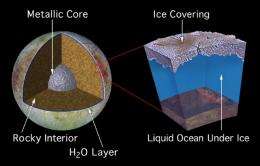
A model of Europa's interior, including a global ocean. If a 100 kilometer-deep ocean existed below the Europan ice shell, it would be 10 times deeper than any ocean on Earth and would contain twice as much water as Earth's oceans and rivers combined. Credit: NASA/JPL
New research suggests that there is plenty of oxygen available in the subsurface ocean of Europa to support oxygen-based metabolic processes for life similar to that on Earth. In fact, there may be enough oxygen to support complex, animal-like organisms with greater oxygen demands than microorganisms.
The global ocean on Jupiter’s moon Europa contains about twice the liquid water of all the Earth’s oceans combined. New research suggests that there may be plenty of oxygen available in that ocean to support life, a hundred times more oxygen than previously estimated.
The chances for life there have been uncertain, because Europa’s ocean lies beneath several miles of ice, which separates it from the production of oxygen at the surface by energetic charged particles (similar to cosmic rays). Without oxygen, life could conceivably exist at hot springs in the ocean floor using exotic metabolic chemistries, based on sulfur or the production of methane. However, it is not certain whether the ocean floor actually would provide the conditions for such life.
Therefore a key question has been whether enough oxygen reaches the ocean to support the oxygen-based metabolic process that is most familiar to us. An answer comes from considering the young age of Europa’s surface. Its geology and the paucity of impact craters suggests that the top of the ice is continually reformed such that the current surface is only about 50 million years old, roughly 1% of the age of the solar system.
Richard Greenberg of the University of Arizona has considered three generic resurfacing processes: gradually laying fresh material on the surface; opening cracks which fill with fresh ice from below; and disrupting patches of surface in place and replacing them with fresh material. Using estimates for the production of oxidizers at the surface, he finds that the delivery rate into the ocean is so fast that the oxygen concentration could exceed that of the Earth’s oceans in only a few million years. Greenberg presented his findings at the 41st meeting of the American Astronomical Society’s Division for Planetary Sciences now under way in Fajardo, Puerto Rico.
Greenberg says that the concentrations of oxygen would be great enough to support not only microorganisms, but also “macrofauna”, that is, more complex animal-like organisms which have greater oxygen demands. The continual supply of oxygen could support roughly 3 billion kilograms of macrofauna, assuming similar oxygen demands to terrestrial fish.
The good news for the question of the origin of life is that there would be a delay of a couple of billion years before the first surface oxygen reached the ocean. Without that delay, the first pre-biotic chemistry and the first primitive organic structures would be disrupted by oxidation. Oxidation is a hazard unless organisms have evolved protection from its damaging effects. A similar delay in the production of oxygen on Earth was probably essential for allowing life to get started here.
Richard Greenberg is the author of the recent book “Unmasking Europa: The Search for Life on Jupiter’s Ocean Moon”, which offers a comprehensive picture of Europa for the general reader.
• Join PhysOrg.com on Facebook!
• Follow PhysOrg.com on Twitter!
Source: American Astronomical Society, via Astrobio.
-
Toxic to aliens -- but key to health of planet
Jun 18, 2008 |
not rated yet |
0
-
Study offers new recipe for oxygen on icy moons
Mar 27, 2006 |
not rated yet |
0
-
The rise of oxygen caused Earth's earliest ice age
May 07, 2009 |
not rated yet |
0
-
New study of solar system speculates about life on other planets
Sep 12, 2006 |
not rated yet |
0
-
Nitrous oxide from ocean microbes
Dec 10, 2007 |
not rated yet |
0
-
Engineers build first sub-10-nm carbon nanotube transistor
Feb 01, 2012 |
5 / 5 (21) |
19
-
Something old, something new: Evolution and the structural divergence of duplicate genes
Jan 31, 2012 |
4.6 / 5 (7) |
1
-
The hidden nanoworld of ice crystals: Revealing the dynamic behavior of quasi-liquid layers
Jan 30, 2012 |
5 / 5 (2) |
1
-
Stock market network reveals investor clustering
Jan 27, 2012 |
4.1 / 5 (21) |
8
-
Of microchemistry and molecules: Electronic microfluidic device synthesizes biocompatible probes
Jan 26, 2012 |
not rated yet |
0
-
Balance of oxygen in the atmosphere
Feb 01, 2012
-
The case for a methanol-based economy
Jan 30, 2012
-
Weather in a rotating cylinder
Jan 25, 2012
-
Importance of difference between SVP over ice and water?
Jan 19, 2012
-
Ozone and atmosphere sampling
Jan 16, 2012
-
Novel Geothermal Energy Source
Jan 14, 2012
- More from Physics Forums - Earth
More news stories
Scientists chart high-precision map of Milky Way's magnetic fields
(PhysOrg.com) -- Scientists at the Naval Research Laboratory (NRL) are part of an international team that has pooled their radio observations into a database, producing the highest precision map to date of ...
10 hours ago |
5 / 5 (4) |
9
|
Coral growth in Western Australia found to be thriving in warmer water
(PhysOrg.com) -- As most people are well aware, global warming isn’t just about the atmosphere, it’s about rising ocean temperatures as well. And like increases in the atmosphere, scientists aren’t ...
Surface of Mars an unlikely place for life after 600 million year drought, say scientists
Mars may have been arid for more than 600 million years, making it too hostile for any life to survive on the planet's surface, according to researchers who have been carrying out the painstaking task of analysing ...
Space & Earth / Space Exploration
10 hours ago |
4.1 / 5 (8) |
1
|
Global extinction: Gradual doom is just as bad as abrupt
A painstakingly detailed investigation shows that mass extinctions need not be sudden events. The deadliest mass extinction of all took a long time to kill 90 percent of Earth's marine life, and it killed ...
Space & Earth / Earth Sciences
10 hours ago |
3.9 / 5 (15) |
0
|
Mission to land on a comet
Europes Rosetta spacecraft is en route to intercept a comet and to make history. In 2014, Rosetta will enter orbit around comet 67P/Churyumov-Gerasimenkoand land a probe on it, two firsts.
Space & Earth / Space Exploration
12 hours ago |
5 / 5 (2) |
1
|
Amazon fungi found that eat polyurethane, even without oxygen
(PhysOrg.com) -- Until now polyurethane has been considered non-biodegradable, but a group of students from Yale University in the US has found fungi that will not only eat and digest it, they will do so even in the absence ...
Whole exome sequencing identifies cause of metabolic disease
Sequencing a patient's entire genome to discover the source of his or her disease is not routine yet. But geneticists are getting close.
Hearing metaphors activates brain regions involved in sensory experience
When a friend tells you she had a rough day, do you feel sandpaper under your fingers? The brain may be replaying sensory experiences to help understand common metaphors, new research suggests.
Renowned physicist invents microscope that can peer at living brain cells
(PhysOrg.com) -- Ever since scientists began studying the brain, theyve wanted to get a better look at what was going on. Researchers have poked and prodded and looked at dead cells under electron microscopes, ...
New kind of high-temperature photonic crystal could someday power everything from smartphones to spacecraft
A team of MIT researchers has developed a way of making a high-temperature version of a kind of materials called photonic crystals, using metals such as tungsten or tantalum. The new materials which ...
Discovery of extremely long-lived proteins may provide insight into cell aging
One of the big mysteries in biology is why cells age. Now scientists at the Salk Institute for Biological Studies report that they have discovered a weakness in a component of brain cells that may explain ...
Oct 16, 2009
Rank: 5 / 5 (5)
Oct 16, 2009
Rank: 5 / 5 (4)
Oct 16, 2009
Rank: 2.7 / 5 (3)
Oct 16, 2009
Rank: 2.3 / 5 (15)
Let's see were we have been thus far? Space junk orbiting earth. We even had Bozo the clown up there!!! Space junk all over the moon some especially slamming on it (in the name of research, of course). Mars has a few rovers, crash sites, and orbiting spy. We constantly have our large telescopes viewing anything that we can get our hands on.
Personally, I love space exploration. It is the aftermath I am afraid of. Science has good intentions. It is governments and corporation that are not trustworthy.
Oct 16, 2009
Rank: 3.7 / 5 (10)
Hopefully we'll grow out of it, we're just a couple of thousands of years old for the most part. On the whole we're insignificant at the Universe's scale, with our pollution and our hate and guns and wars and it will probably take millions of years of survival until we can become barely significant to become noticeable if anyone is out there watching.
My great sadness is that we won't get to see any of it, but it's up to each of us to support the wiser path, while we're here, the only thing we can really do.
Oct 16, 2009
Rank: 3.5 / 5 (4)
Oct 16, 2009
Rank: 4.2 / 5 (5)
http://en.wikiped...universe
Oct 16, 2009
Rank: 4 / 5 (8)
Oct 16, 2009
Rank: 2.9 / 5 (14)
Oct 17, 2009
Rank: 5 / 5 (5)
Oct 17, 2009
Rank: not rated yet
Oct 17, 2009
Rank: 4 / 5 (3)
Oct 17, 2009
Rank: 4.5 / 5 (4)
Europas gravity is 0.134 Earths gravity. This may rule out long-term habitation, but stays shorter than two years are safe, with some exercise.
Oct 18, 2009
Rank: 5 / 5 (1)
Oct 19, 2009
Rank: 5 / 5 (2)
Either they had a lucky guess (which is what I think) or the information was carried via interplanetary bacteria. Bacteria carry information, extremely unlikely, but possible.
Oct 19, 2009
Rank: 3 / 5 (2)
I would like to point out that dogs did not detonate the first nuclear bomb, nor did carrier pigeons turn Dresden into a post-apocalyptic wasteland...
Oct 20, 2009
Rank: not rated yet
Oct 20, 2009
Rank: 1 / 5 (1)
It's not science because, in the foreseeable future, it's not feasible. It's pure fiction.
Oct 20, 2009
Rank: 5 / 5 (1)
Oct 22, 2009
Rank: not rated yet
Eventually all the bodies in this system will be dismantled to build an enormous rotating Ring around the sun, to provide a million times the surface area of old earth. But alas, the civilization which builds it will collapse. You gotta put things in the proper perspective. Useable resources will be used by someone sooner or later. Best to do it first ourselves.
Oct 22, 2009
Rank: 5 / 5 (1)
Why do people-haters visit this site anyways? It only features the many wonderful things people are inventing or discovering or fixing every day. Must depress them.
Oct 22, 2009
Rank: 5 / 5 (1)
Oct 23, 2009
Rank: 1 / 5 (1)
Here is PhysOrg. Elsewhere we sing Leibowitz's canticles.
Oct 23, 2009
Rank: not rated yet
And who died and made you der Kaiser sir? I was describing the kind of post one might find here, and rightly so IMHO, from time to time or even most of the time. I think people of all ages and persuasions come here for some inspiration and enjoy expressing that from time to time. Whats wrong with that in your estimation?
Oct 23, 2009
Rank: not rated yet
Report from the 2175 Earth Resources Counsel:
With little water left on Earth we are left with only one resource: Massive mining of Europa's Ocean.
Oct 23, 2009
Rank: not rated yet
Er, make that Arthur C Clarke as the one who originally thought of the communications satellite.
Azimov just thought of everything else:)
Oct 24, 2009
Rank: not rated yet
thanks for backup. Asimov was robot ethics of course. For water we would drop a few small comets into orbit
Oct 24, 2009
Rank: 1 / 5 (1)
Fortunately nobody made me der kaiser, lieber herr otto1923. I'm just expressing my humble opinion.
Nothing at all. But I'm here for enlightenment, not for entertainment.
Oct 25, 2009
Rank: 4 / 5 (1)
Terraforming has been well explored already by legitimate scientists as I'm sure you know. We're already malforming this one. Enlightment/entertainment- what's the difference? One w/o the other is annoying. Planetary engineering is Kool. And Inevitable. Once we set automated bot factories on mars moons, asteroids, comets, who knows what might be accomplished? A million rovers. A million balloons in the Jovian atmosphere, thousands of additional factories...
Oct 27, 2009
Rank: not rated yet
Oct 27, 2009
Rank: 1 / 5 (1)
Science is held in high esteem by most people. Unfortunately there are way too many out there who'd love to exploit this for their non-scientific ends.
Oct 27, 2009
Rank: 1 / 5 (1)
IMHO these guys are engineers, not scientists.
Enlightenment is in the brain, entertainment in the belly.
My brain needs different food from my belly. I could do without my belly (if it were possible) but not without my brain.
Oct 27, 2009
Rank: 5 / 5 (1)
Oct 27, 2009
Rank: 5 / 5 (1)
By the way, science is pointless without engineering. It's one thing to know how the world works, but what difference does it make if you don't use that knowledge for anything?
Oct 28, 2009
Rank: 1 / 5 (1)
I didn't mean to introduce a ranking. You are completely right, we need both of them. Here's my personal definition: The engineer is he who gets everything working but doesn't understand why it's working. The scientist is he who does understand everything but doesn't get it working.
Oct 28, 2009
Rank: 1 / 5 (1)
Yep.
But there is "weed". And while a certain amount doesn't matter we can't afford to let it grow dominant until it suffocates the crop.
Oct 28, 2009
Rank: 4.5 / 5 (2)
You're a twit. Scientists don't understand everything (no-one does), they merely propose the simplest possible explanations for things until these explanations are disproven and more complicated ones have to be proposed. That's what science actually is. Nowhere does it claim to be the be all and end all of understanding. And "engineers don't understand why things work"? How on earth would they 'make things work' if they knew nothing about them? IMHO your comments are 'weed'.
Oct 28, 2009
Rank: not rated yet
(off-topic post):
I think nuge has you in a corner. This site is pretty fair and there are obvious needs to stay on topic and attract knowledgable professionals to discussions. But I think I'm hearing 'i know science when I see it' and 'science is in the eye of the beholder' in your argument which are personal, not empirical, viewpoints. Anyways it's a good site keep up the excellent work. Everybody takes a hit once in awhile so what? Bring it on!
Oct 28, 2009
Rank: not rated yet
Nov 04, 2009
Rank: 1 / 5 (1)
Why? Of course, he's is right. He (and you) only didn't get the joke. Wanna read some more?
Nov 04, 2009
Rank: not rated yet
Nov 05, 2009
Rank: 1 / 5 (1)
True. But Herr otto1923 told me he'd be enlightened by entertainment. And like a true engineer, I put away maths/logics and simply had a try.