NASA satellite tracking Typhoon Lupit on a march toward the northern Philippines
October 16, 2009 NASA satellite tracking Typhoon Lupit on a march toward the northern Philippines

Enlarge

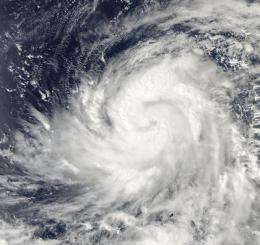
The MODIS instrument on NASA's Aqua satellite captured an image of Typhoon Lupit heading west toward Luzon, at 12:45 a.m. EDT Oct. 16, 2009. Lupit was in the open waters of the Philippine Sea. Credit: NASA MODIS Rapid Response Team

Three instruments on NASA's Aqua satellite captured views of Typhoon Lupit on its western track toward the Philippines and are helping forecasters get an idea of its strength and behavior. Lupit strengthened quickly in 24 hours from a tropical depression to a typhoon, between October 15 and 16.

From 12:41a.m. to 12:45 a.m. EDT (12:45 p.m. Asia/Manila Time) on October 16, NASA's Aqua satellite was capturing important data on Lupit, so that forecasters in the U.S. Navy's Joint Typhoon Warning Center (who forecasts tropical cyclones in the Western Pacific) could make a forecast. In the Philippines, meteorologists are referring to the storm by the name "Ramil."

Aqua's Moderate Imaging Spectroradiometer (MODIS) instrument, Atmospheric Infrared Sounder (AIRS) and Advanced Microwave Sounding Unit (AMSU) instrument captured visible, infrared and microwave images of Typhoon Lupit.
NASA satellite tracking Typhoon Lupit on a march toward the northern Philippines
Enlarge

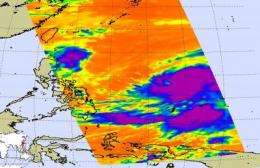
Aqua's Atmospheric Infrared Sounder (AIRS) instrument captured Lupit's (purple and blue) high thunderstorm cloud temperatures at 12:41 a.m. EDT on Oct. 16. The thunderstorm tops were colder than minus 63 Fahrenheit. The Philippines are visible to the west (left) of Lupit. Credit: NASA JPL, Ed Olsen

Infrared imagery measures temperatures and not only can it see cold, high cloud tops in tropical cyclones, but also the warm ocean waters that power the cyclones (if the temperatures are over 80F(26.6 C)). Cold cloud top temperatures provide clues about the power of the thunderstorms in a tropical cyclone. The colder the are, the higher they are, and the more powerful the thunderstorms are that make up the cyclone. Lupit's cloud temperatures were colder than minus 63 Fahrenheit (-52.78 C), indicating very cold, high, strong thunderstorms within.

The ocean waters beneath Typhoon Lupit are over 80F (26.6 C), the threshold to maintain , so they're helping to strengthen the storm.

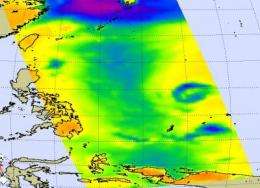
AIRS data is also coupled with data from AMSU create microwave images of storms. The AMSU image uses the radiances of the 89 GHz channel, and the cold areas in those images indicate where there is precipitation or ice in the cloud tops.

By using both the infrared and microwave , forecasters at the Joint Typhoon Warning Center (JTWC) were able to see inside the storm. The JTWC discussion on October 16 said "Typhoon Lupit has developed an impressive convective structure evident in a microwave image, [from 4:59 a.m. EDT] as well as in recent animated infrared imagery which shows a tightly wrapped system with a banding eye. Lupit's intensification to typhoon strength has been enabled by excellent poleward outflow into the mid-latitude westerlies."
NASA satellite tracking Typhoon Lupit on a march toward the northern Philippines
Enlarge

Microwave images are created when data from NASA's Aqua satellite AIRS and AMSU instruments are combined. The cold areas in this image of Lupit from Oct. 16 (yellow-green) indicate where there is precipitation or ice in the cloud tops. The microwave image suggests cold, high thunderstorms. Credit: NASA JPL, Ed Olsen

At 11 a.m. EDT (11 p.m. Asia/Manila Time) on October 16, Typhoon Lupit's maximum sustained winds were near 74 mph. Lupit's center was 400 nautical miles (643 kilometers) north of Palau, near 14.4 North latitude and 133.8 East longitude. Lupit was moving west at 20 mph (32 km/hr) and generating 17-foot-high waves.

Over the weekend, Typhoon Lupit is expected to continue moving generally in a west-northwest direction. The northern Philippines will likely feel the first effects of Lupit by 8:00 a.m. EDT (1200 UTC, or 8 p.m. Asia/Manila Time) on October 20. Storm-weary residents in Luzon, the Philippines should make preparations over the weekend.

Source: JPL/NASA (news : web)


print this article email this article download pdf blog this article bookmark this article     Stumble it Digg this share on Facebook retweet share on Reddit add to delicious
Rate this story - 5 /5 (1 vote)


October 16, 2009 all stories

Comments: 0

5 /5 (1 vote)
  • Stumble this up

  • Digg this

  • share this

  • hide
  • Related Stories


  • hide
  • Relevant PhysicsForums posts

  • The IPCC and the term "most"
    created Nov 23, 2009
  • Is global warming a fact?
    created Nov 23, 2009
  • Random variability of wind patterns
    created Nov 23, 2009
  • Record precipitation in the UK
    created Nov 22, 2009
  • How to move cloud from one time to another..
    created Nov 22, 2009
  • Which countries around the world cause the most destruction to the rain forest
    created Nov 21, 2009
  • More from Physics Forums - Earth

Other News

Monster Waves on the Sun are Real

Monster Waves on the Sun are Real (w/ Video)

Space & Earth / Astronomy

created 10 hours ago | popularity 4.8 / 5 (11) | comments 1

Sometimes you really can believe your eyes. That's what NASA's STEREO (Solar Terrestrial Relations Observatory) spacecraft are telling researchers about a controversial phenomenon on the sun known as the "solar ...


Cosmic 'dig' reveals vestiges of the Milky Way's building blocks

Cosmic 'Dig' Reveals Vestiges of the Milky Way's Building Blocks

Space & Earth / Astronomy

created 15 hours ago | popularity 4.9 / 5 (15) | comments 1

(PhysOrg.com) -- Peering through the thick dust clouds of our galaxy's "bulge" (the myriads of stars surrounding its center), a team of astronomers has unveiled an unusual mix of stars in the stellar grouping ...


Climate experts debate strategies for reducing atmospheric carbon and future warming

Climate experts debate strategies for reducing atmospheric carbon and future warming

Space & Earth / Environment

created 10 hours ago | popularity 2.6 / 5 (7) | comments 9

(PhysOrg.com) -- Reducing carbon dioxide to safe levels may require extracting carbon from the air, says Cornell climate researcher.


No Wheel Stall in Diagnostic Drive

Spirit Mars Rover: No Wheel Stall in Diagnostic Drive

Space & Earth / Space Exploration

created 10 hours ago | popularity 4.5 / 5 (2) | comments 0

(PhysOrg.com) -- On Sol 2095 (Tuesday, Nov. 24), Spirit performed a set of diagnostic actions related to a stall of the right-rear wheel on the previous drive, three days earlier.


Cutting greenhouse pollutants could directly save millions of lives worldwide

Space & Earth / Environment

created 17 hours ago | popularity 2.2 / 5 (10) | comments 6

Tackling climate change by reducing carbon dioxide and other greenhouse emissions will have major direct health benefits in addition to reducing the risk of climate change, especially in low-income countries, according to ...