Rio youth use GPS phones to put favelas on map
October 17, 2009 by Caroline Vignet
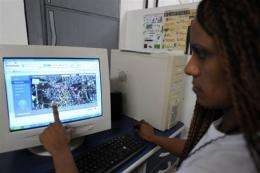
Brazilian Alini dos Santos Silva, 28, points at the map of the three "favelas" she and a team of neighbours designed

Enlarge

Brazilian Alini dos Santos Silva, 28, points at the map of the three "favelas" she and a team of neighbours designed for the Internet in September 2009 in Rio de Janeiro.

Rio's favelas are home to a third of the city's population, but are almost invisible on maps -- a situation five young women are trying to change with the help of GPS and the Internet.

Rafaela Goncalves da Silva, 21, has lived in the Santa Marta favela, a poor and dangerous slum that was recently the target of a police pacification operation, since she was two years old.

She is bringing up her son there now, and takes him to school each day by cable-car under the watchful gaze of the Christ the Redeemer statue that dominates the city's horizon.

She is also among the five women recruited by youth organization Rede Jovem to use GPS-equipped cellphones to map and log the streets of Rio's favelas.

"I start up the at the beginning of the street, then I walk without stopping until the end," she told AFP. The information is then uploaded to the Wikimapa site, where is available for anyone to access.

Some of the streets being mapped do not have an official name.

"I just ask the older residents what they call, the community calls the street," she said, tapping in one such name -- Paciencia Street -- into her cellphone.

The mapping project goes beyond just street names, and includes details of local shops, clubs and meeting points.

On this street, Rafaela's first stop is at Flavio's, "whose fatty cakes are bad for your heart," she said, sitting on the sidewalk. She takes down the name of the shop, a little background, opening hours and a photograph. Within minutes, the information is available on the online map.

There is plenty more for Rafaela to document -- football fields, cybercafes, shops, churches. She takes photographs and videos, and little escapes her telephone. She even captures the location where Michael Jackson filmed the video for his song "They don't really care about us," in 1996.

"People are often suspicious, but I explain that I'm doing this for an Internet project and that reassures them," she said.

Rafaela is one of five so-called "wikireporters" recruited by Rede Jovem.

"We looked for dynamic young people from poor neighborhoods who wanted to learn," said Natalia Santos, a Rede Jovem representative.

The five young women, chosen because they are "less timid than boys", will compete to see who can obtain the most information over the next six months. The winner will receive a grant to study journalism, but for now each of the five receives a monthly stipend of 105 dollars along with a GPS cellphone.

Rede Jovem works to try and drive social engagement among underprivileged youth by facilitating their access to new information and communication technologies. The group points out that Wikimapa can serve as a way to encourage Internet use.

"Everyone can participate and send their information," Santos said. "All you need is a 3G telephone with GPS and to upload the Wikimapa software. We're hoping to map all of Brazil."

In many favelas, wi-fi access is free, and more and more residents have Internet access.

For Alini dos Santos Silva, a wikireporter from Pavao-Pavaozinho in the heights of Copacabana, the project is also a chance to refute the "big lies" she says are told about the slums, many of which are run by drug traffickers and gangs.

"People think that there's nothing here but violence. But I want to show them! The favelas are above all places of life, of meetings," she said.

(c) 2009 AFP


Rank 2 /5 (1 vote)
Related Stories
Relevant PhysicsForums posts
  • feed hold button on CNC lathe
    created11 hours ago
  • Mechanics of Solids ( Final exam question) plz help!
    created13 hours ago
  • RFAC in Fortran
    created16 hours ago
  • dynamics 2/32
    created21 hours ago
  • dynamics
    created21 hours ago
  • Vibration Absorbtion Problem
    createdFeb 08, 2012
  • More from Physics Forums - General Engineering

More news stories

New integrated building model may improve fish farming operations

Today's "locavore" movement with its emphasis on eating more locally-produced food is a natural fit for fruits and vegetables in nearly every region, but few entrepreneurs have dared to apply the concept to ...

Technology / Engineering

created 7 minutes ago | popularity not rated yet | comments 0

Soraa LED light may dim 50-watt halogen rivals

(PhysOrg.com) -- Soraa, a Fremont, California company founded in 2008, this week launched its first product, a light that uses LEDS (light emitting diodes). The "Soraa LED MR16 lamp" is the "perfect" replacement ...

Technology / Semiconductors

created 11 hours ago | popularity 4.6 / 5 (13) | comments 8 | with audio podcast report

Model analyzes shape-memory alloys for use in earthquake-resistant structures

Recent earthquake damage has exposed the vulnerability of existing structures to strong ground movement. At the Georgia Institute of Technology, researchers are analyzing shape-memory alloys for their potential ...

Technology / Engineering

created 6 hours ago | popularity not rated yet | comments 0 | with audio podcast

Google launches Chrome browser for Android smartphones

With more and more people connecting to the Internet through a phone or a tablet instead of a PC, Google Inc. is bringing its fast-growing browser, Chrome, to the newest Android-powered mobile devices.

Technology / Software

created 8 hours ago | popularity 5 / 5 (4) | comments 0

Samsung can continue selling Galaxy tabs in Germany: court

South Korea's Samsung Electronics can continue to sell its Galaxy Tab 10.1N tablet computer in Germany, a German court ruled Thursday, rejecting a bid by arch-rival Apple to have them banned.

Technology / Business

created 9 hours ago | popularity 5 / 5 (2) | comments 2


'Dark plasmons' transmit energy

Microscopic channels of gold nanoparticles have the ability to transmit electromagnetic energy that starts as light and propagates via "dark plasmons," according to researchers at Rice University.

Decoding the molecular machine behind E. coli and cholera

Scientists from Queen Mary, University of London have discovered the workings behind some of the bacteria that kill hundreds of thousands every year, possibly paving the way for new antibiotics that could treat infections ...

Deadly bird parasite evolves at exceptionally fast rate

A new study of a devastating bird disease that spread from poultry to house finches in the mid-1990s reveals that the bacteria responsible for the disease evolves at an exceptionally fast rate. What's more, ...

Flexible paper robots

(PhysOrg.com) -- These inexpensive robots can stretch, bend and twist under control, and lift objects up to 120 times their own weight. Being soft, they can apply gentle and even pressure, and adapt to varied ...

Cell biologists describes mechanism by which some people may be more susceptible to colon cancer

An international research team led by cell biologists at the University of California, Riverside has uncovered a new insight into colon cancer, the third leading cause of cancer-related deaths in the United ...

New method makes culture of complex tissue possible in any lab

Scientists at the University of California, San Diego have developed a new method for making scaffolds for culturing tissue in three-dimensional arrangements that mimic those in the body. This advance, published online in ...