Climate concerns turn city's smell into cash cow
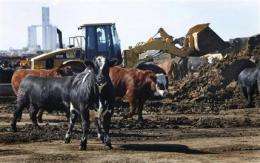
(AP) -- The smell of manure hangs over Greeley as it has for half a century. These days it's more than just a potent reminder of the region's agricultural roots and the hundreds of thousands of cattle raised on the city's outskirts. The stench smells like an opportunity.
Investors are lining up to support a planned clean energy park that eventually will convert some of the methane gas released from the manure piles into power for a cheese factory and other businesses. JBS, which runs two of the largest feed yards and the local slaughterhouse, is testing a new technology that heats the cattle excrement and turns it into energy.
"What once used to be a waste stream that was just a byproduct ... they are now recognizing has value," said Bruce Biggi, the economic development coordinator for the city of Greeley, which received an $82,000 grant from the governor's energy office this year for the park.
The idea is to lure new business to the area with what Biggi likes to call its renewable natural gas - the endless supply of methane from cheap manure.
By reducing the amount of the potent greenhouse gas released into the air, the projects also potentially could turn cow dung into dollars, if a climate bill before Congress becomes law.
"Agriculture and agribusiness is what Greeley is all about," Biggi said. "We needed to take that strong traditional economic base and ... merge it with emerging renewable energy and technology."
Waste may be the new energy crop in these parts. But elsewhere, communities are looking anew at power sources such as the sun and wind that may exist in their own backyards.
The shift is being driven partly by legislation in Congress that would reduce the gases linked to global warming.
The legislation, experts acknowledge, would do little to stem the heating up of the planet if other countries don't take similar action.
Should President Barack Obama sign the bill, it would put a price on each ton of carbon dioxide released. That would drive up the cost of polluting fossil fuels such as oil and natural gas and lead to investment in cleaner sources of energy.
Getting into the game now - like JBS and the investors eyeing Greeley's energy park are doing - could potentially reap profits: selling credits generated by reducing greenhouse gases now into the emissions-trading market the bill would create.
That market could prove lucrative for projects that reduce methane, which is 20 times more potent than carbon dioxide when it comes to trapping heat in the earth's atmosphere.
The fear in Greeley, and elsewhere, is what else the legislation would change.
In the city and surrounding Weld County, the worry is it would raise energy and fertilizer costs for farmers. They need to pump water to irrigate their crops and rely on cheap manure - the same manure that will be tapped for energy - when high natural gas prices drive up the cost of fertilizer.
For the oil and gas industry, which produces more oil in Weld County than any other in the state, a shift to cleaner sources of energy could take away good-paying jobs. And it's not clear whether all those will be replaced by the new green jobs that supporters are banking on.
"I can't think of another place in the country like Weld County, where all the various interests are at play," said John Christiansen, a spokesman for Anadarko Petroleum Corp., which produces oil and gas from 4,600 wells in the county. Many are on fields planted with feed corn, which also is being used to produce ethanol for gasoline locally.
The confluence of different interests has made Weld County a frequent stop for members of Congress interested in how climate legislation is playing outside of Washington. Sen. Michael Bennet, D-Colo., Rep. Betsy Markey, D-Colo., and House Agriculture Committee Chairman Collin Peterson, D-Minn., all made visits over the summer.
"Our rural communities aren't sold on this yet, there is a lot of uncertainty. But I think in the long run it will stabilize energy prices," Markey said in an interview.
Markey voted for the climate bill when it passed the House in June. Her vote could play a role in her re-election race next year in the largely Republican district.
On an August afternoon, Markey and three other members of the state's congressional delegation were singled out for their climate bill vote. A billboard covered with signatures and topped with the words "Shame on you!" stood at the entrance of the lunchtime event, organized by the American Petroleum Institute. The event drew about 600 people to a cavernous exhibit hall outside of Greeley for a pep rally opposing the legislation. API is a Washington, D.C.-based lobbying organization for the oil and gas industry.
"Why would we do anything to drive up their cost of doing business? It makes no sense," local radio host Amy Oliver Cooke told the crowd. Many wore shirts that said, "Congress, Don't Take Away my Job."
"I can't afford the legislation and neither can you," she said.
David Eckhardt, a fourth-generation Weld County farmer, is struggling with the math. Despite meeting with Bennet and Agriculture Secretary Tom Vilsack, Eckhardt remains skeptical of an Agriculture Department's analysis of the House climate bill that says farmers stand to make more money from trapping carbon in their soil and crops than they will pay out in higher energy prices.
"I know my fuel will go up, I know my chemicals will go up. And the question that was asked at the meeting we had with them was how much? And their answer was not as much as you think it will," said Eckhardt. "That's not an answer."
For Eckhardt, a climate law could change what crops he plants.
For JBS, which operates a feedlot down the road from his farm, changes are already afoot.
Fattening the tens of thousands of cattle the company slaughters annually at its Greeley headquarters requires flaking with steam the corn it receives from farmers. That can get expensive because it relies on traditional natural gas, which in recent years has been subject to price swings.
In 2006, with gas prices peaking, Tom McDonald, the environmental affairs manager for JBS Swift's cattle-feeding operation Five Rivers, started looking for ways not to waste the cows' waste any longer.
At one of the company's largest feedlots in Weld County, some of the manure that used to be raked up from the pens and stockpiled is now being fed into a manure gasifier. The apparatus, which looks like an extra large pizza oven, bakes the excrement, extracting the gases which in turn feed the fire. The heat generated can power the feedlots' boiler, reducing the company's natural gas consumption.
Eventually, McDonald says it could supply all the power the facility needs to make its corn flakes.
It would also help with global warming because the process converts methane into the less efficient heat-trapper carbon dioxide.
"These ideas had been kicked around for years and been dismissed because they weren't economical," said McDonald. "Well now the economics are coming in line and these systems actually have a payback are looking very promising."
---
On the Net:
City of Greeley: http://www.greeleygov.com/
Senate Environment and Public Works Committee: http://tinyurl.com/ybcmypo
House Energy and Commerce Committee: http://tinyurl.com/ph52vs
Information on the House-passed bill, H.R. 2454, and the Senate bill, S. 1733, can be found at http://thomas.loc.gov/
©2009 The Associated Press. All rights reserved. This material may not be published, broadcast, rewritten or redistributed.


