Time in a bottle: Scientists watch evolution unfold
October 18, 2009
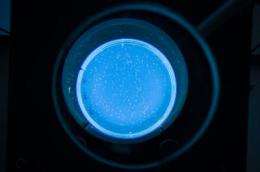
E. coli cultures in the laboratory of Michigan State University evolutionary biologist Richard Lenski. Credit: Greg Kohuth, Michigan State University
A 21-year Michigan State University experiment that distills the essence of evolution in laboratory flasks not only demonstrates natural selection at work, but could lead to biotechnology and medical research advances, researchers said.
Charles Darwin's seminal Origin of Species first laid out the case for evolution exactly 150 years ago. Now, MSU professor Richard Lenski and colleagues document the process in their analysis of 40,000 generations of bacteria, published this week in the international science journal Nature.
Lenski, Hannah Professor of Microbial Ecology at MSU, started growing cultures of fast-reproducing, single-celled E. coli bacteria in 1988. If a genetic mutation gives a cell an advantage in competition for food, he reasoned, it should dominate the entire culture. While Darwin's theory of natural selection is supported by other studies, it has never before been studied for so many cycles and in such detail.
"It's extra nice now to be able to show precisely how selection has changed the genomes of these bacteria, step by step over tens of thousands of generations," Lenski said.
Lenski's team periodically froze bacteria for later study, and technology has since developed to allow complete genetic sequencing. By the 20,000-generation midpoint, researchers discovered 45 mutations among surviving cells. Those mutations, according to Darwin's theory, should have conferred some advantage, and that's exactly what the researchers found.
The results "beautifully emphasize the succession of mutational events that allowed these organisms to climb toward higher and higher efficiency in their environment," noted Dominique Schneider, a molecular geneticist at the Université Joseph Fourier in Grenoble, France.
Lenski's long-running experiment itself is uniquely suited to answer some critical questions -- such as whether rates of change in a bacteria's genome move in tandem with its fitness to survive.
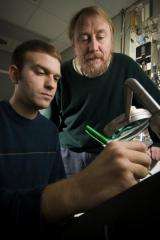
Michigan State University Richard Lenski, standing, analyzes E. coli cultures with postdoctoral researcher Jeffrey Barrick. Credit: Greg Kohuth, Michigan State University
"The coupling between genomic and adaptive evolution is complex and can be counterintuitive," Lenski concluded. "The genome was evolving along at a surprisingly constant rate, even as the adaptation of the bacteria slowed down a lot. But then suddenly the mutation rate jumped way up, and a new dynamic relationship was established."
A mutation involved in DNA metabolism arose around generation 26,000, causing the mutation rate everywhere else in the genome to increase dramatically. The number of mutations jumped to 653 by generation 40,000, but researchers surmise that most of the late-evolving mutations were not helpful to the bacteria.
Gene mutations involved in human DNA replication are involved in some cancers. Many of the patterns observed in the experiment also occur in certain microbial infections, "and cancer progression is a fundamentally similar evolutionary process," observed collaborator Jeffrey Barrick. "So what we learn here can help us better understand the course of these diseases."
Barrick, a postdoctoral researcher in MSU's Department of Microbiology and Molecular Genetics, developed computational tools to discover and validate often complex mutations. "We know an astounding amount about the details of evolution in these little Erlenmeyer flasks," he said.
The Nature paper involved collaboration with scientists from South Korea as well as France and MSU. The research, said genomics team leader Jihyun Kim of the Korea Research Institute of Bioscience and Biotechnology, "is not only useful in understanding the tempo and mode of evolution, but can serve as a nice framework for practical applications in biotechnology, such as improving the performance or productivity of an industrial strain."
Thousands of generations later, the MSU experiment continues to evolve. "Like a lot of science, our study answers some questions but raises many others," Lenski said.
-
Natural selection may not produce the best organisms
Jul 18, 2008 |
not rated yet |
0
-
New research on mutation in yeast can enhance understanding of human diseases
Jun 19, 2008 |
not rated yet |
0
-
Beyond a 'speed limit' on mutations, species risk extinction
Oct 01, 2007 |
not rated yet |
0
-
Novel experiment documents evolution of genome in near-real time
Nov 06, 2006 |
not rated yet |
0
-
Natural selection is not the only process that drives evolution
Jan 27, 2009 |
not rated yet |
0
-
Engineers build first sub-10-nm carbon nanotube transistor
Feb 01, 2012 |
4.9 / 5 (29) |
30
-
Something old, something new: Evolution and the structural divergence of duplicate genes
Jan 31, 2012 |
4.6 / 5 (7) |
1
-
The hidden nanoworld of ice crystals: Revealing the dynamic behavior of quasi-liquid layers
Jan 30, 2012 |
5 / 5 (3) |
1
-
Stock market network reveals investor clustering
Jan 27, 2012 |
3.9 / 5 (23) |
8
-
Of microchemistry and molecules: Electronic microfluidic device synthesizes biocompatible probes
Jan 26, 2012 |
5 / 5 (1) |
0
-
Any books/articles for evolutionary stable strategy models in humans?
1 hour ago
-
Science behind the bore feeling?
7 hours ago
-
Homo Sapien vs. Chimpanzee - Divergence Timeline
11 hours ago
-
a single mRNA strand is attached to sevaral ribosomes?
Feb 08, 2012
-
Oestrogen and FSH
Feb 07, 2012
-
Linear Blood Vessel Network Examples in Animals or Plants
Feb 07, 2012
- More from Physics Forums - Biology
More news stories
Ocean warming causes elephant seals to dive deeper
Global warming is having an effect on the dive behaviour and search for food of southern elephant seals. Researchers from the Alfred Wegener Institute for Polar and Marine Research in the Helmholtz Association cooperating ...
1 hour ago |
not rated yet |
0
Deciding to go left or right: Researchers use device to determine that lower animals can navigate too
For decades, scientists have associated binary decision making opting to go left or right with higher-ranking animals, including humans. A team of Harvard researchers, however, is rewriting that ...
4 hours ago |
not rated yet |
2
|
New Zealand team finds early plant arrivers dominated landscape
(PhysOrg.com) -- It seems intuitive that not all plant species could have taken a foothold on land at the same time all those millions of years ago as conditions on Earth evolved to the point where they could survive; some ...
Fresh city tomatoes, any time
Why not produce lettuce, beans and tomatoes where most of the consumers are to be found: in the city? The flat roofs of many buildings are well-suited for growing vegetables. Rooftop greenhouses can also make ...
1 hour ago |
not rated yet |
0
Can indigenous insects be used against the light brown apple moth?
The light brown apple moth (LBAM), Epiphyas postvittana (Walker), an invasive insect from Australia, was found in California in 2006. The LBAM feeds on apples, pears, stonefruits, citrus, grapes, berries and many other plants ...
3 hours ago |
not rated yet |
0
Secrets of immune response illuminated in new study
When disease-causing invaders like bacteria infect a human host, cells of various types swing into action, coordinating their activities to address the threat.
Nanotube therapy takes aim at breast cancer stem cells
Wake Forest Baptist Medical Center researchers have again proven that injecting multiwalled carbon nanotubes (MWCNTs) into tumors and heating them with a quick, 30-second laser treatment can kill them.
Potentially important new mechanisms found anti-aging effects of resveratrol
A well-conducted experimental study in mice has provided potentially important new insights into the association of the intake of resveratrol and like compounds with health benefits. Resveratrol is a constituent of red wine ...
Touch screens create online shopping experiences at stores
Imagine browsing knife sets in an airport and then ordering one before you board your plane, or going to a department store to look at makeup without having to bounce from counter to counter to check out each brand's selection.
Doctors telling more adults: Get out and exercise
(AP) -- More and more U.S. adults are being told by their doctor to get out and exercise, according to government survey released Thursday.
Study shows fainting factor in cardiac arrests
A new study by Dr. Andrew Krahn shows that over a quarter of unexplained cardiac arrests occurred after the patient had an event of fainting, known as syncope. According to Dr. Krahn, a Cardiologist at London Health Sciences ...

Oct 18, 2009
Rank: 2 / 5 (4)
Oct 18, 2009
Rank: 2.6 / 5 (9)
2. Nothing in this report suggests that the cultured bacteria have become anything but the same critters selectively bred for the conditions of Lenski's flask. There is no evidence that they are a new species, nor is there any report of a new survival advantage under more natural conditions. Indeed, most of the mutations were harmful, as any creationist would predict.
This is a demonstration of "micro-evolution" within a species under specific conditions, but not the Darwinian molecules-to-man story. There is no new support for big-E Evolution here, despite the headline. It may re-affirm the faith of evolutionists, but won't convince their opposition.
Oct 18, 2009
Rank: 4.2 / 5 (5)
Well, that depends on the initial, intermediate conditions and final conditions (although I do not think that the experiment has been terminated as yet and if so even the current "final" conditions are only intermediate). If the researchers maintained a static set of conditions in some flasks, and btw I believe there are multiple experiments (flasks) running concurrently, then changes due to mutation are not adaptive for an environmental change so some should display inter-strain competitive advantage.
In other cases where conditions are altered over time then yes, adaptation is to environmental change. The better-fit strain has advantage. This demonstrates selection quite nicely in a time-frame we can easily watch. So your point would be...?
Oct 18, 2009
Rank: 5 / 5 (5)
I do not think they claimed finding a new species. At least, I did not read this into the research discussion. From where in the article do you take that assumption?
Similarly, how do you make the assumption that most of the mutations were harmful? ("Not helpful" does not necessarily mean "harmful".) And even if they were, what of it and why would this be claimed by creationists? (I presume that your unstated claim is that the presence, at some points in time across the generations of the e. coli, of harmful mutations somehow support a creationist viewpoint?)
Oct 18, 2009
Rank: 4.2 / 5 (5)
You confuse, or mischievously seek to conflate, biogenesis with evolution through natural selection.
Nowhere in this article did the researchers claim to have seen biogenesis, nor was this the object of their studies. They do claim good evidence for observable ongoing mutation of the genome of an organism through generations and, by virtue of some of those mutations, evolution of the overall phenotype of the organism by natural selection of advantageous genomic mutations.
(NB. with reference to your other comment about "harmful" mutations, in some environmental contexts a mutation that is beneficial in another context may be considered "harmful".)
Oct 19, 2009
Rank: 4.8 / 5 (4)
Showing a mutation that controls rate of mutation is very interesting, too.
Oct 19, 2009
Rank: not rated yet
I'd be interested in knowing if any stressors were applied to the samples and if so what they were and what the genetic response was. That would give us a more informative example of how genetics reacts and adapts to environmental changes and at what rate - at least for these samples.
Oct 19, 2009
Rank: not rated yet
Oct 19, 2009
Rank: 2.3 / 5 (3)
Please show this darwinian skeptic how E. coli can change into some other prokaryote (a different genus would do nicely). *Advantageous genomic mutations* malapropizzim? I read in this article, *but researchers surmise that most of the late-evolving mutations were not helpful to the bacteria* Kinda goes along with creation-basher Paul Ehrlich, who said, *. . . mutations normally are either neutral or harmful; only very rarely are they helpful - just as random change made by poking a screwdriver into the guts of your computer will rarely improve its performance* (2000, p. 21). E. coli remains E. coli, as I taught my medical microbiology students for 9 years. That's right, I did not teach my students to genuflect before darwin's altar.
Oct 20, 2009
Rank: not rated yet
I'd imagine that in far less than 40,000 generations under difficult environmental conditions that may force the genome to adapt it will. How much mutation would be required to "evolve" and become a new gene? I don't know and likely that point would be hotly debated far longer than needed.
Oct 20, 2009
Rank: 5 / 5 (5)
The title is 100% accurate. The bacteria adapted via mutation and natural selection to the environment they are in. That is evolution. You have a religious problem with it which has nothing to do actual facts.
That isn't all there is to evolution. Using your own private definitions doesn't change the facts.
{q}Paul Ehrlich, who said, *. . . mutations normally are either neutral or harmful; only very rarely are they helpful {/q}
The key word is NORMALLY and in the previous statement it was MOST. Occasionally they are helpful and you clearly are ignoring the FACT that the bacteria adapted via mutation to the new environment. You ignored NORMALLY and MOST as you must to support your religion.
Ethelred
Oct 20, 2009
Rank: 5 / 5 (2)
Unfortunately there are some problems with your suggestion:
Regardless of the mutation it seems extremely unlikely that an organism could effectively move between Genera except by evolution over geological time scales. This is unlikely to be seen directly. A species-level (or sub-species/strain level) change is much more likely to be observed.
E. coli transfer DNA horizontally through 3 mechanisms, none of which is a direct analogue of sexual reproduction as they do not create gametes or a fusion zygote (the closest is donation of DNA, usually a copy of some sort, from one bacterial cell to another while they are in contact - termed conjugation). I think it would be difficult, though perhaps not impossible, to devise an experiment to determine that this transfer could not occur after some notional evolutionary change (i.e. demonstrating speciation).
Oct 20, 2009
Rank: 5 / 5 (1)
Yes, indeed - advantageous (for the ecological conditions in the flask). Note that I did not comment about the number of these - it could have been just 1 mutation that was advantageous; the number is irrelevant as it is the fact of selection happening under competitive pressure while also finding the mutational change involved that is the core issue. And that demonstrates an important facet of evolution occurring and being observed.
As Ethelred said, the keywords are "normally" and "most" - these leave the possibility of the abnormal and the least. ("Only very rarely are they helpful," is a quite acceptable statement that sometimes something useful happens, that you seem to conveniently ignore.)
By the way, I do not genuflect at anything, let alone at an altar, if that was your implication.