Fracture zones endanger tombs in Valley of Kings
October 19, 2009
Fracture zones endanger tombs in Valley of Kings

Enlarge

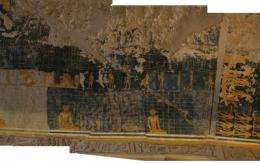
This is a photograph of a damaged ceiling in tomb KV6 in the Valley of the Kings, Luxor, Egypt. The top portion of the image shows areas damaged by water and repaired cracks. Credit: Katarin Parizek

Ancient choices made by Egyptians digging burial tombs may have led to today's problems with damage and curation of these precious archaeological treasures, but photography and detailed geological mapping should help curators protect the sites, according to a Penn State researcher.

"Previously, I noticed that some tomb entrances in the Valley of Kings, Luxor, , were aligned on fracture traces and their zones of fracture concentration," said Katarin A. Parizek, instructor in digital photography, department of integrative arts. "From my observations, it seems that tomb builders may have intentionally exploited these avenues of less resistant limestone when creating ."

Fracture traces are the above-ground indication of underlying zones of rock fracture concentrations. They can be between 5 and 40 feet wide, but average about 20 feet and can be as long as a mile. Lineaments are similar geological features that exceed one mile in length. Geologists suggest that fracture traces are good locations for drilling water wells and probably the highly fractured rock made it easier for the Egyptians to dig tombs.

Working with Richard R. Parizek, professor of geology and geoenvironmental engineering, Parizek has now looked at 33 of the 63 known tombs in the Valley of Kings. She reports her results today (Oct. 18) at the annual meeting of the Geological Society of America in Portland, Or.

"We have now documented nine tombs in detail, photographing and mapping the entire tombs inside and out, and preliminary observations have been made in another ten, which still have to be mapped in detail." said Parizek. "We have recorded 14 more tombs through field observations, but still need to map and photograph these as well."
Fracture zones endanger tombs in Valley of Kings
Enlarge

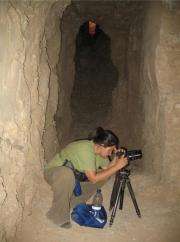
Katarin Parizek, instructor in digital photography, department of integrative arts, Penn State, photographs the wall of Tia's tomb in the Valley of Kings, Luxor, Egypt. Credit: Katarin Parizek, Penn State

Of the 63 tombs in the Valley of the Kings, so far 30 have been identified by Parizek as lying on fracture traces, two lie diagonal to a trace and one is completely off of this type of geological structure.

The importance of these is not just that they allow easier tomb creation, but the fracture traces are natural entry points for water, which sometimes damage tombs.

"We have seen evidence of seven separate flood events in four tombs so far," said Parizek.

When it does rain in the area, water enters the fracture traces and runs through the zones of fracture. Because so many of the tombs are located on the traces, the water runs into the tombs destroying wall and ceiling paintings and causing the tomb surfaces to spall or flake off. Even if archaeological curators divert water away from the entrances of known tombs, they may be directing the water to currently undiscovered tombs and flooding them.

"Archaeologists try very hard to mitigate flooding in the tombs, but it becomes even harder if there are tombs flooding that no one knows about," says Parizek.

The geological information the team has been gathering is now allowing archaeologists to plan better ways to stop the flooding of both known and unknown tombs by diverting the water away from traces and exposed entrances.

Parizek also notes that archaeologists are using this geological information along with archaeological clues to explore for new tombs and other archaeological sites in the Valley of Kings. In February 2006, KV63 was discovered by professor Otto Schaden.

"This tomb is localized along master joints immediately adjacent to a zone of fracture concentration that we mapped in 2002," said Parizek.

This discovery supplied evidence the Parizeks' original hypothesis that tombs were dug on fracture traces and into fracture zones is correct.

For the last two years, Zahi Hawass, Secretary General of the Supreme Council of Antiquities and a renowned Egyptian archaeologist, has been leading an extensive exploration effort within the Valley of Kings.

"He is using our geological information along with archaeological clues to guide excavations," said Parizek.

The researchers hope to investigate and map the geology of more tombs in the future and to combine the photographs and maps to create 3-D images of the tombs.

Source: Pennsylvania State University (news : web)

Filter


Move the slider to adjust rank threshold, so that you can hide some of the comments.


Display comments: newest first

Nik_2213
Oct 19, 2009

Rank: not rated yet
Could this be why many tombs had a pit outside their entrance doorway ? The old saw about 'man-trap' always seemed a bit weak. A flood catcher makes sense...
Rank 5 /5 (2 votes)
Related Stories
Relevant PhysicsForums posts
  • Discrepancy between oxygen and carbon-dioxide levels
    created13 hours ago
  • where gems are found in the world
    created17 hours ago
  • Wind Waves in Reservoir ~ Wind run-up and Wind set-up
    createdFeb 08, 2012
  • Balance of oxygen in the atmosphere
    createdFeb 01, 2012
  • The case for a methanol-based economy
    createdJan 30, 2012
  • Weather in a rotating cylinder
    createdJan 25, 2012
  • More from Physics Forums - Earth

More news stories

Humans may have helped the decline of African rainforests 3000 years ago

(PhysOrg.com) -- Large areas of rainforests in Central Africa mysteriously disappeared over three thousand years ago, to be replaced by savannas. The prevailing theory has been that the cause was a change ...

Space & Earth / Environment

created 6 hours ago | popularity 5 / 5 (3) | comments 4 | with audio podcast report

Could Venus be shifting gear?

(PhysOrg.com) -- ESA’s Venus Express spacecraft has discovered that our cloud-covered neighbour spins a little slower than previously measured. Peering through the dense atmosphere in the infrared, the ...

Space & Earth / Space Exploration

created 2 hours ago | popularity 5 / 5 (3) | comments 4 | with audio podcast

Clam fields found at deep, low-temperature Mariana vents

(PhysOrg.com) -- Scientists have marveled at the unusual life forms thriving at high temperature hydrothermal vents of the deep ocean.

Space & Earth / Earth Sciences

created 2 hours ago | popularity not rated yet | comments 0 | with audio podcast

Mars Science Laboratory computer issue resolved

(PhysOrg.com) -- Engineers have found the root cause of a computer reset that occurred two months ago on NASA's Mars Science Laboratory and have determined how to correct it.

Space & Earth / Space Exploration

created 3 hours ago | popularity 5 / 5 (4) | comments 2 | with audio podcast

Two new moons for Jupiter

Advances in technology have lead to the discovery of new planets outside of our Solar System, and now even new moons in our own backyard.

Space & Earth / Space Exploration

created 2 hours ago | popularity not rated yet | comments 2


Curry spice component may help slow prostate tumor growth

Curcumin, an active component of the Indian curry spice turmeric, may help slow down tumor growth in castration-resistant prostate cancer patients on androgen deprivation therapy (ADT), a study from researchers ...

Netflix light on flicks as viewers soak up TV shows

Like most fresh faces that arrive in Hollywood, Netflix wanted to be a movie star. But now it's learning what many in Tinseltown have known for decades: Movies are sexy, but the real money is in television.

Antidepressants and pregnancy: Women must consider the impact of drugs on baby, and of depression on baby, themselves

Upon learning they are pregnant, most women dutifully nix the alcohol, sushi and caffeine. But what about antidepressants?

Arthritic knees, but not hips, have robust repair response

Researchers at Duke University Medical Center used new tools they developed to analyze knees and hips and discovered that osteoarthritic knee joints are in a constant state of repair, while hip joints are not.

The power of estrogen -- male snakes attract other males

A new study has shown that boosting the estrogen levels of male garter snakes causes them to secrete the same pheromones that females use to attract suitors, and turned the males into just about the sexiest ...

Fool's gold may prove an unlikely alternative to overexploited catalytic materials

Catalytic materials, which lower the energy barriers for chemical reactions, are used in everything from the commercial production of chemicals to catalytic converters in car engines. However, with current catalytic materials ...