Nanosatellites expected to benefit from advanced propulsion technology
October 19, 2009
Nanosatellites expected to benefit from advanced propulsion technology

Enlarge

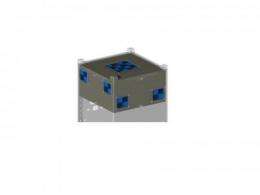
A University of Michigan professor is developing an electric rocket thruster (NanoFET) that uses nanoparticle electric propulsion and enables spacecraft to travel faster and with less propellant than previous technology allowed. Credit: Michael Rayle, Electrodynamic Applications, Inc.

A University of Michigan professor is developing an electric rocket thruster, NanoFET, that uses nanoparticle electric propulsion and enables spacecraft to travel faster and with less propellant than previous technology allowed.

The Air Force Office of Scientific Research is funding Professor Alec D. Gallimore's research because particle electric propulsion, with its half-inch thruster, increases velocity by several hundred or thousand miles an hour and is expected to have a dramatic impact on nanosatellites and larger . These electric fields help to create thrust when the particles are charged, accelerated and propelled into space.

"Particles used in this technology are initially 10 to 50 in size (approximately a thousand times smaller than a human hair in diameter), and we scale them up to between one and ten microns (1/20th to about half the size of a human hair) because at that size, we can see and use them for advanced propulsion research," said Gallimore.

Even with the modifications there are still challenges in doing NanoFET research.

"There are material science aspects of designing the right materials that can withstand high voltages and close proximity to each other," Gallimore said. "There's also a challenge of making certain that all materials are in a form that fits on a satellite that's not much larger than a baseball." Currently the materials are more functional than form-fitting.

"We're hoping that we can actually resolve a lot of these issues in the next three to four years," said Gallimore.

In the meantime, the researchers have tested the nanoparticle, electric-based propulsion in air and in a on an aircraft that replicates conditions of limited gravity.

"It has the potential to be a revolutionary propulsion concept, especially regarding nanosatellites and larger satellites, but there's also a possibility of applying the technology to non-space vehicle applications as well," he said.

AFOSR Program Manager, Dr. Mitat Birkan who oversees the research, agrees. "Electrostatic acceleration of charged nanoparticles has many potential applications besides space , including manufacturing and biomedical technologies."

Source: Air Force Office of Scientific Research

4.1 /5 (12 votes)  

Filter


Move the slider to adjust rank threshold, so that you can hide some of the comments.


Display comments: newest first

danman5000
Oct 19, 2009

Rank: 4.5 / 5 (2)
increases velocity by several hundred or thousand miles an hour

Velocity of what? The craft (over long periods of slow acceleration) or the ejected particles themselves? What sort of accelerations can this provide? Cool stuff, but shares a common problem with many other articles on this site - more details please!
E_L_Earnhardt
Oct 19, 2009

Rank: not rated yet
Electrons DO leap from sharp conductive points at very high velocities when high negative voltage is applied,and furnish thrust! It is a worth-while experiment - for CONTROL if not propulsion! The front of the rocket should carry a positive charge!
poi
Oct 20, 2009

Rank: not rated yet
here's for "more details"
http://data.engin...dex.html

doesn't hurt to do your own digging.

don't rely on physorg too much.
they're not experts in everything.
neither are the posters here (i assume).

from what i gather, when you deal with particles this small, health risks are always present, which the researchers don't seem to discuss.
Rank 4.1 /5 (12 votes)
Related Stories
Relevant PhysicsForums posts
  • polymer nanocomposites
    createdFeb 10, 2012
  • Corrosion Tests on Magnesium
    createdFeb 09, 2012
  • polyethylene copper nanocomposite
    createdFeb 09, 2012
  • Output of xrd analysis
    createdFeb 08, 2012
  • Transport phenomena problem based on problems 18.B11 and 19B.6 from Bird, stewart, lw
    createdFeb 06, 2012
  • Help with material selection - Car Piston
    createdFeb 05, 2012
  • More from Physics Forums - Materials & Chemical Engineering

More news stories

Lab study raises questions over nano-particle impact

Tests involving chickens have raised questions about the impact on health from engineered nano-particles, the ultra-fine grains commonly used in drugs and processed foods, scientists said on Sunday.

Nanotechnology / Bio & Medicine

created 1 hour ago | popularity 5 / 5 (1) | comments 0

New kind of solar cell could capture significantly more energy than current cells

New solar cells could increase the maximum efficiency of solar panels by over 25%, according to scientists from the University of Cambridge.

Nanotechnology / Nanophysics

created Feb 08, 2012 | popularity 4.5 / 5 (13) | comments 14 | with audio podcast

Nanoshell whispering galleries improve thin solar panels

Visitors to Statuary Hall in the U.S. Capitol Building may have experienced a curious acoustic feature that allows a person to whisper softly at one side of the cavernous, half-domed room and for another on ...

Nanotechnology / Nanomaterials

created Feb 07, 2012 | popularity 4.4 / 5 (7) | comments 6 | with audio podcast

'Dark plasmons' transmit energy

Microscopic channels of gold nanoparticles have the ability to transmit electromagnetic energy that starts as light and propagates via "dark plasmons," according to researchers at Rice University.

Nanotechnology / Nanophysics

created Feb 09, 2012 | popularity 4.8 / 5 (10) | comments 1 | with audio podcast

Revealing how a battery material works

Since its discovery 15 years ago, lithium iron phosphate (LiFePO4) has become one of the most promising materials for rechargeable batteries because of its stability, durability, safety and ability to deliver ...

Nanotechnology / Nanomaterials

created Feb 08, 2012 | popularity 5 / 5 (6) | comments 0 | with audio podcast


Scientists discover molecular secrets of 2,000-year-old Chinese herbal remedy

For roughly two thousand years, Chinese herbalists have treated Malaria using a root extract, commonly known as Chang Shan, from a type of hydrangea that grows in Tibet and Nepal. More recent studies suggest that halofuginone, ...

New method to examine batteries -- MRI from the inside

There is an ever-increasing need for advanced batteries for portable electronics, such as phones, cameras, and music players, but also to power electric vehicles and to facilitate the distribution and storage of energy derived ...

A mitosis mystery solved: How chromosomes align perfectly in a dividing cell

Although the process of mitotic cell division has been studied intensely for more than 50 years, Whitehead Institute researchers have only now solved the mystery of how cells correctly align their chromosomes during symmetric ...

Starve a virus, feed a cure? Findings show how some cells protect themselves against HIV

A protein that protects some of our immune cells from the most common and virulent form of HIV works by starving the virus of the molecular building blocks that it needs to replicate, according to research published online ...

Researchers find extensive RNA editing in human transcriptome

In a new study published online in Nature Biotechnology, researchers from BGI, the world's largest genomics organization, reported the evidence of extensive RNA editing in a human cell line by analysis of RNA-seq data, demons ...

The proteins ensuring genome protection

Researchers from the University of Geneva (UNIGE), Switzerland, have discovered the crucial role of two proteins in developing a cell 'anti-enzyme shield'. This protection system, which operates at the level of molecular ...